
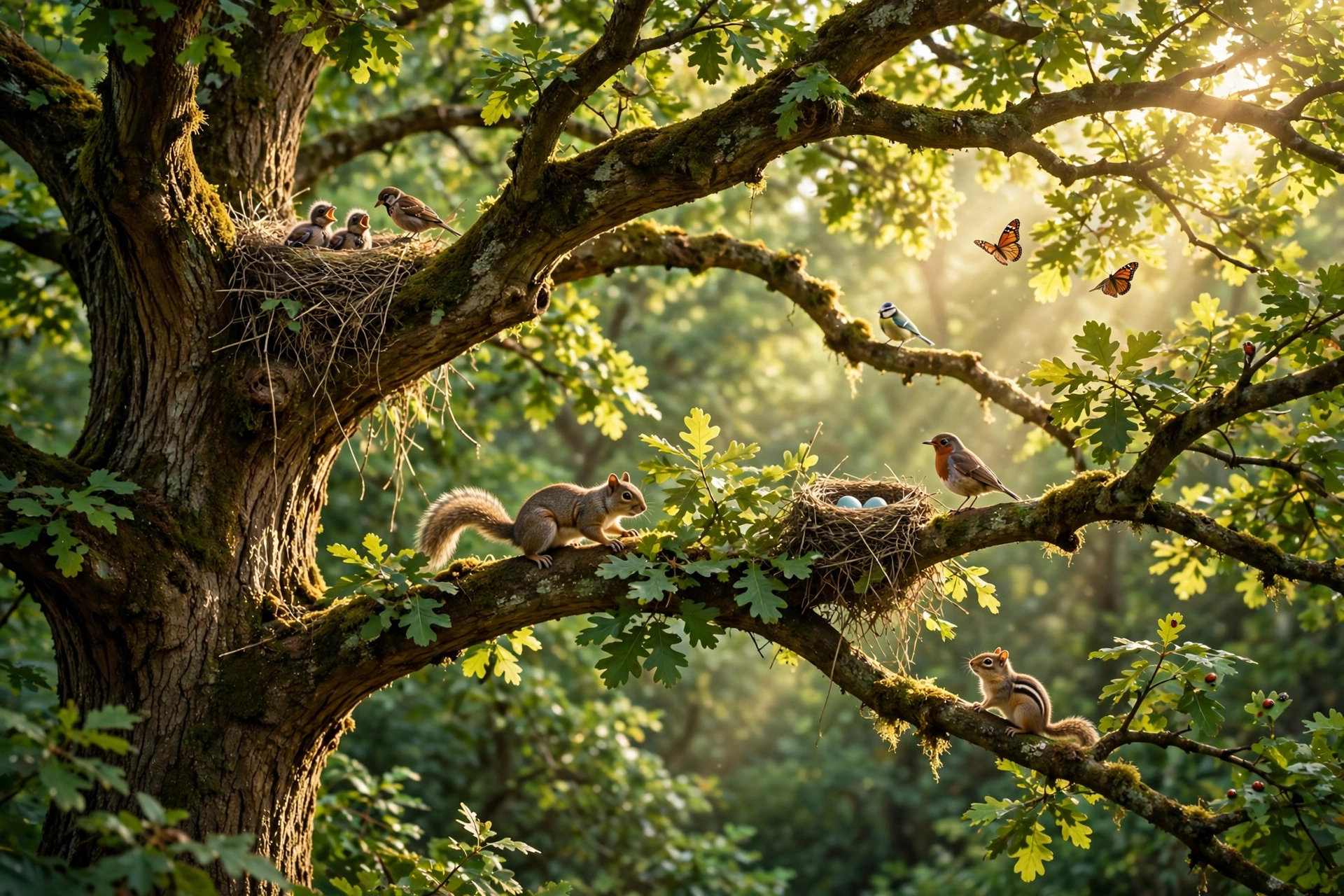
A single tree can support hundreds of species. It offers food in its leaves, flowers, fruits, and seeds; shelter in its bark, branches, and roots; and nesting sites in its hollows, forks, and canopy. A whole woodland offers even more: layered habitats from the forest floor to the treetops, where different animals live at different heights. Understanding the role of trees in wildlife habitats helps you see why trees matter — not just for shade or beauty, but as the foundation of entire ecosystems.
This guide explains how trees provide food, shelter, and nesting sites, which trees support the most wildlife, and what you can look for on a walk to see these relationships in action. Whether you have a garden, a park, or a woodland nearby, trees are doing quiet, essential work all around you. Even a street tree in a city can feed bees in spring, shelter birds in winter, and connect small green spaces into a corridor that wildlife can travel along.
Food: Leaves, Flowers, Fruits, and Seeds
Trees feed wildlife throughout the year. In spring, flowers provide nectar and pollen for bees, butterflies, and other pollinators. Hawthorn, cherry, and lime are especially valuable in spring. In summer, leaves feed caterpillars, which in turn feed birds. Oak is famous for this: a single oak can support hundreds of caterpillar species, making it a vital food source for nesting birds.
In autumn, fruits and seeds take over. Acorns feed jays, squirrels, and badgers. Beech mast feeds birds and mammals. Rowan berries feed thrushes and waxwings. Pine cones feed crossbills and squirrels. Hawthorn berries feed birds through winter. Even fallen leaves feed fungi, worms, and soil invertebrates, which feed birds and mammals in turn. A tree that looks bare in winter is still feeding wildlife through its seeds, bark insects, and leaf litter.
Sap is another overlooked food. In spring, rising sap attracts butterflies, bees, and other insects, and woodpeckers drill holes to reach it. Aphids feeding on leaves produce honeydew, a sugary liquid that ants, wasps, and other insects collect. Even the insects that feed on a tree are food for something else: a single brood of blue tits can eat thousands of caterpillars in a season, and without trees full of caterpillars, those chicks would not survive.
Shelter and Nesting: From Roots to Canopy
Trees shelter wildlife at every height. At the roots, the soil is cooler and moister, and it shelters earthworms, beetles, fungi, and small mammals. Hollow roots and the base of the trunk offer hiding places for frogs, toads, and hedgehogs. The trunk itself is a habitat: bark crevices shelter spiders, beetles, and overwintering butterflies, while woodpeckers and nuthatches search the bark for insects all year.
Higher up, branches and forks support nests of every size, from a wren's nest tucked into ivy to a magpie's large dome of twigs. Hollows in old trees are especially valuable: owls, stock doves, jackdaws, and bats all use them, and a single old oak can contain several hollows at different heights. Ivy growing on a tree is not a parasite — it provides late-season nectar for insects, berries for birds in winter, and dense cover for nesting birds and roosting bats. Dead branches, too, are habitat: they support fungi, beetles, and the woodpeckers that feed on them.
Step-by-Step: See Trees Supporting Wildlife
Step 1: Pick a tree and observe it for ten minutes
Choose a tree in a garden, park, or woodland. Stand quietly and watch: what birds visit? What insects are on the bark or flowers? What is growing underneath? Ten minutes of quiet observation reveals a surprising amount.
Step 2: Look for food signs
Check for flowers, fruits, seeds, and cones. Look for chewed leaves, stripped cones, and fallen fruit. Note which animals are feeding and what they are eating.
Step 3: Look for shelter and nesting signs
Look for hollows, holes, nests, dreys, and bark crevices. Look for feathers, fur, or droppings near the base. Note the height and position of any nest you see — from a distance, without disturbing it.
Step 4: Note the tree species and season
Identify the tree if you can, and note the season. The same tree supports different wildlife in spring, summer, autumn, and winter. A spring visit and an autumn visit to the same tree will look very different.
Step 5: Research the tree's wildlife value
Use the Tree Researcher on aitreeidentier.site to learn more about the tree species you observed. Compare what you saw with what the tree is known to support, and note any species you want to look for next time.
Common Mistakes to Avoid
Removing dead wood unnecessarily. Dead wood is habitat, not waste. Leave standing dead trees where safe, and keep a log pile in a quiet corner.
Planting only one tree species. A mix of native trees supports far more wildlife than a single species. If you are planting, choose a variety that flowers and fruits at different times.
Disturbing nests to look closer. Nests should be observed from a distance. Disturbing them can cause parents to abandon eggs or young. Use binoculars, not your hands.
Forgetting the forest floor. Leaf litter, fallen branches, and undergrowth are part of the tree's habitat too. They shelter insects, fungi, and small mammals that birds depend on.
Cutting back ivy in autumn. Ivy flowers late, when few other plants are in bloom, and its berries ripen in late winter when birds need them most. Leave ivy on trees unless it is genuinely causing a problem.
FAQ
Which tree supports the most wildlife? Oak is often cited as one of the best, supporting hundreds of insect species and many birds and mammals. Hawthorn, willow, birch, and rowan are also very valuable. Native trees generally support more wildlife than non-native ones.
Do trees help wildlife in winter? Yes. Evergreen trees provide shelter and roosting sites in winter. Deciduous trees provide berries, seeds, bark insects, and leaf litter that feed wildlife through the cold months.
Can a single garden tree help wildlife? Yes, a great deal. A single tree provides food, shelter, and nesting sites, and connects your garden to nearby parks and woodlands as part of a wider habitat network.
How can I help trees support more wildlife? Plant native species, leave dead wood where safe, avoid pesticides, let leaf litter stay in quiet corners, and provide water. Small changes make a large difference over time.
Are non-native trees useless for wildlife? Not useless — many non-native trees provide nectar, fruit, or shelter — but they usually support far fewer insects than native trees, because local insects have not evolved to feed on them. A mix is best: native trees as the backbone, with a few non-native trees for extra flowers or fruit.
How long does it take for a new tree to help wildlife? Faster than you might think. Flowers and leaves attract insects within the first year or two, and birds begin using a young tree for perching and shelter soon after. The full value — hollows, dead wood, and a rich insect community — builds over decades, which is why protecting old trees matters so much.
Conclusion
Trees are the foundation of wildlife habitats: they provide food through flowers, leaves, fruits, and seeds; shelter through bark, branches, roots, and shade; and nesting sites through hollows, forks, and canopies. A single oak can support hundreds of species, and a varied woodland supports thousands. Observe a tree for ten minutes, look for food, shelter, and nesting signs, and use the Tree Researcher on aitreeidentier.site to learn more. Protecting trees — and planting the right ones — is one of the most powerful ways to help wildlife thrive.
Safety note: Do not climb trees, disturb nests, or eat or use a wild plant or mushroom based on AI alone. Consult a local expert if you are unsure.