
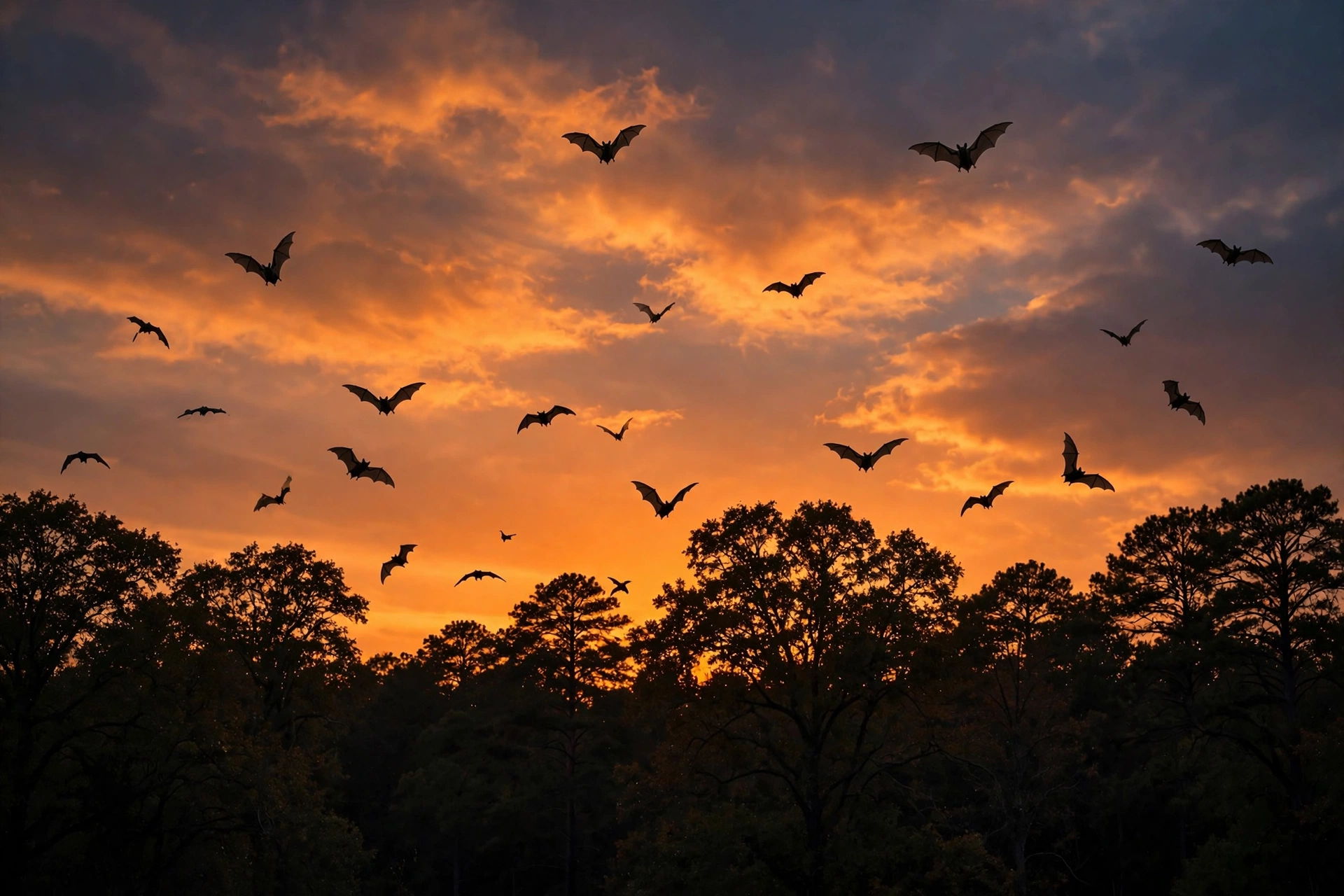
On a warm summer evening, just as the light fades, small dark shapes flicker over gardens, woodland edges, and rivers. These are bats, the only mammals that truly fly, and they are far easier to watch than most people expect. You can practise from a garden chair with nothing more than patience and a good vantage point.
This guide explains how to tell bats apart by flight pattern, size, silhouette, and sound. You never need to catch a bat or see one up close — everything can be learned by watching the sky at dusk and listening carefully. Bats are also worth watching because they are a sign of a healthy environment: a garden with bats has plenty of insects, and plenty of insects means a garden full of life.
Why Dusk Is the Best Time
Bats are nocturnal, and most species emerge about twenty to thirty minutes after sunset, when the sky is still pale enough to see their outlines. The first bats out are usually the fast, bold hunters, followed by slower species. Watching the order in which they appear is itself a useful clue.
Dusk is also when their food is most active: midges and moths gather over water, hedgerows, and garden lights, and bats follow them. A still, warm evening is ideal; cold, wet, or windy evenings keep both insects and bats away.
Where to Watch
The best places to watch bats are where insects gather: along rivers and ponds, beside hedgerows and woodland edges, in old gardens, and around street lamps on quiet lanes. Bats often follow straight lines, such as hedges and watercourses, as routes between roosts and feeding grounds.
Find a spot with a clear view of the sky, with trees or a building behind the bats so their silhouettes stand out. Sit still, keep noise and bright lights to a minimum, and give your eyes time to adjust. Bats are easily put off by torchlight and sudden movement.
Roosts matter too. Bats roost in old trees, in roof spaces, behind loose bark, and in cracks in walls. If you find a roost, do not disturb it — note the location from a distance and watch the bats emerge at dusk. A regular emergence time, night after night, is a strong clue to the species, because different bats leave their roosts at different times after sunset.
Bats Through the Seasons
Bats follow a yearly cycle, and knowing it helps you know when and where to watch. In spring, bats wake from hibernation hungry and thin, and they feed heavily on the first warm evenings to rebuild their strength. In summer, females gather in maternity roosts to give birth to a single pup each, and the colony is at its busiest — this is the best time of year to watch, with large numbers of bats emerging at dusk. In autumn, bats feed intensively to build fat reserves, and males gather at mating sites, sometimes calling loudly enough to be heard without a detector. In winter, most bats hibernate in cool, sheltered places such as caves, old mines, cellars, and hollow trees, where they sleep for months on stored fat. A bat seen flying on a mild winter night is usually one that has woken briefly to drink or to move to a better roost, not one that is feeding normally.
Step-by-Step: Identify Bats at Dusk
Step 1: Watch the flight pattern
Flight is the most useful clue. Common pipistrelles fly fast and erratically, twisting as they chase midges. Noctules fly high and straight, with slow, powerful wingbeats and occasional dives. Daubenton's bats skim low over water in smooth lines. Note whether the bat flutters, glides, or dives — each pattern points to a different species.
Step 2: Judge the size
Compare the bat with a house sparrow. Pipistrelles are tiny, with a wingspan of about twenty centimetres, while noctules are much larger, closer to forty. Size is hard to judge in the dark, so compare bats that fly together: one noticeably bigger than the others is probably a different species.
Step 3: Look at the silhouette
Broad, rounded wings suggest a slow hunter that picks insects from leaves, while long, narrow wings suggest a fast, open-air hunter. Note the tail too: some species show a clear tail membrane, while others seem to end abruptly. A photo against the sky can help you study the outline later.
Step 4: Listen for sound
Most bat calls are too high for human ears, but some are partly audible. Noctules make loud, sharp clicks, while pipistrelles produce a faint buzzing. A bat detector lowers their calls into a range we can hear and makes identification far easier. Even without one, note the rhythm and pitch of any sounds you hear.
Step 5: Note the time and place
Record when the bat appeared, how high it flew, and what it flew over. A bat hunting low over a river is likely a Daubenton's bat, while one circling a garden lamp is more likely a pipistrelle. Habitat, hour, and height together narrow the possibilities far more than any single clue.
Step 6: Compare your notes and photo
Write down what you saw — flight pattern, size, silhouette, habitat, and time — and compare it with a field guide or the free Animal Identifier on aitreeidentier.site. If you have a clear silhouette photo, upload it. A careful "probable pipistrelle" is worth more than a confident guess.
Common Mistakes Beginners Make
- Confusing bats with swifts or swallows. Birds rarely appear after dark. If it is flying erratically at dusk with fluttering wings, it is almost certainly a bat.
- Shining a torch at bats. Bright light disturbs feeding bats and ruins your night vision. Use a dim red light for your notes.
- Assuming all bats are the same size. A noctule can be twice the size of a pipistrelle, and size is one of the best ways to separate them.
- Trying to get closer for a better look. Bats are protected, and disturbing a roost is illegal in many places. Watch from a distance.
- Watching only once and giving up. Bats do not appear every evening — cold or windy nights keep them in the roost. Try several warm, still evenings before deciding a spot has no bats.
FAQ
Can I hear bats without a bat detector?
Sometimes. Noctule calls are loud enough to hear as sharp clicks, and pipistrelles can sound like faint buzzing. Most species call above the range of human hearing, so a detector reveals far more.
Is it safe to watch bats?
Yes, from a distance. Bats are shy and will avoid you. Never touch a bat or enter a roost — contact a local bat group or wildlife rescue for help instead.
How do I tell a pipistrelle from a noctule?
Pipistrelles are small, fly low with fast, twisting flight, and chase midges around gardens and lamps. Noctules are larger, fly high with slow, powerful wingbeats, and often appear first. Size and height are the clearest differences.
How can I encourage bats in my garden?
Plant night-scented flowers such as honeysuckle, jasmine, and evening primrose to attract moths, leave a small pond or water source, avoid pesticides, and keep a dark corner free of bright lights. A bat box on a tree or wall may be used, but it can take years for bats to find it — patience is essential.
Conclusion
Identifying bats at dusk is about watching the sky with care: the twist of a pipistrelle's flight, the high path of a noctule, the low skim of a Daubenton's bat over water. Start on a warm, still evening near water or a hedgerow, keep notes, and compare what you see.
Try it: Try the free Animal Identifier on aitreeidentier.site — upload a clear photo of the bat you spotted, taken from a safe distance, for instant guidance.
Safety disclaimer: Never disturb wildlife, roosts, or nests; observe bats from a distance and never handle a bat or enter a roost. AI identification is guidance only — consult a local wildlife expert or bat group before acting on a finding, especially for protected species.