
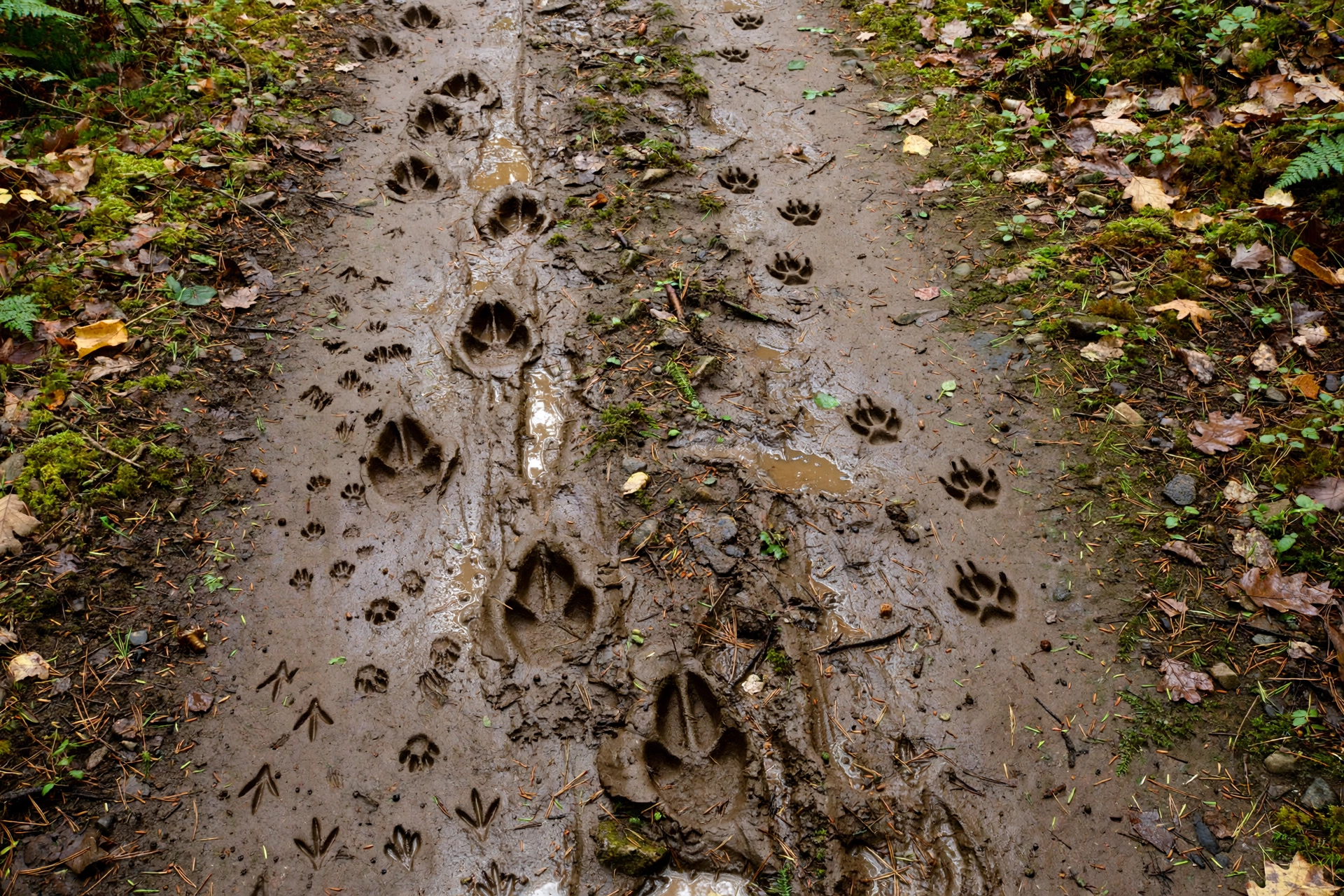
Wild animals are often shy, nocturnal, or simply hard to see. Their tracks and signs, however, are everywhere: a footprint in mud, a feather on a path, a nibbled nut, a trail through long grass, or a burrow under a hedge. Learning to identify these signs is like learning to read a second language — suddenly the landscape is full of messages about who lives there, where they go, and what they eat.
This guide covers the most common animal tracks and signs, how to record them, and how to avoid the mistakes that lead beginners astray. You do not need to be a tracker to start; you need to slow down, look at the ground, and note what you see. With practice, a single clear track can tell you more than a fleeting glimpse of the animal itself. The best time to start is after rain, when soft ground holds fresh prints, and the best places are near water, along field edges, and under hedgerows where animals travel regularly.
Footprints: Size, Shape, and Toes
Footprints are the most direct sign. Start with size: measure the track or photograph it next to a coin, a pen, or your hand for scale. Then count the toes. Dogs and foxes show four toes with claw marks in a neat oval. Cats show four toes but usually no claw marks, because their claws retract. Badgers show five toes with long claw marks. Deer and other hoofed animals show two pointed halves of a cloven hoof.
Also note the shape and arrangement. Are the tracks in a straight line, suggesting a walking animal, or in a bounding pattern, suggesting a rabbit or squirrel? Are they in pairs, suggesting a hopping animal? Is there a tail drag mark? The pattern of tracks — called the gait — is as informative as a single footprint. Soft mud, sand, and snow preserve tracks best; look there first, especially after rain.
Birds leave tracks too, and they are often overlooked. Most perching birds show three toes forward and one back, while waterbirds may show webbing between the toes. A heron leaves long, thin, splayed toes near the water's edge, while a duck leaves clear webbed prints in wet mud. Small mammal tracks are harder: mice and voles leave tiny prints in pairs, and shrews leave even smaller ones, often in a neat line along a bank or log. Do not expect to identify every tiny print — note the size, the pattern, and the habitat, and treat small tracks as clues rather than certainties.
Feeding Signs, Droppings, and Other Clues
Feeding signs often outlast footprints and can be just as distinctive. Squirrels leave hazelnut shells split neatly in half, while wood mice nibble a small, neat hole in the side. Woodpeckers leave rows of holes in tree trunks and scatter wood chips below, and deer strip bark or leave ragged, torn twigs where they have browsed — unlike rabbits, which cut stems cleanly at an angle. Pine cones stripped down to a bare core are a classic sign of squirrels, and a pile of discarded scales at the base of a tree often marks a regular feeding spot.
Droppings, trails, and homes add more evidence. Deer droppings are small, dark pellets in piles; fox droppings are often left in prominent places and may contain fur or berry seeds; badger latrines are shallow pits used repeatedly. Trails through grass or undergrowth, flattened vegetation, and muddy runs along a bank show where animals travel day after day. Nests, burrows, and dens tell you where they live: a rabbit warren with many entrances, a badger sett with large spoil heaps outside, or a bird's nest tucked into a hedge. Put several signs together, and the picture becomes much clearer than any single clue alone.
Step-by-Step: Identify Tracks and Signs
Step 1: Find good ground
Look for soft mud, sand, snow, or dusty paths after rain. These surfaces hold clear tracks. Walk slowly and scan the ground ahead, not just at your feet.
Step 2: Photograph with scale
Photograph each track from directly above, with a coin, pen, or ruler beside it for scale. Take a second photo showing several tracks in a row, so the gait is visible. Note the location and habitat.
Step 3: Count toes, claws, and shape
Count the toes, note whether claws are visible, and describe the overall shape: round, oval, cloven, or three-toed. Compare with a field guide or identification chart.
Step 4: Look for other signs nearby
One track alone can be ambiguous. Look for droppings, feeding signs, fur, feathers, or trails nearby. Several signs pointing to the same animal give a much stronger identification.
Step 5: Confirm with an AI tool
Upload your clearest track photos to the Animal Identifier on aitreeidentier.site and compare its suggestion with your notes on size, toes, gait, and habitat. Use it as a second opinion, and cross-check with local field guides.
Common Mistakes to Avoid
Identifying from one unclear track. A single smudged print can look like several species. Find a clear track, photograph several in a row, and look for supporting signs.
Forgetting scale. Without scale, a small dog track and a fox track can look identical in a photo. Always include something of known size.
Touching droppings or disturbing nests. Observe without touching. Droppings can carry germs, and nests should never be disturbed. Photograph from a safe distance.
Assuming every trail is made by one animal. Trails are shared by many species. Use footprints, droppings, and feeding signs together to narrow it down.
Ignoring the time of day and season. A fresh track in morning mud may be only hours old, while an old, dried track could be days old. Note the weather and when you found the sign, and remember that some animals are active at night and others only in certain seasons.
FAQ
What is the best surface for finding animal tracks? Soft mud, wet sand, snow, and dusty paths after rain preserve tracks best. Look near water, along trails, and under hedgerows where animals travel regularly.
How can I tell a fox track from a dog track? Fox tracks are usually smaller, neater, and more oval, with a narrower overall shape. Dog tracks vary widely by breed and are often rounder and more splayed. Habitat, gait, and other signs help too.
Are animal droppings safe to examine? Observe and photograph them, but do not touch them with bare hands. Wash your hands after being outdoors, and do not handle droppings if you are unsure what animal left them.
Can AI identify an animal from its tracks? AI can help, especially from a clear, scaled photo of a track or feeding sign. Accuracy improves when you include several tracks, the gait, and notes on habitat and location.
How do I tell a badger track from other five-toed animals? Badger tracks are large, with five toes and long, obvious claw marks well ahead of the toes, and the front feet are broader than the hind feet. Compare the size with your hand, look for a sett or latrine nearby, and check the gait — badgers walk with a steady, flat-footed stride.
Conclusion
Animal tracks and signs turn a quiet walk into a detective story. Start with footprints — size, toes, claws, and gait — then add droppings, feeding signs, nests, and trails. Photograph with scale, look for several signs together, and use the Animal Identifier on aitreeidentier.site as a helpful second opinion. Slow down, look at the ground, and keep a record of what you find. Over time, you will recognise the animals that share your local landscape, even when you never see them directly.
Safety note: Keep a safe distance from wild animals, do not disturb nests or burrows, do not touch droppings with bare hands, and never eat or use a wild plant or mushroom based on AI alone. Consult a local expert if you are unsure.