
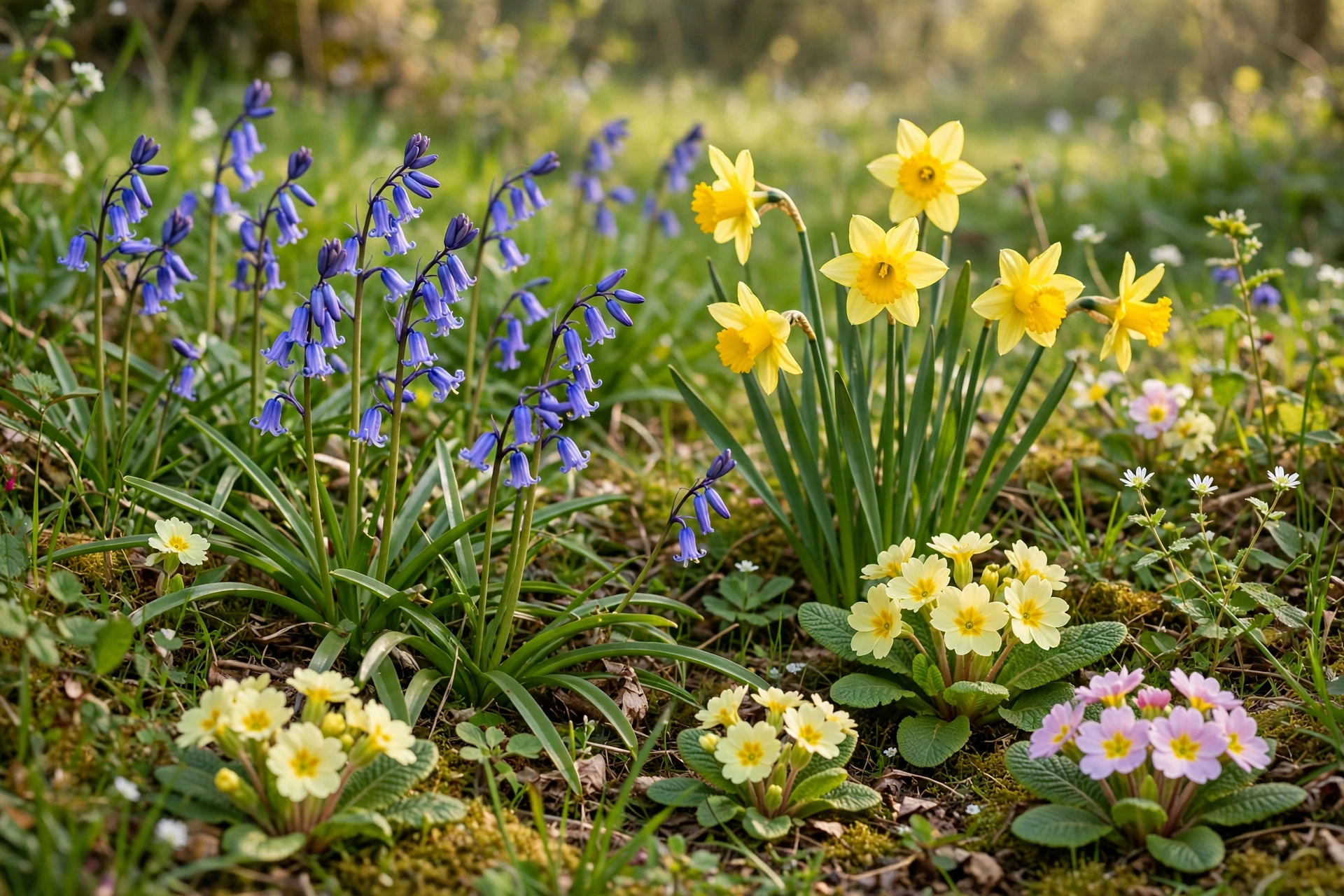
Spring flowers arrive in waves: snowdrops and crocuses, then daffodils and primroses, then bluebells, tulips, and cherry blossom. Each flower offers clues in its petals, leaves, stem, and habitat, turning an ordinary walk into a discovery every few steps.
This guide covers how to identify wildflowers and garden blooms in spring, what to look for, and how to record what you find without harming the plants.
Try it: Use the Flower Identifier on aitreeidentier.site — photograph a flower in daylight, with leaves visible, for the best suggestion.
Why Spring Flowers Are Easier — and Harder — to Identify
Spring flowers are often easier to identify than summer flowers because there are fewer species in bloom at once, and many spring species are distinctive. A daffodil, a bluebell, or a primrose is hard to mistake for anything else once you have seen it a few times.
At the same time, many spring flowers are small, short-lived, and similar to each other — think of the many small white flowers in woodlands, or the different violets and speedwells in lawns. That is why looking at leaves, stems, and habitat matters as much as looking at the flower itself.
Step-by-Step: How to Identify a Spring Flower
Step 1: Photograph the whole plant
Take one photo of the flower close up, and one of the whole plant showing stem, leaves, and how it grows. A flower without its leaves is much harder to identify — many species share similar blooms but have very different foliage.
Step 2: Count petals and note the shape
Count the petals, or petal-like parts, and note the flower's shape. Is it trumpet-shaped like a daffodil, bell-shaped like a bluebell, star-shaped, or flat and open? Are petals separate or joined? Is the flower single or in a cluster?
Daffodils have six petal-like segments around a central trumpet. Primroses have five pale yellow petals with a darker centre. Bluebells have nodding, bell-shaped flowers along one side of the stem.
Step 3: Look at the leaves
Leaves are often the deciding clue. Are they long and strappy, like daffodils and bluebells? Round and heart-shaped, like violets? Deeply divided, like anemones? Note whether leaves grow from the base, along the stem, or in pairs, and whether they are smooth, hairy, or toothed.
Step 4: Note colour, size, and scent
Record the exact colour — not just "blue" but pale blue, violet-blue, or deep purple — and the size of the flower. Note any scent, and whether the flower opens in sun and closes at night, as many spring flowers do.
Step 5: Record where and when you saw it
Habitat is a powerful clue. Woodland, meadow, lawn, hedgerow, garden bed, and wetland each host different species. Note the date, too — snowdrops in February, bluebells in late spring, and poppies in early summer follow a predictable sequence.
Common Spring Flowers to Learn First
- Snowdrop: Small, white, nodding flowers in late winter and early spring, often in woodlands and gardens.
- Daffodil: Yellow or white trumpet flowers with long, strappy leaves, common in gardens, parks, and verges.
- Primrose: Pale yellow, five-petalled flowers in rosettes of wrinkled leaves, in woodlands and hedgerows.
- Bluebell: Nodding, violet-blue bells along one side of a stem, forming carpets in ancient woodlands.
- Tulip: Cup-shaped flowers in many colours, almost always in gardens and parks.
- Cherry blossom: Masses of pink or white five-petalled flowers on trees before or with new leaves.
Learn these six, and you will recognise a large share of the spring flowers you meet.
Common Mistakes in Spring Flower Identification
Photographing only the flower. Without leaves and stem, many flowers look alike. Always include the whole plant.
Relying on colour alone. Colour varies within a species and fades with age. Shape, leaf, and habitat are more reliable.
Picking flowers to identify them. Many wildflowers are protected or slow to recover from picking. Photograph instead of picking, and leave plants where they grow.
Confusing garden escapes with wildflowers. A flower in a wood may be a garden plant that has spread. Check whether it is likely to be planted or truly wild.
Frequently Asked Questions
What is the best time to see spring wildflowers? Mid to late spring is peak time in most temperate regions, when woodland flowers bloom before tree leaves shade the ground. Early spring brings snowdrops, crocuses, and primroses.
Can I identify a flower from a photo alone? Often, yes, if the photo shows the flower, leaves, stem, and scale clearly. A photo of a single bloom with no leaves is much harder to identify reliably.
Should I pick a flower to identify it? No — photograph it instead. Picking harms the plant and is illegal for some protected species. A good photo gives you everything you need.
Why do some spring flowers grow in woodlands? Woodland spring flowers bloom early to catch light before tree leaves open and shade the forest floor. By summer, many have died back underground until next spring.
Conclusion
Spring flower identification is about looking beyond the bloom. Petals, leaves, stem, habitat, and timing together tell you what you are seeing. Start with the common species near you, photograph the whole plant, and record where and when you found it. Over a few springs, you will build a mental calendar of flowers — and every walk will feel richer for it.
Safety note: Never eat or use any flower or plant based on AI identification alone. Many spring flowers are toxic, and some lookalikes are dangerous. Always consult a local expert.