
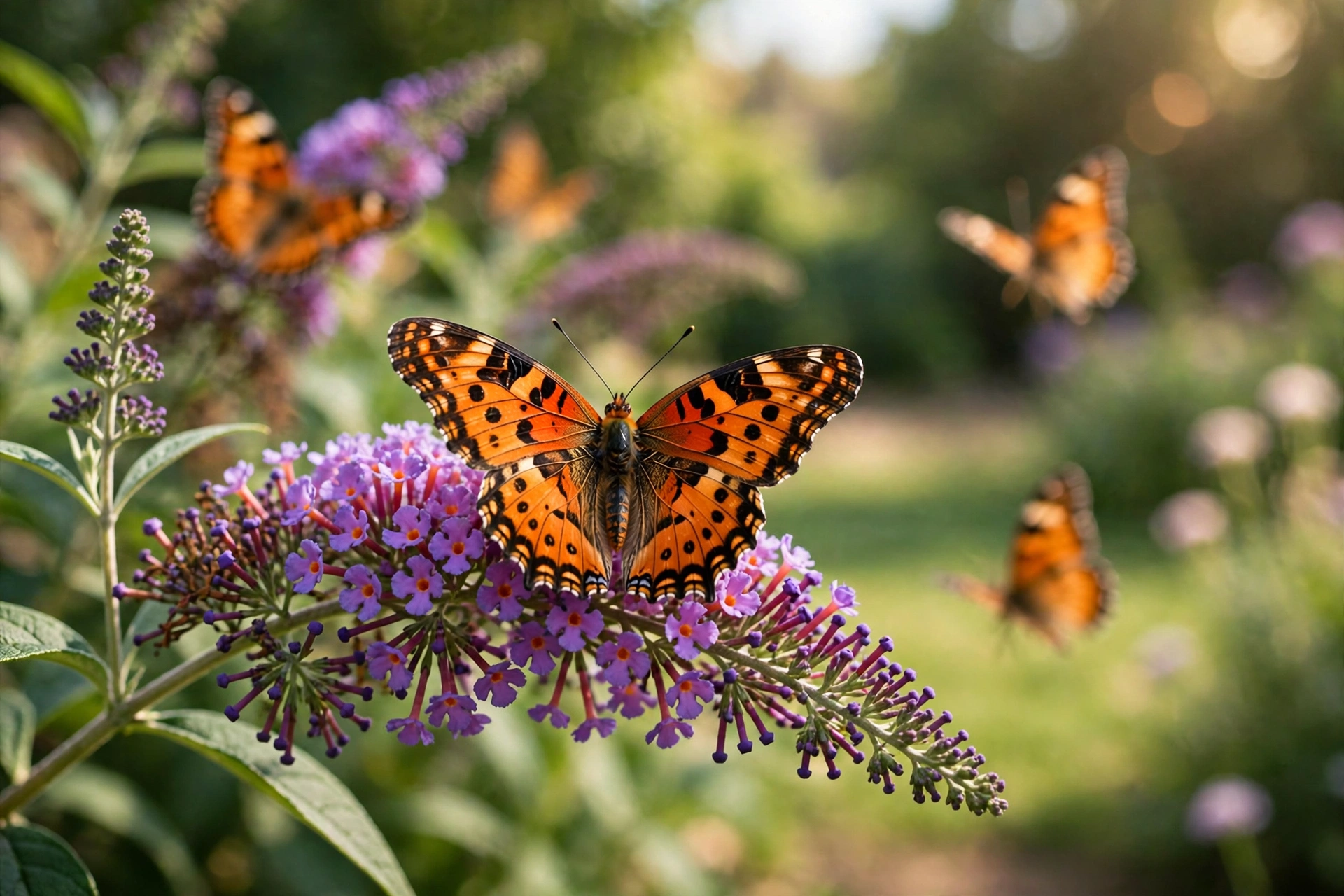
Butterflies are one of the easiest and most rewarding creatures to identify in a garden. Unlike birds, which often fly away before you can look closely, butterflies feed slowly on flowers, bask with their wings open in the sun, and return to the same plants day after day. With a little practice you can learn to name the common species in your garden by their colour, size, shape and flight, without catching them or needing special equipment. This guide is butterfly-specific: it focuses only on butterflies, how to tell them apart from each other, and how to attract more of them to your garden.
Start by learning the difference between a butterfly and a moth, and between a butterfly and a bee or hoverfly. Butterflies fly by day, rest with their wings closed upright over their backs, and have thin bodies with clubbed antennae. Moths usually fly at night, rest with wings flat, and have feathery antennae. Bees and hoverflies are much smaller, have no large coloured wings, and hover rather than flutter. Once you are sure you are looking at a butterfly, you can work through its colour, size, wing shape and behaviour.
What to Look For First
Colour is the first clue, but it is not the only one. Note the main colour on the upper side of the wings, then any spots, borders or bands. A large white butterfly with black wingtips is very different from a small blue butterfly, and an orange butterfly with black veins is different again. Also note the underside of the wings, which you will see when the butterfly rests with wings closed. Many species have completely different patterns underneath, and those patterns are often the best way to tell two similar species apart.
Size matters too. Compare the butterfly with a familiar object, such as your thumb or a coin. Large species, such as swallowtails and red admirals, have a wingspan of 6 to 8 centimetres. Medium species, such as painted ladies and peacocks, are about 5 centimetres across. Small species, such as common blues and small coppers, are only 2 to 3 centimetres across and are easy to miss. Wing shape also helps: swallowtails have tails on their hind wings, commas have ragged wing edges, and whites have rounded wings.
Common Garden Butterflies to Learn First
Start with the whites. The large white and small white are the commonest garden butterflies in many areas. Both are white with black wingtips, but the large white is bigger, with a wingspan up to 7 centimetres, while the small white is smaller and weaker in flight. The green-veined white is similar, but its wings have greenish veins underneath. Whites are often seen around cabbages and other brassicas, because their caterpillars feed on those plants.
Orange and red butterflies are easy to spot. The orange-tip is unmistakable in spring: the male has bright orange tips to white forewings, while the female is white with black tips and is harder to tell from other whites. The red admiral is black with red bands and white spots, and it is often seen on buddleia and on fallen fruit in late summer. The peacock is dark red with large eyespots on each wing, which it flashes when disturbed. The painted lady is orange and black with white spots, and it is a strong migrant that arrives in varying numbers each year.
Blue and brown butterflies are smaller and need closer looking. The common blue is small, with bright blue upper wings in the male and brown wings with blue dusting in the female, and spotted grey undersides. The holly blue is pale blue and flies around holly and ivy in spring and summer. The speckled wood is brown with cream spots and is common along hedges and woodland edges. The gatekeeper is orange-brown with a dark eyespot, and it is often seen on grasses and bramble in mid-summer.
Two larger species are worth learning because they are so distinctive. The brimstone is pale yellow-green, shaped like a leaf when its wings are closed, and it is one of the first butterflies of spring. The comma is orange-brown with ragged wing edges and a small white comma mark underneath, and it is often seen basking on walls and paths in autumn. If you learn these ten or so species, you will be able to name most of the butterflies you see in a typical garden.
How to Watch Butterflies Without Disturbing Them
The best time to watch butterflies is on a warm, sunny day between late morning and mid-afternoon, when they are most active. They need sun to warm their wings before they can fly, so they are slow and easy to approach early in the morning, when they are basking with wings open. Move slowly, approach from the side rather than from above, and avoid casting a shadow over the butterfly, which will make it fly away.
You do not need to catch a butterfly to identify it. A pair of binoculars, or the zoom on a phone camera, will let you see the wing patterns from a distance. Take a photo if you can, including both the upper side and the underside if possible, and note the date, time, weather, and the plant it was on. That information will help you confirm the identification later, and it will build up a record of what visits your garden and when.
Attracting Butterflies to Your Garden
Butterflies need two things: nectar for the adults and food plants for the caterpillars. For nectar, plant flowers with flat, open heads that butterflies can land on, such as buddleia, lavender, marjoram, verbena, sedum and Michaelmas daisies. Plant them in sunny, sheltered spots, in groups rather than singly, so butterflies can find them easily. A mix of flowers that bloom from spring to autumn will keep butterflies visiting all season.
For caterpillars, leave some wild areas. Nettles are the food plant for red admirals, peacocks, commas and small tortoiseshells, so a small patch of nettles in a sunny corner is one of the best things you can do for butterflies. Cabbages and nasturtiums feed white butterfly caterpillars, grasses feed speckled woods and gatekeepers, and holly and ivy feed holly blues. Avoid spraying insecticide in the garden, because it kills caterpillars as well as pests, and leave fallen leaves and long grass over winter, where many butterflies shelter as pupae or adults.
Common Identification Mistakes
The commonest mistake is confusing similar white butterflies. Large white, small white and green-veined white look alike at a glance, but size, flight and the underside pattern will separate them if you look closely. Another mistake is calling every orange butterfly a monarch; in many gardens the orange butterfly you see is a painted lady, a red admiral, or a comma, not a monarch, which is rare in many areas.
Do not rely on colour alone. Light, angle and wear can change how a butterfly looks, and a faded, worn butterfly can look very different from a fresh one. Check the wing shape, the spots and bands, and the underside as well as the upper side. If you are unsure, take a photo and compare it with a field guide or an identification app, and note the date and place, because some species fly only at certain times of year.
Frequently Asked Questions
What is the difference between a butterfly and a moth? Butterflies usually fly by day, rest with wings closed upright, and have clubbed antennae. Moths usually fly at night, rest with wings flat, and have feathery antennae, though there are day-flying moths too.
Why do butterflies sit with their wings open in the sun? They are warming their flight muscles. Butterflies need sun to fly, so they bask with wings open on a sunny surface until they are warm enough.
Can I attract butterflies with just one plant? One plant will help, but a mix is better. Buddleia is famous for attracting butterflies, but you also need caterpillar food plants, such as nettles and grasses, if you want butterflies to breed in your garden.
Conclusion
Identifying butterflies in your garden is a skill that grows with practice, and it starts with looking carefully at colour, size, wing shape and flight. Learn the common whites, oranges, blues and browns first, watch them on sunny days, take photos, and keep a simple record of what you see. Plant nectar flowers, leave food plants for caterpillars, and avoid insecticides, and your garden will attract more butterflies every year. The more you watch, the more you will see, and the more you will want to protect the small wild corners that butterflies need.
Try it on aitreeidentier.site — use the Insect Identifier to check a butterfly or other insect you photograph in your garden, and the Plant Identifier to confirm the flowers it is feeding on. Try the insect identifier at aitreeidentier.site