
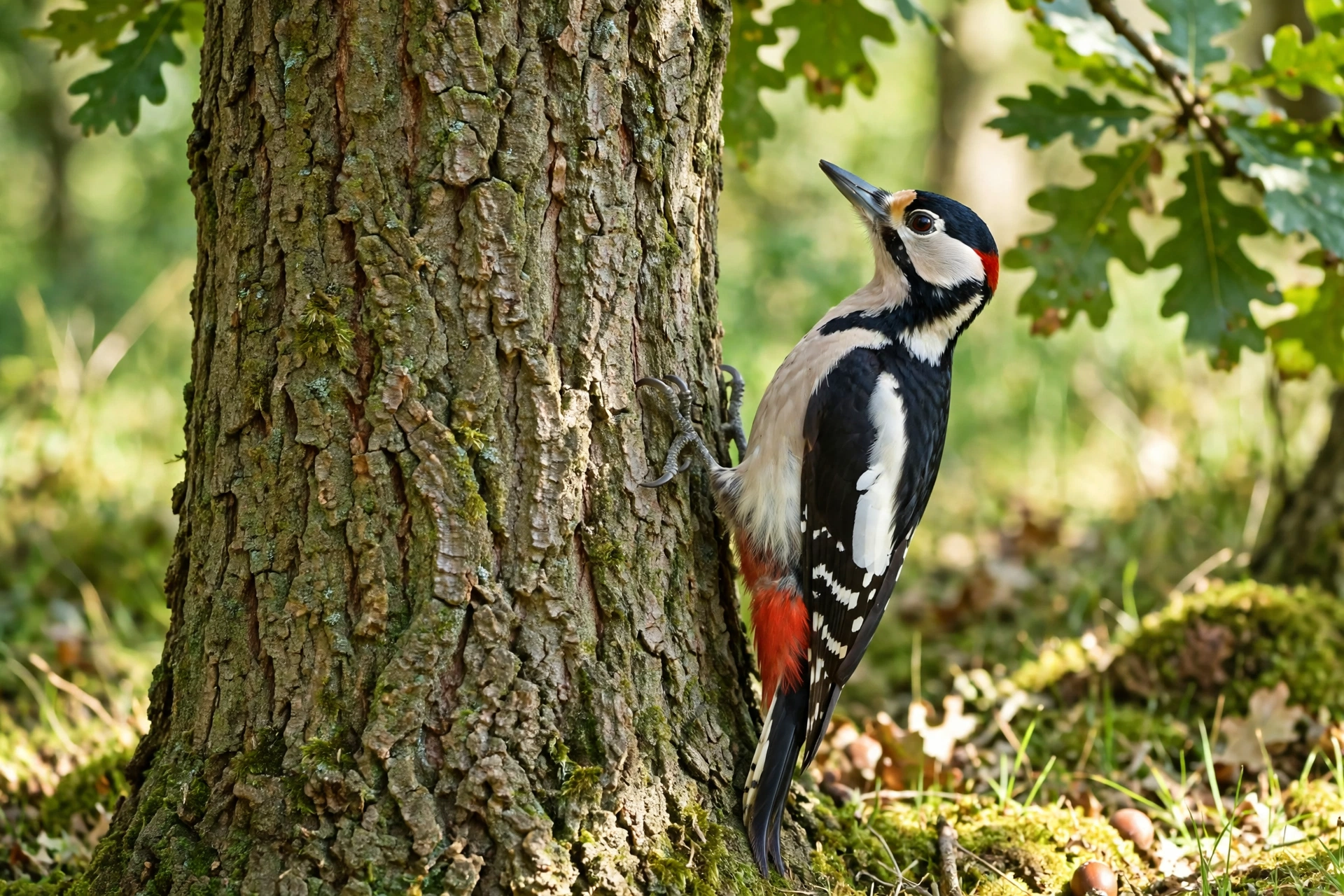
A woodpecker is one of the easiest birds to find once you know what to look for, and one of the hardest to see clearly when it is working high in a tree. You will often hear a woodpecker long before you see it. The loud drumming on a hollow branch, the sharp call, or the sound of pecking can lead you straight to it, and its bold black, white and red plumage stands out against bark and leaves. Learning to identify woodpeckers by sight and by sound turns a walk in the woods into a small treasure hunt, and it is a skill any beginner can learn. This guide covers the woodpeckers you are most likely to meet, how to tell them apart by size, pattern, flight and behaviour, and how to use their drumming and calls to identify them even when they stay hidden.
Why Woodpeckers Are Special
Woodpeckers are built for a life on tree trunks. They have strong, chisel-shaped bills for pecking wood, stiff tail feathers that act as a prop, and feet with two toes pointing forward and two pointing back, which let them grip vertical bark. Their tongues are very long and can reach deep into cracks to pull out insects. A woodpecker's skull is also specially adapted to absorb the shock of pecking, so it can hammer away thousands of times a day without injury. Most woodpeckers eat insects hidden under bark, especially beetle larvae, ants and caterpillars, and in winter they also eat nuts, seeds and berries. They nest in holes they carve in dead or decaying trees, and those holes are later used by many other birds, so woodpeckers are important for the whole woodland. Because they depend on trees, they are a good sign of a healthy woodland with plenty of dead wood.
The Woodpeckers You Are Most Likely to See
In most gardens and woodlands, the great spotted woodpecker is the commonest species. It is about the size of a blackbird, with black and white wings, a white belly, and a bright red patch under the tail. Males have a red patch on the back of the head, while females do not. The lesser spotted woodpecker is much smaller, about the size of a sparrow, with a barred black and white back and no large white shoulder patches. Males have a red crown. The green woodpecker is larger, about the size of a jay, and is often seen on the ground, feeding on ants. It has a green back, a pale belly, a red crown and a black face mask. In North America, the downy woodpecker is small and common, with a white back stripe and a small bill, while the larger hairy woodpecker looks similar but has a longer bill. The red-bellied woodpecker has a pale body with black and white barred wings and a red patch on the head. Knowing which species live in your area is the first step, because it narrows the choices before you even lift your binoculars.
Identifying by Sight: Size, Colour and Pattern
Start with size. Compare the bird with birds you know well: a sparrow, a blackbird or a pigeon. A lesser spotted or downy woodpecker is sparrow-sized, a great spotted or hairy woodpecker is blackbird-sized, and a green woodpecker is larger still. Next, look at the head. A red patch on the back of the head usually means a male great spotted, a red crown means a male lesser spotted or a green woodpecker, and a black and white striped head with no red at all usually means a female. Look at the back and wings. Bold white shoulder patches point to a great spotted woodpecker, a barred black and white back points to a lesser spotted, and a green back points to a green woodpecker. Look at the belly and the patch under the tail. A bright red patch under the tail is a clear mark of the great spotted woodpecker. Finally, watch the flight. Woodpeckers fly in a bounding, undulating pattern, rising and falling as they flap and glide, which is very different from the straight flight of most other birds.
Identifying by Sound: Drumming and Calls
Sound is often the best way to find and identify a woodpecker. Drumming is the loud, rapid hammering a woodpecker makes on a hollow branch to claim territory and attract a mate. It is not feeding, it is communication, and each species drums at a different speed and length. A great spotted woodpecker drums in a short, fast burst, about half a second long, that fades away. A lesser spotted woodpecker drums in a longer, even roll. A green woodpecker rarely drums at all, but has a loud, laughing call that sounds like a series of descending notes, often given in flight. The great spotted woodpecker also gives a sharp, single call, like a short kick. The downy woodpecker gives a high, descending whinny and a sharp pick note. Listen for the rhythm and the length of the drumming, and for the shape of the call. With practice, you will recognise a woodpecker by ear before you ever see it, and that is a satisfying skill to build.
Where and When to Look
Woodpeckers live wherever there are trees, but they favour old woodland, parks, large gardens and orchards, especially where there are dead trees and fallen branches. Dead wood is full of insects, so a woodland with plenty of standing dead trees will have more woodpeckers than a tidy park where every dead branch is removed. Look for woodpeckers on tree trunks and large branches, especially on the shady side of the tree, and listen for drumming in spring, when males are most active. Early morning is the best time, because birds are feeding and calling most then. In winter, woodpeckers visit garden feeders for peanuts and fat, and they are easier to see when the trees have no leaves. Move slowly, stop often, and scan each trunk from the bottom up. A woodpecker that is working on the far side of a trunk will often circle around to the side you can see if you wait quietly.
Common Identification Mistakes
The most common mistake is confusing a great spotted woodpecker with a lesser spotted woodpecker. They look similar, but the size difference is large: the great spotted is blackbird-sized, the lesser spotted is sparrow-sized. The lesser spotted also has a barred back and no large white shoulder patches, while the great spotted has clean white shoulder patches. Another mistake is confusing a female great spotted with a male, because the female has no red on the back of her head. A green woodpecker is sometimes confused with a jay, but the woodpecker has a red crown, a black face mask and a green back, and it flies with a bounding flight. In North America, the downy and hairy woodpeckers are often confused. The hairy woodpecker is larger, has a longer bill, and has a clean white outer tail feather, while the downy has black spots on its outer tail feathers. When in doubt, note the size, the bill length and the back pattern, and check a field guide or a photo later.
Frequently Asked Questions
Do woodpeckers hurt trees? No, woodpeckers usually peck at trees that are already dead or infested with insects. They help control pests, and their nesting holes are used by many other birds.
Why do woodpeckers drum? Drumming is a way to claim territory and attract a mate in spring. It is not feeding, and the bird chooses a hollow branch that makes a loud sound.
What do woodpeckers eat? Mostly insects under bark, especially beetle larvae and ants. In winter they also eat nuts, seeds, berries and fat from feeders.
How can I attract woodpeckers to my garden? Put out peanuts, fat balls and sunflower seeds, leave some dead wood if you can, and plant native trees. Be patient, because woodpeckers visit gardens irregularly.
Are woodpeckers active all year? Yes, most woodpeckers stay in the same area all year. They are easiest to find in spring, when they drum and call, and in winter, when trees have no leaves.
Conclusion
Identifying woodpeckers is a mix of looking, listening and knowing where to stand. Start with size and the pattern on the head, back and wings, then listen for the drumming and the call, and watch where the bird feeds. The great spotted woodpecker is the one most beginners meet first, but the green woodpecker on a lawn and the tiny lesser spotted high in a tree are just as rewarding to find. Woodpeckers reward patience, and once you know their sounds, you will hear them everywhere.
Try it: photographed a woodpecker but not sure which one it is? Upload the photo to the Bird Identifier on aitreeidentier and compare it with the field marks in this guide.