
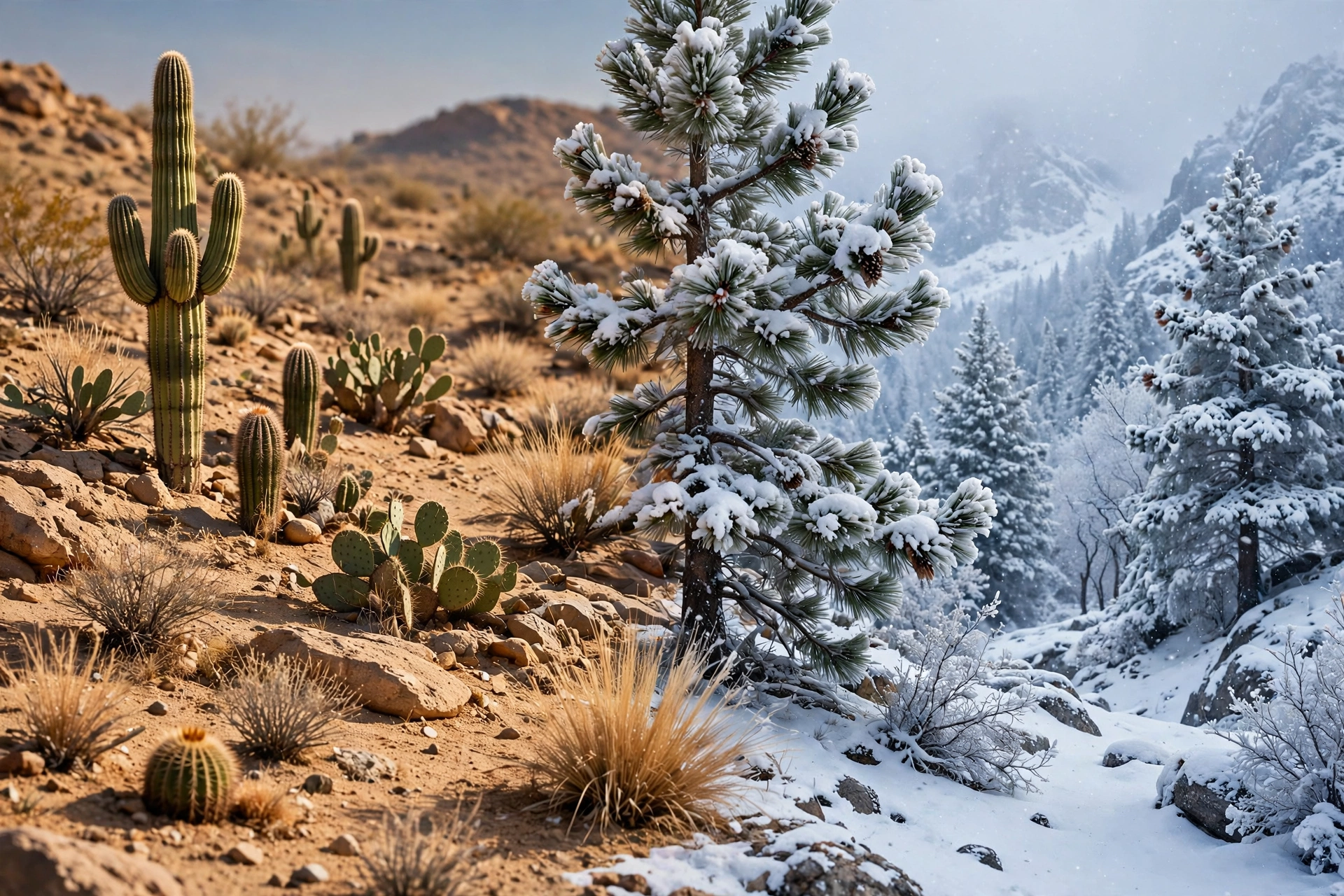
Introduction: Plants Are Shaped by Place
A cactus in a desert, a pine on a snowy mountain, and a mangrove in salty water look very different, but they are all solving the same problems: getting enough water, light, and nutrients, surviving heat, cold, wind, and salt, and reproducing before conditions turn harsh. Over time, plants evolve adaptations — features that help them survive in a particular place.
Understanding adaptations helps you choose plants that will thrive, not just survive, in your garden. Instead of fighting your climate and soil, you can work with them, choosing species that are already adapted to similar conditions.
Adaptation to Dry Climates
Water is the biggest challenge in dry places. Desert plants use several strategies to save it.
Succulents, such as cacti and agaves, store water in thick, fleshy leaves or stems. Their waxy coating reduces evaporation, and many open their stomata at night, when it is cooler, to take in carbon dioxide with less water loss. This is called CAM photosynthesis.
Adaptation Takes Generations, Acclimation Takes Weeks
It helps to separate two ideas that gardeners often mix up. Adaptation is inherited: over many generations, natural selection favours traits that suit a place, such as the waxy leaves of a desert plant or the antifreeze proteins in an alpine cushion plant. No single plant can acquire these traits in its own lifetime. Acclimation, by contrast, is what an individual plant does in days or weeks, such as thickening its leaves in strong sun, growing deeper roots in a dry spell, or hardening off against frost in autumn.
Plants also show phenotypic plasticity, meaning one genotype can look quite different in different conditions. A single species grown in sun may be short and compact with small, thick leaves, while the same species in shade grows tall and leggy with large, thin leaves. This flexibility helps plants survive changeable conditions, but it has limits: a plant acclimated to shade will still scorch in full desert sun. Good gardening works with both ideas, choosing species adapted to the local climate, then giving them time to acclimate to their exact spot.
Adaptation to Cold Climates
Cold brings freezing, short growing seasons, and drying winds. Alpine and boreal plants cope in several ways.
Adaptation to Wet, Salty, and Poor Soils
Adaptation to Light, Wind, and Fire
Wind-pruned trees on coasts grow low and asymmetrical, with flexible branches and strong roots. In fire-prone landscapes, some plants have thick bark, buds protected underground, or seeds that only germinate after fire. These are not accidents; they are long-term responses to a recurring challenge.
How to Choose Plants for Your Climate and Soil: Step by Step
1. Know your climate. Check your hardiness zone, average rainfall, summer heat, winter low, and wind exposure. Note frost pockets and sheltered spots in your garden. 2. Test your soil. Feel it, check drainage by digging a hole and seeing how fast water drains, and test pH if you can. Is it sandy, clay, chalky, or rich loam? 3. Identify plants already thriving nearby. Use the Plant Identifier on aitreeidentier.site to identify plants that grow well in your area. They are clues to what your conditions suit. 4. Match adaptations to conditions. Choose drought-tolerant plants for dry, sunny beds, moisture-lovers for damp spots, and acid-lovers only if your soil is acidic. 5. Plant in the right season. Plant in spring or autumn when roots can establish before heat or frost stress. 6. Improve soil gradually. Add compost to improve structure, but do not try to turn clay into sand overnight. Choose plants for the soil you have, then improve it over time. 7. Observe and adjust. Keep notes on what thrives, what struggles, and where. Move or replace plants that are clearly in the wrong place rather than forcing them to cope.
Common Mistakes
Choosing by looks alone. A beautiful plant from a different climate may need constant watering, protection, or feeding to survive, and may still fail in a hard winter.
Ignoring soil drainage. Most plant deaths in gardens are linked to water: too much or too little. Drainage matters as much as nutrients.
Planting a sun plant in shade, or vice versa. Light needs are not flexible for long. A sun-loving plant in shade becomes leggy and disease-prone, while a shade plant in full sun scorches.
Forgetting local extremes. Average temperature is not enough. One hard frost, heatwave, or flood can kill a plant that coped well on average days.
Over-amending soil for one plant. Changing soil pH or fertility for a single plant is hard to maintain. It is usually better to choose a plant that likes your soil.
Microclimates: Your Garden Has Many Climates
A garden is rarely one uniform climate. A south-facing wall can be several degrees warmer than an open lawn, storing daytime heat and releasing it at night, which is why tender plants often survive against a sheltered wall when they fail elsewhere. Low spots collect cold air on still nights, creating frost pockets where tender plants suffer, while a raised bed or a slope drains cold air away. Wind is another divider: a hedge or fence can cut wind speed sharply on its sheltered side, reducing drying and chill.
Cities add their own warming, with paved surfaces and buildings holding heat, so urban gardens often suit plants rated a zone warmer than the surrounding countryside. The practical lesson is to map your garden before you plant: note where frost lingers in the morning, where the wind bites, and which corners stay damp. Matching plants to these small zones is often the difference between a plant that merely survives and one that thrives.
Frequently Asked Questions
What is a hardiness zone?
A hardiness zone is a map-based guide to average minimum winter temperatures. It helps you judge whether a perennial, shrub, or tree is likely to survive winter in your area, but it does not cover summer heat, rainfall, or soil.
Can a plant adapt to a new climate in one season?
Individual plants can acclimatise a little, for example by growing thicker leaves, but true adaptation happens over generations through evolution. You cannot train a tropical plant to survive a hard frost.
Why do some plants need poor soil?
Some plants, such as many wildflowers and Mediterranean herbs, produce more flowers and stronger oils in poor, well-drained soil. Rich soil makes them grow lush leaves but fewer flowers, and can make them floppy or disease-prone.
How do I know if my soil is acidic or alkaline?
A simple soil test kit, or a local garden centre test, can tell you. You can also look at indicator plants: rhododendrons, blueberries, and heathers usually indicate acidic soil, while many chalk-loving plants indicate alkaline soil.
Can I grow a plant outside its hardiness zone?
Sometimes, with protection. A plant rated one zone colder than yours may survive in a sheltered microclimate, against a warm wall, or with winter mulch and fleece. But each zone beyond its rating raises the risk, and a single severe winter can undo years of growth, so treat out-of-zone planting as an experiment, not a guarantee.
What is the fastest way to test whether a plant suits my soil?
Start with the plants already thriving nearby, including weeds, which are honest indicators: nettles suggest rich, moist soil, while heather points to acid, poor ground. Then run a simple pH test and a squeeze test for texture. Together, these take an afternoon and tell you more than guessing from a plant label.
Conclusion
Plants adapt to climate and soil through leaf shape, root depth, water storage, timing, and partnerships with fungi and bacteria. Those adaptations are a guide, not a limitation: they tell you which plants are likely to thrive with less work, less water, and fewer problems. Learn your climate, test your soil, observe what already grows well nearby, and choose plants that match. When a plant is in the right place, it needs less intervention from you and gives more back — flowers, fruit, shade, and habitat — season after season.
Try it: Try the free Tree Researcher on aitreeidentier.site — identify a tree from a photo and learn more about the science behind it.
Safety note: This guide is for general learning only. Never eat or use a plant based on AI identification alone, and consult a local expert before using any plant for food or medicine.