
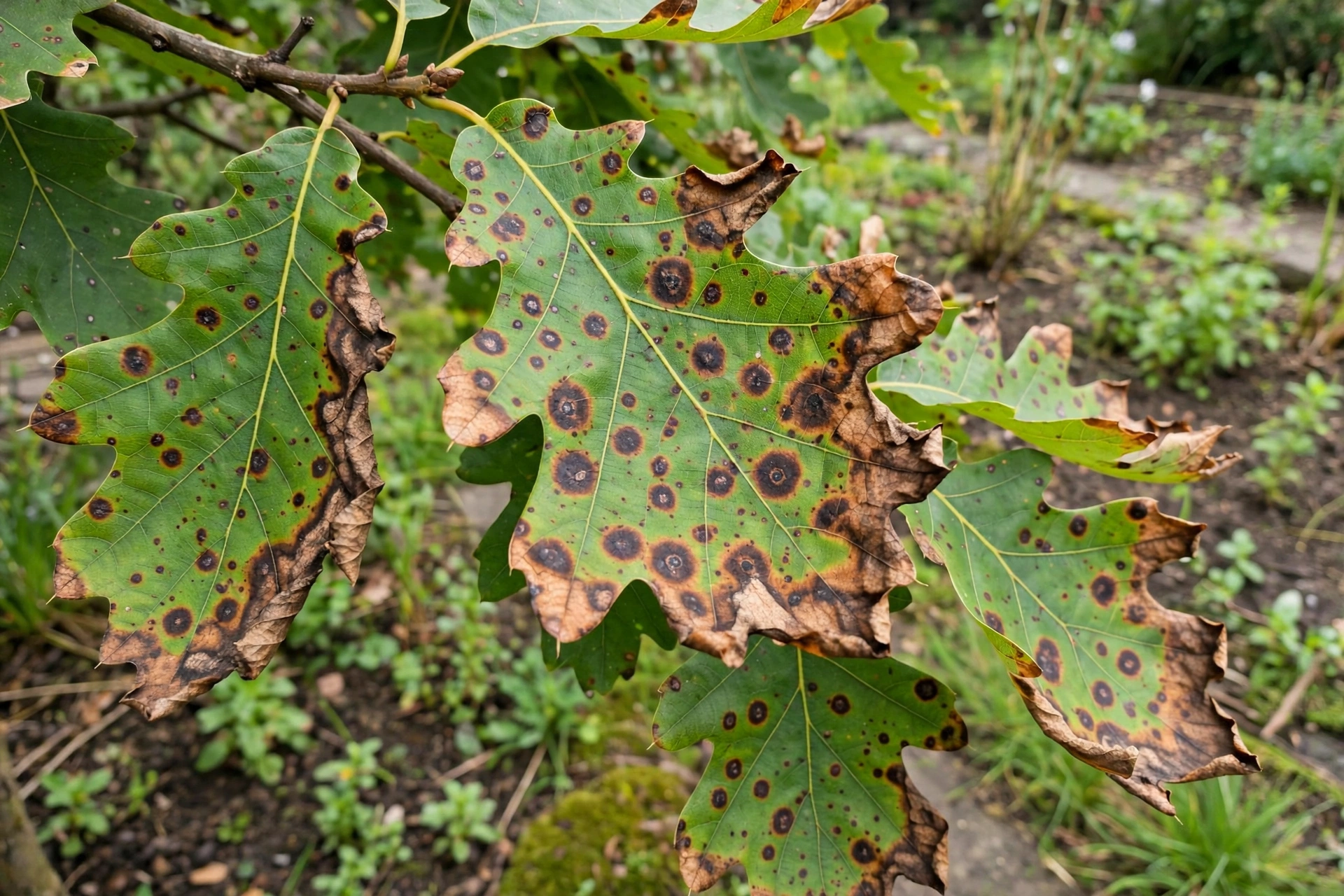
Anthracnose is one of the most common fungal diseases of trees and shrubs, and one of the most worrying to see for the first time. Leaves develop brown or black spots, edges turn scorched, twigs die back, and in a bad year a tree can lose much of its canopy. It looks serious, and it can be, but most established trees recover with the right care.
The name covers a group of related fungi that attack many different plants, including sycamore, ash, oak, maple, dogwood, and roses.
What Anthracnose Looks Like
Anthracnose usually starts on the leaves. Small dark spots appear, often along the veins or near the leaf edges, and gradually grow larger. The centres of older spots may turn pale and fall out, leaving a shot-hole effect. In wet weather, affected leaves can twist, curl, or drop early, and young shoots may blacken and wilt as if scorched by frost.
On twigs and branches, the disease causes small sunken cankers and dieback of the shoot tips. In severe cases, whole branches lose their leaves and the tree looks thin and bare in early summer. New leaves often grow back later in the season, which is a hopeful sign, but repeated heavy attacks over several years can weaken a tree and slow its growth.
Which Trees and Shrubs Are Most at Risk
Some trees are far more vulnerable than others. Sycamore and London plane are classic hosts, often showing leaf blight in cool, wet springs. Ash, oak, and maple can also be badly affected, while flowering dogwood is famously sensitive and may suffer twig dieback as well as leaf spots.
Young trees, newly planted trees, and trees already stressed by drought, waterlogging, or poor soil suffer most. Healthy, well-established trees in an open, airy position often shake off a mild attack with little lasting harm.
How Anthracnose Spreads
The fungi survive winter in fallen leaves, infected twigs, and small cankers on the branches. In spring, spores are released in wet weather and carried by rain splash and wind onto young, tender leaves. Once a leaf stays wet for several hours, the spores can germinate and infect it.
Step-by-Step: Help an Affected Tree Recover
Step 1: Confirm the symptoms
Photograph the spots, the pattern of damage, and the whole tree. Anthracnose spots usually follow the veins and leaf edges and appear after wet weather. Compare your photos with a trusted guide or identification tool, and remember that frost, sunscald, and other leaf spots can look similar.
Step 2: Clean up fallen leaves and twigs
Rake up fallen leaves and remove dead twigs from the ground and the canopy where you can reach them safely. Do not compost diseased material at home, because a garden compost heap rarely gets hot enough to kill the fungi. Bag it or dispose of it with garden waste instead.
Step 3: Improve airflow and water at the base
Thin out crowded growth to let air and sunlight reach the inner canopy, and prune only in dry weather, cutting back to healthy wood. Water the soil around the tree in the morning, keeping the leaves as dry as possible, and keep mulch away from the trunk so air can circulate.
Step 4: Support recovery and monitor
A layer of compost or mulch over the root zone helps a stressed tree rebuild, but avoid heavy fertiliser that forces soft, vulnerable growth. Watch for new leaves through the summer. If the tree leafs out again and holds its foliage, it is recovering well.
Preventing Anthracnose Next Year
Prevention is mostly about hygiene and site. Choose resistant varieties when planting new trees, especially dogwood and sycamore, and give each tree enough space for air to move freely. Rake up leaves every autumn, prune for an open shape, and water at the base.
Common Mistakes Beginners Make
- Panicking when leaves drop in spring. A tree that loses leaves to anthracnose often grows a second flush later. Judge recovery by the new growth, not the first flush alone.
- Composting diseased leaves. Home compost rarely kills fungal spores, so diseased material can reinfect the garden next spring.
- Watering overhead in the evening. Wet leaves overnight are exactly what anthracnose fungi need to spread.
- Pruning in wet weather. Cutting during rain can spread spores and open fresh wounds at the worst possible time.
Anthracnose on Different Hosts
Anthracnose is not one disease but a group of related fungi, each favouring particular hosts, and the symptoms vary a little from tree to tree. On sycamore and London plane, it usually appears as leaf blight in cool, wet springs: young leaves blacken and fall, then a second flush grows in summer. On ash, it causes dark spots along the leaf veins and twig dieback, and can be confused with ash dieback, a far more serious disease — if you are unsure, seek expert advice, because ash dieback must be reported in some areas. On flowering dogwood, anthracnose is more damaging: it causes leaf spots, twig cankers, and dieback that can kill the tree over several years, especially in shade. On roses and other shrubs, it appears as dark, sunken spots on leaves and stems. The control is similar in every case — clean up fallen leaves, improve airflow, water at the base, and prune in dry weather — but the stakes are higher for dogwood and young trees, so watch those hosts most closely in spring.
Recovery: What to Expect Over the Season
Recovery from anthracnose is usually visible, and knowing what to expect stops unnecessary worry. In a typical year, an affected tree loses some or many of its first leaves in spring, then produces a second flush of healthy leaves in early summer as the weather warms and dries. Those new leaves are the sign that the tree is recovering: if they stay healthy through summer, the tree will usually be fine. A tree that fails to produce a second flush, or whose new leaves are also spotted and distorted, may be more seriously affected or may be suffering from another problem as well. Give the tree time, keep it watered in dry spells, mulch the root zone, and avoid heavy fertiliser. If the same tree is hit hard for three years in a row, or large branches die back, call an arborist — the tree may need structural pruning, or there may be a deeper stress, such as root damage or waterlogging, that needs to be addressed.
FAQ
Is anthracnose fatal to trees?
Rarely on its own. Most established trees recover, especially if they grow a second flush of leaves.
Can anthracnose spread to other plants?
Yes, within the same host group, since spores travel by rain splash and wind. Different anthracnose fungi favour different plants, so a sick sycamore does not automatically mean your roses are at risk, but good hygiene protects everything nearby.
When should I call an arborist?
Call one if large branches are dying back, the tree fails to leaf out again, the same tree is hit hard year after year, or you are unsure whether the problem is anthracnose at all.
Can anthracnose affect fruit? Yes, on some hosts, including apples and other fruit trees, anthracnose can cause dark, sunken spots on fruit. Remove affected fruit, clean up fallen fruit, and improve airflow to reduce the risk next year.
Is anthracnose worse in wet years? Yes. Anthracnose fungi need wet leaves to infect, so cool, wet springs bring the worst outbreaks, while warm, dry springs usually bring only mild symptoms. That is why the weather in April and May is the best predictor of how bad the year will be.
Conclusion
Anthracnose is alarming to see, but it is also a disease you can manage. Learn the signs, clean up fallen leaves, water at the base, prune in dry weather, and give the tree space and light. Most trees bounce back with a second flush of leaves and return stronger the following year.
Try it: Try the free Tree Disease Identifier on aitreeidentier.site — upload a clear photo of the spotted leaves or twigs for instant guidance.
Safety disclaimer: Never eat or use any part of a tree, or treat a disease, based on AI identification alone. AI results are guidance only — consult a local arborist or plant expert before applying treatments, especially near people, pets, food crops, or waterways.