
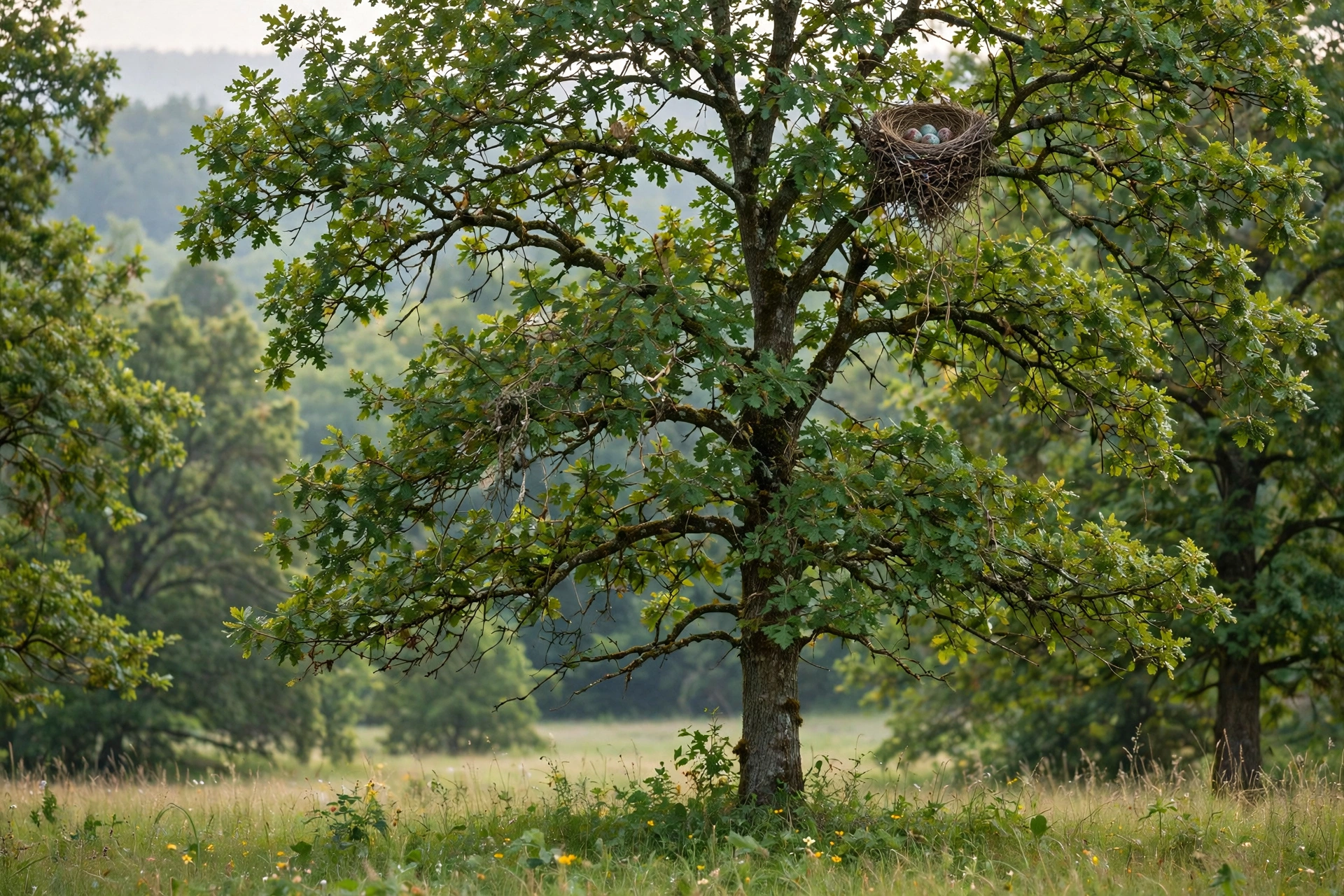
A bird's nest can tell you a great deal about the species that built it: where it lives, what materials it uses, how it raises its young, and how it avoids predators. Learning to recognise nests is a fascinating part of birdwatching, but it must be done with care. Nests are vulnerable, and disturbance can cause parents to abandon eggs or chicks, or attract predators to the site.
Introduction: Nests Tell a Story — From a Distance
This guide explains how to identify nests safely, from a distance, without touching, approaching closely, or revealing the location to others. The rule is simple: observe, do not disturb.
It is worth understanding why nests are so vulnerable. A nest is a fixed, visible target, and many predators — crows, magpies, jays, cats, rats, and even other birds — are always looking for eggs and chicks. Parent birds have evolved to hide their nests, to visit them quickly and quietly, and to defend them fiercely, but they cannot protect a nest if a human keeps visiting it, leaving a scent trail, or parting the vegetation so that the nest is visible. Even a well-meaning visit can be harmful: if a parent is scared away for too long, eggs can chill and chicks can go hungry. That is why the law in many countries protects nests, and why the first rule of nest identification is always the same — watch the adults, not the nest.
Step 1: Observe from a Distance
Watch the Adults, Not the Nest
The safest way to identify a nest is to watch the adult birds from a distance. Note which species visits the site, what it carries — twigs, moss, feathers, or food — and how often it visits. A bird carrying food is likely feeding chicks. A bird carrying nesting material is likely building. That behaviour, seen from a hide, a window, or a distant viewpoint, is often enough to identify the nest owner without ever approaching the nest itself.
Use binoculars, not your feet, to get a closer view. Do not part vegetation to see a nest, do not stay too long near a site, and do not visit the same nest repeatedly. If a bird gives alarm calls or flies away when you approach, you are too close — leave quietly and do not return.
Watching adults is also more informative than looking at a nest, because the adults tell you what stage the nest is at. A bird carrying twigs and moss is building. A bird carrying food is feeding chicks. A bird sitting quietly on the nest for long periods is incubating eggs. A bird carrying a faecal sac — a small white parcel — away from the nest is cleaning up after its chicks. Each of these behaviours tells you something about the nest, and none of them requires you to approach it. The best vantage point is often a window, a garden chair, or a hide, where you can watch for twenty minutes without the birds knowing you are there. If you watch from indoors, the birds will behave naturally, and you will see far more than you would by standing near the nest.
Step 2: Note Location, Height, and Habitat
Location is one of the best clues to nest identification. Some birds nest in trees, others in hedges, on the ground, in buildings, in nest boxes, or on cliffs. A robin often nests in a sheltered spot low in a hedge or in a wall. A blackbird builds a cup nest in a shrub or tree. A blue tit uses a hole in a tree or a nest box. A house martin builds a mud cup under eaves. A lapwing nests in a scrape on open ground.
Note the height, the type of tree or shrub, whether the nest is in a hole, on a ledge, or in a cup in vegetation, and the surrounding habitat. A nest in a reedbed is different from a nest in a garden hedge, and that difference narrows the possibilities quickly.
Step 3: Look at Shape, Size, and Materials — From Afar
If you can see a nest safely from a distance — for example, a large, visible nest in a tree in winter, or a house martin's nest under eaves — note its shape and size. Is it a neat cup, a bulky platform, a domed structure, or a simple scrape? What materials can you see — twigs, grass, moss, mud, feathers, or leaves?
Do not touch a nest, do not look inside it, and do not use a camera on a pole or a drone to inspect it. In many places, disturbing a nest is illegal, and it is always harmful to the birds.
Common Mistakes
The most common mistake is approaching a nest to get a better look or a photo. That is the most harmful thing you can do. Another mistake is visiting a nest repeatedly, which can leave a scent trail for predators or cause parents to abandon the site. A third mistake is assuming a nest is empty because you cannot see birds — parents may be away feeding, and chicks may be silent and hidden. A fourth mistake is sharing a nest location online, which can attract disturbance from others. Keep sensitive locations private, and enjoy the nest from a distance.
FAQ
Can I identify a nest without seeing the bird? Sometimes, from location, shape, and materials, but it is often uncertain. Watching the adults from a distance is the most reliable way to confirm the species.
Is it illegal to disturb a nest? In many countries, it is illegal to disturb wild birds, their nests, and eggs, especially during breeding. Check local law, and always observe from a distance.
What should I do if I find a nest in my garden? Leave it alone, keep pets away, avoid pruning or work nearby, and watch from indoors or from a distance. The parents will usually raise their young successfully if left undisturbed.
How can I help nesting birds? Provide food, water, and shelter, put up nest boxes in autumn, avoid pruning in spring, and keep cats indoors or supervised during the breeding season.
When should I put up a nest box? Autumn is the best time, because birds look for roosting sites in winter and may use the box as a roost before they nest in it in spring. Put the box up in autumn, clean it out each autumn after the breeding season, and do not disturb it in spring. A box that has been in place for a year or two is more likely to be used than a brand-new one.
What should I do if I find a fallen nest or a chick on the ground? Do not touch it unless the chick is in immediate danger, such as in the middle of a road. If a nest has fallen, you can try to put it back in a nearby tree or shrub, but only if you can do so quickly and without disturbing the parents. If a chick is uninjured and its parents are nearby, leave it alone — they will continue to feed it. If you are unsure, contact a local wildlife rescue for advice.
Conclusion
Nest identification is rewarding when done safely and respectfully. Watch the adults from a distance, note location, height, habitat, shape, and materials, and use those clues to identify the nest owner without ever touching or approaching the nest. Keep sensitive locations private, follow local law, and remember that the birds' welfare comes before a closer look or a photo. A nest left undisturbed is a nest that has the best chance of success.
Try the free Bird Identifier on aitreeidentier.site — upload a clear photo of the bird for instant guidance.
Safety disclaimer: Never disturb nests or wildlife. Observe from a distance, do not touch nests or eggs, and consult a local expert if you are unsure about a species or a sensitive site.