
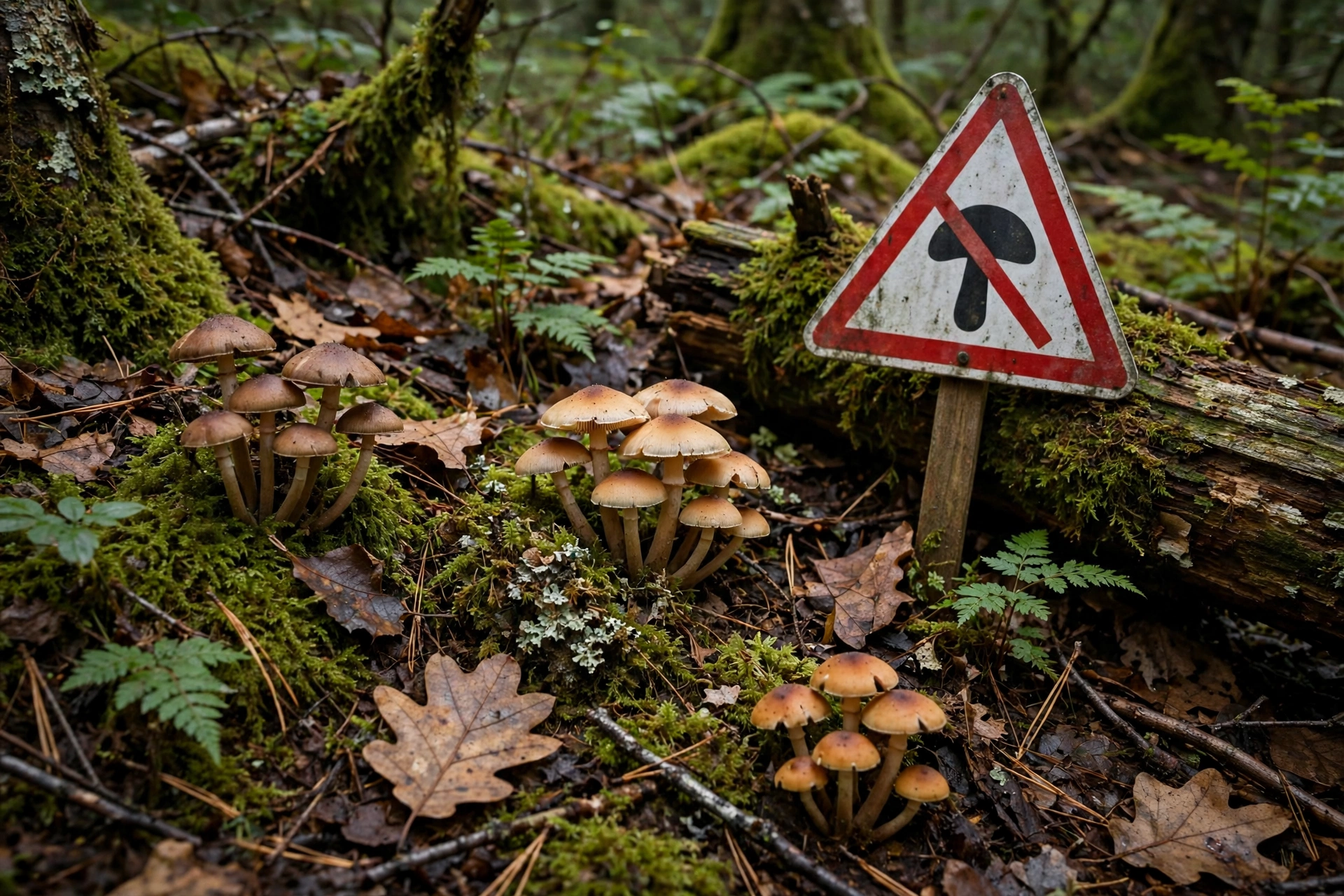
Mushrooms are fascinating, beautiful, and sometimes dangerous. A single walk in a park or woodland can reveal dozens of species, from tiny white buttons to large, colourful caps. It is natural to be curious, and photo identification tools make it easy to get a suggested name in seconds. That speed is useful for learning, but it is not safe for eating.
Mushrooms are fascinating, and that fascination can turn into overconfidence surprisingly fast. A mushroom that matches a photo online, or that an app names with apparent certainty, can feel identified — but a name on a screen is not the same as a mushroom identified by an expert holding the real fungus in their hands. With mushrooms, the gap between those two things can be the difference between a meal and a medical emergency.
Try it: Try the free Mushroom Identifier on aitreeidentier.site — use it only to learn about mushrooms you photograph, never as a reason to eat one.
Why Mushrooms Are Especially Risky
Unlike many plants, mushrooms can change quickly. Young and old specimens of the same species can look very different. Rain, sunlight, insects, and age can change colour, shape, and texture. Two species can grow side by side and look almost identical in a photo, yet one is edible and the other is poisonous.
Identification often depends on features a photo cannot show clearly, such as spore colour, smell, flesh texture, habitat, and microscopic details. An expert in the field will check several features together, look at the whole mushroom including the underground base, and consider the season and location. A single photo, however clear, rarely captures all of that. That is why even experienced foragers learn slowly, with local mentors, field guides, and many supervised outings before they ever eat a wild mushroom.
How to Observe Mushrooms Safely
You can enjoy mushrooms without picking or eating them. Follow these steps for safe observation.
Step 1: Look, do not taste. Admire mushrooms where they grow. Do not eat, lick, or taste any wild mushroom, even a tiny piece, to test it.
Step 2: Photograph from several angles. Take a photo of the cap from above, the gills or pores underneath, the stem from the side, and the base where it meets the ground. Include the surrounding trees, leaves, and soil for habitat clues. Use a coin or your hand nearby for scale, without touching the mushroom if you prefer not to.
Step 3: Note the habitat and season. Record the date, location type, nearby tree species, and whether the mushroom was growing on wood, soil, or dung. These details help an expert narrow down the species.
Step 4: Use an identification tool for learning only. Upload your photos to the Mushroom Identifier on aitreeidentier.site and read the suggestions as learning clues. Compare the suggested species with a trusted field guide and note where they differ.
Step 5: Ask a local expert before any use. If you want to learn more, join a local mycological society walk or ask a trained identifier. Do not eat a mushroom because an app, a friend, or a social media post said it was safe.
Step 6: Keep children and pets away from wild mushrooms. Teach children not to pick or eat wild mushrooms, and remove mushrooms from gardens where small children or pets play if you are unsure what they are. Wear gloves if you remove them.
Common Mistakes to Avoid
Eating a mushroom based on one app result. One photo match is not proof of edibility. Toxic lookalikes are the most common cause of serious mushroom poisoning.
Trusting a single feature. Colour alone, a common name, or a similar photo online is not enough. Safe identification uses many features together.
Assuming cooking makes it safe. Cooking does not make all toxic mushrooms safe. Some toxins survive heat, so never assume a poisonous species becomes edible after cooking.
Picking every mushroom you see. Picking can damage the organism and spread spores, and handling unknown mushrooms without washing your hands afterwards can transfer irritants. Observe first, and wash your hands after handling any wild mushroom.
Following social media foraging tips. Videos and posts often skip important checks, use different species in different regions, or show a mushroom out of context. Learn from local experts who know your area.
Why Photos and Apps Get Mushrooms Wrong
A photograph flattens a mushroom. It can hide the gills, the stem base, the ring, the spore colour, and the smell — the very features that separate an edible species from a toxic lookalike. Lighting changes colour, a young mushroom looks different from a mature one, and two species can look identical in a single photo while differing in a feature the camera never captured. An app that names a mushroom from one photo is therefore guessing from incomplete information, however confident it sounds.
Location adds another layer of error. Many apps are trained on species from one region and can suggest a familiar name for a mushroom that does not even grow in your area. A name that is correct in one country can belong to a different, toxic species in another. That is why mycologists insist on examining the actual mushroom, its habitat, and its microscopic features before they confirm an identification — and why a photo alone is never enough for an eating decision.
How Mycologists Actually Confirm a Mushroom
A careful mushroom identification is a slow process, and watching it is the best way to understand why shortcuts fail. An expert starts with the whole mushroom: cap, gills or pores, stem, ring, and the base, including whether it grows from a cup or a bulb underground. They note the habitat, the trees nearby, the season, and the smell, then they take a spore print by leaving the cap on paper overnight to see the colour of its spores.
For difficult species, they may look at spores under a microscope or check chemical reactions. Even then, they will often say that a mushroom is a probable match rather than a certainty, and they will never declare a wild mushroom safe to eat from a photo. If you want to learn, join a local fungus group and go on guided walks: you will see this process in person, handle mushrooms safely with guidance, and learn how much careful checking a real identification involves.
FAQ
Can an AI mushroom identifier tell me if a mushroom is edible? No. It can suggest a possible name for learning, but it cannot confirm edibility. Only a trained local expert who has examined the mushroom in person can give reliable advice, and even then eating wild mushrooms carries risk.
What if a mushroom looks exactly like an edible one I know? Do not eat it. Lookalikes can differ by a small detail that is easy to miss in a photo. Check the gills, stem base, ring, spore colour, habitat, and season, and ask a local expert.
Is it safe to touch a wild mushroom? Touching a mushroom for a photo is generally considered low risk for most people, but wash your hands afterwards and do not touch your face or mouth. Never taste it, and keep children from putting mushrooms in their mouths.
What should I do with mushrooms growing in my garden? Photograph them for learning, keep children and pets away, and remove them with gloves if they are in a play area. Dispose of them in a sealed bag in household waste, not in compost where pets or children might reach them.
Can I touch a wild mushroom safely? Touching a mushroom to photograph it is generally low risk if you wash your hands afterwards, but do not put your fingers in your mouth, and do not let children pick or taste wild mushrooms. The danger is in eating a toxic mushroom, not in briefly touching one — though some people are sensitive, so wash up after handling.
Conclusion
Mushrooms deserve respect, curiosity, and caution in equal measure. Use photos and identification tools to learn, enjoy their shapes and colours, and build your knowledge slowly with local experts. Never let speed or confidence replace careful checking. When it comes to eating, the safest mushroom is one you did not need to guess about.
Safety Disclaimer: Never eat or use a plant, mushroom, or fruit based on AI identification alone. AI results can be wrong, and toxic lookalikes are common. Always consult a local expert before touching, picking, or eating any wild mushroom. This article is general information only and is not medical advice.