
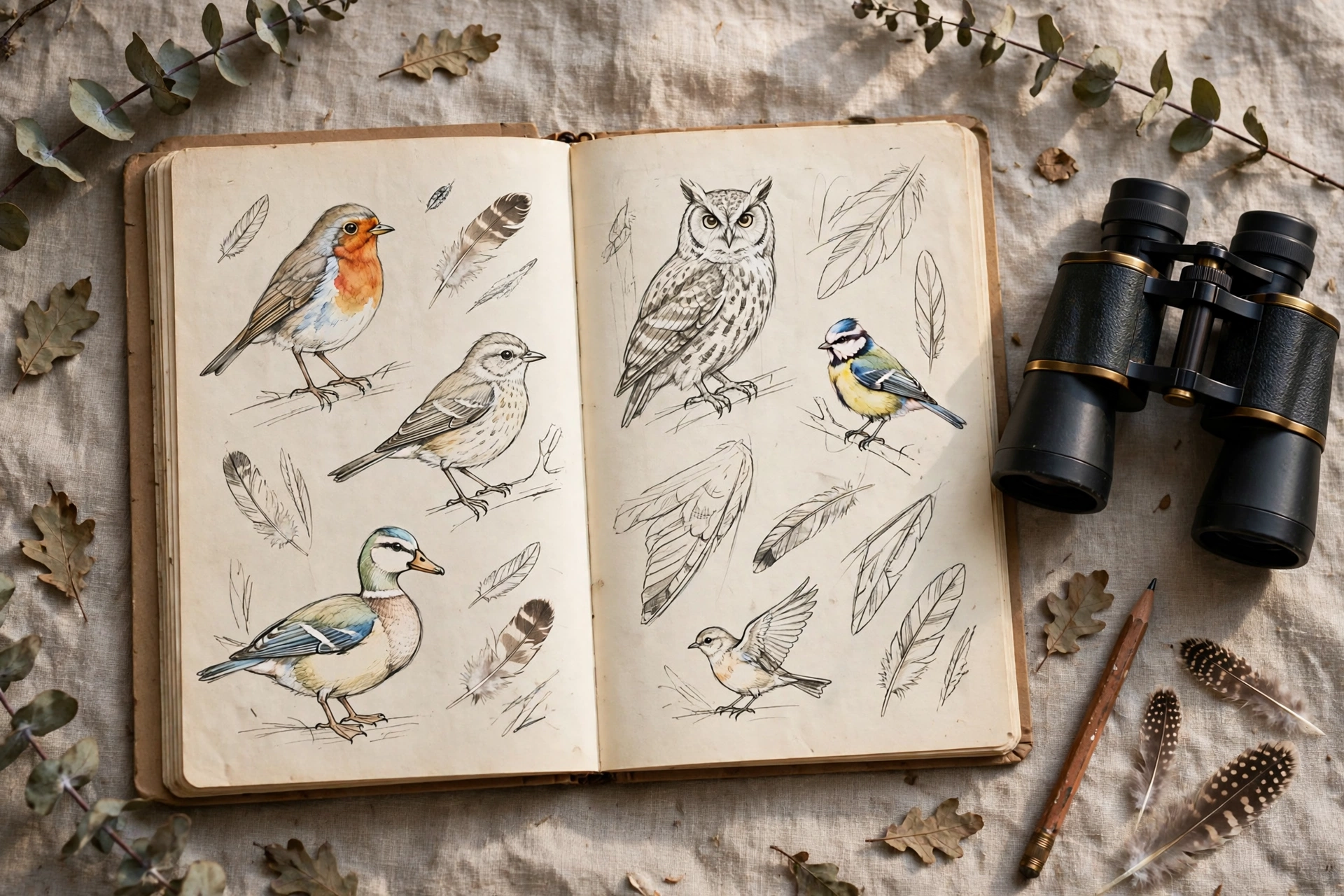
A bird watching journal is more than a list. It is a record of what you saw, where, when, and how — and a tool for learning. Writing down your observations forces you to notice details, helps you remember identifications, and lets you see patterns over weeks, months, and years. It also turns a casual walk into a small piece of citizen science, because your notes can contribute to local records if you choose to share them.
Introduction: A Journal Turns Sightings into Learning
You do not need to be an artist or a writer. A simple notebook, a few lines per outing, and a willingness to record honestly — including birds you were unsure about — is enough to start.
Many birdwatchers start a journal and give up after a week, because they try to write too much. The secret is to keep it short and to write it on the day. Five minutes after a walk, while the birds are still fresh in your mind, is worth more than an hour of writing a week later from a fading memory. A journal does not need to be beautiful or complete. It needs to be honest, regular, and useful to you. If you write three lines after every outing — the date, the place, and the birds you saw — you will have a record that is more valuable than a beautifully illustrated journal that you abandoned after a month. Start small, keep it regular, and let the habit grow.
What to Record on Every Outing
The Basics
For each outing, record the date, time, location, weather, and habitat. Those details matter, because they explain why you saw what you saw. A cold, windy day will be different from a calm, sunny morning. A wetland in winter will be different from the same site in summer. Without that context, a list of species is less useful later.
Then record each species you saw or heard, with numbers if you can estimate them, and a note on behaviour. Did the bird sing, feed, fly over, or perch? Was it alone or in a flock? Was it a first sighting for the year, or a regular visitor? Those notes help you learn and make your journal more interesting to read later.
Field Marks and Uncertainty
Record the field marks you used to identify a bird, especially for a new or difficult species. Write in plain words: "small brown bird, pale eyebrow, streaked breast, thin bill, feeding on ground under hedge." That description is useful if you later check the identification, and it helps you learn what to look for next time.
Be honest about uncertainty. Write "probable chiffchaff — heard song, not seen well" or "warbler sp. — brown, in reeds, not identified." That honesty is valuable, and it is better than a false certainty. Over time, you will see your uncertain records become fewer as your skills grow.
How to Keep a Journal That You Will Actually Use
Keep it simple and regular. A few lines per outing, written on the day, is better than a long entry written weeks later from memory. Use a consistent format — date, place, weather, species, notes — so you can find information later. Add a sketch if you like, even a rough one; drawing forces you to look closely at shape and pattern, and it helps you remember.
What Your Journal Gives You Over Time
Patterns, Progress, and Memories
After a few months, your journal will start to show patterns you could never have seen from memory alone. You will notice that the first chiffchaff arrives in the same week every spring, that goldfinches visit your garden more in autumn than in summer, and that a particular woodland is best in May and quiet in August. Those patterns are not just interesting — they help you plan your watching, so you visit the right place at the right time. After a year, you will have a record of your first full year of birdwatching, and you will be able to see how much you have learned: the birds you once found difficult will now be familiar, and the uncertain records will be fewer.
A journal also preserves memories that a list alone cannot. A note that says "watched a barn owl hunting over the field at dusk, with my daughter" will bring back the whole evening years later, long after you have forgotten the date. A sketch of a bird you saw on holiday, a pressed leaf from a walk, or a note about the weather on a memorable day — all of these turn a journal from a record into a keepsake. And if you choose to share your records with a local bird group or a citizen science project, your journal becomes something more: a small contribution to our understanding of bird populations, migration, and change over time. Your notes, however modest, are part of a much larger picture.
A Simple Template to Start
Date / Time / Location / Weather / Habitat: Species seen or heard: (with numbers and behaviour notes) New or notable birds: (first of year, unusual, or difficult identification) Field marks noted: (for new or difficult species) Questions to check later: (songs, lookalikes, or uncertain birds) Other notes: (other wildlife, people, or memorable moments)
Use this template for a few outings, then adapt it to what works for you. The best journal is the one you will keep using.
Common Mistakes
The most common mistake is trying to record too much and giving up. Keep it short and simple, especially at first. Another mistake is only recording rarities and ignoring common birds — common birds are the foundation of your learning, and their patterns matter too. A third mistake is writing notes days later from memory, when details have faded. Write on the day, even if it is brief. Finally, do not be discouraged by gaps. A journal with some missed days is still far more useful than no journal at all.
FAQ
Do I need to be good at drawing to keep a journal? No. Rough sketches, written descriptions, and photos are all useful. Drawing helps you observe, but it does not need to be artistic.
Should I use paper or an app? Use whichever you will use regularly. Paper is simple and reliable in the field; an app makes it easier to search and share. Many people use both.
What if I cannot identify a bird? Record it as uncertain, with a description, date, and location. Check it later with a guide or tool, and update your journal if you confirm it.
Can my journal help conservation? Yes, if you choose to share your records with a local bird group or a citizen science project. Your notes can contribute to understanding bird populations over time.
How often should I write in my journal? After every outing, even if it is only a few lines. A short entry written on the day is far more useful than a long entry written a week later. If you watch birds every day, a few lines each day is enough; if you watch once a week, a longer entry for that one outing is fine.
What should I do with old journals? Keep them. Old journals are a record of your learning and of the birds you saw in years gone by, and they become more valuable with time. If you move to an app, keep the paper journals as well — they are a personal history that no app can replace.
Conclusion
Keeping a bird watching journal is a simple habit that makes you a better birdwatcher. Record date, place, weather, species, behaviour, and field marks, be honest about uncertainty, and write on the day. Over time, your journal will reveal patterns, track your progress, and preserve memories of your walks. Start small, keep it regular, and let your journal grow with you — one outing at a time.
Try the free Bird Identifier on aitreeidentier.site — upload a clear photo of the bird for instant guidance.
Safety disclaimer: Never disturb nests or wildlife. Observe from a distance, keep sensitive locations private in your notes, and consult a local expert if you are unsure about a species or a sensitive site.