
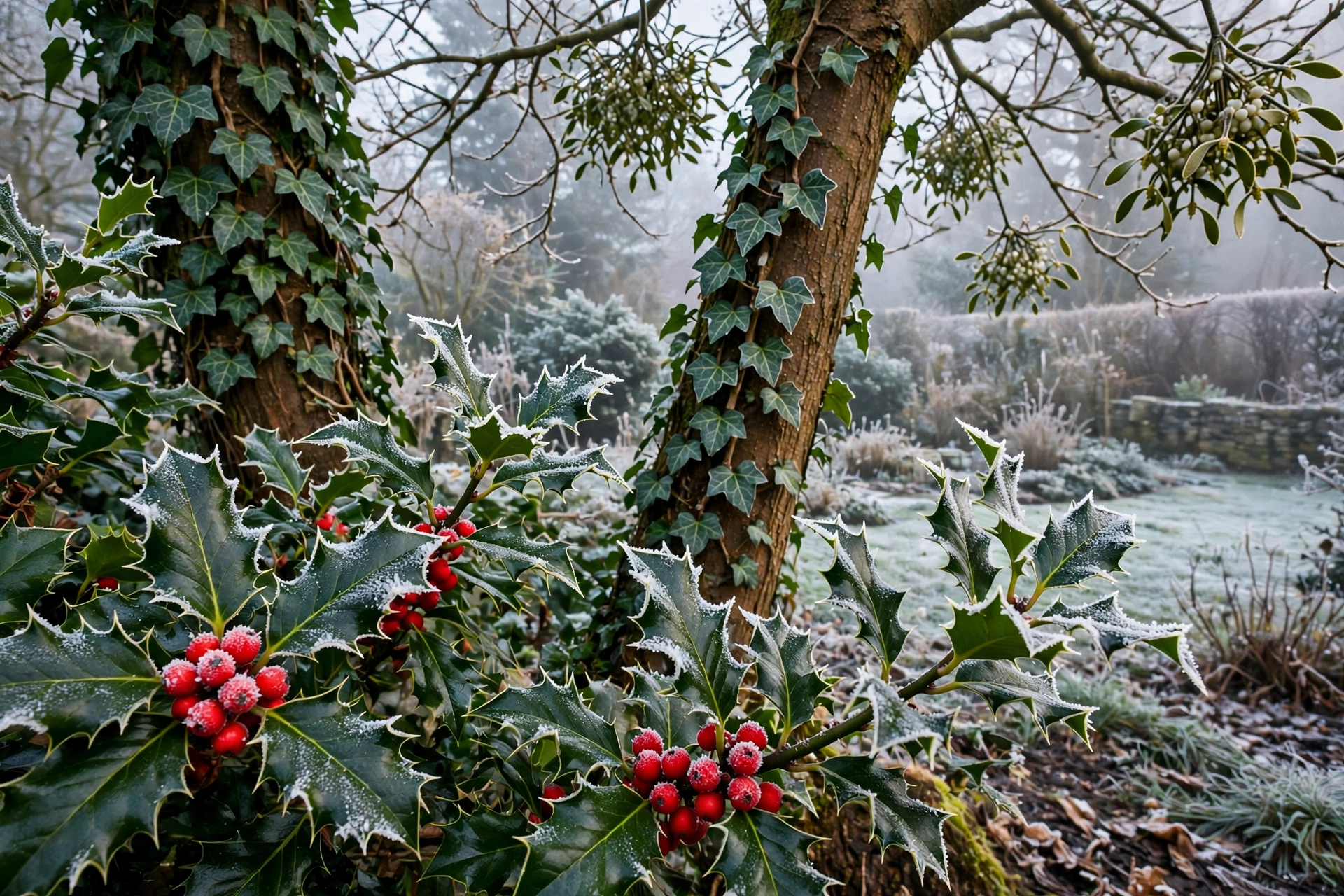
Holly, ivy, and mistletoe are the three plants most people associate with winter. They appear on Christmas cards, in carols, and in festive decorations, yet many people struggle to tell them apart in the wild, or to recognise them outside the festive season. Each has its own distinctive leaves, growth habit, and habitat, and once you know what to look for, all three are easy to identify in any month of the year.
This guide explains how to identify holly, ivy, and mistletoe by their leaves, stems, and growth habits, where to find them, and how to tell them apart from the plants they are most often confused with. It focuses on identification, not on folklore, although a little of the history of these plants is too interesting to leave out entirely.
Holly: The Spiky Evergreen
Holly is a small evergreen tree or large shrub, and its leaves are unmistakable. They are dark green, glossy, and leathery, with a wavy edge armed with sharp spines. The spines are a defence against grazing animals, and they are fiercest on the lower branches, within reach of deer and rabbits. Higher up, out of reach, the leaves are often much smoother, with few spines or none at all. This is a useful identification clue: if you find a holly with smooth upper leaves and spiky lower leaves, you have found the same tree.
The bark of holly is smooth and grey, becoming slightly rough with age, and the tree often grows in a neat, conical shape. Female holly trees produce the famous bright red berries in autumn, which last through winter, but only if a male tree grows nearby to provide pollen. Male trees never bear berries, which is why some hollies seem bare while others are covered in red fruit. The berries are mildly toxic to people, so they should be admired and left alone.
Holly is often confused with the holm oak, which also has spiny evergreen leaves. The difference is in the leaf arrangement: holly leaves grow alternately along the stem, one at a time, while holm oak leaves are more variable and the tree produces acorns. Holly also has no acorns, and its berries, when present, settle the question at once.
Ivy: The Climbing Evergreen
Ivy is one of the most common plants in Britain and Ireland, and it is also one of the most misunderstood. It is an evergreen climber that uses small, root-like holdfasts to cling to trees, walls, and fences. It does not strangle trees or steal their food, despite what many people believe. The holdfasts grip the surface but do not penetrate the bark, and ivy makes its own food through photosynthesis. It can add weight to a tree, and it can hide structural problems, but a healthy tree is not harmed by ivy.
Ivy leaves are the key to identification, and they come in two distinct shapes. The leaves on climbing stems are lobed, with three to five pointed lobes, and they are dark green with paler veins. The leaves on mature, flowering stems are quite different: they are oval or diamond-shaped, with no lobes at all. This change is so dramatic that beginners often think they are looking at two different plants. Ivy flowers appear in autumn, in small, round, greenish-yellow clusters, and the berries that follow are black and ripen in late winter and spring.
Ivy berries are an important food for birds, but they are poisonous to people and pets. The sap can also irritate the skin, so wear gloves when handling it. Ivy is sometimes confused with Virginia creeper, but Virginia creeper is deciduous, loses its leaves in winter, and turns brilliant red in autumn, while ivy stays green all year round.
Mistletoe: The Tree-Top Parasite
Mistletoe is the hardest of the three to find, because it grows high in the branches of host trees and is easy to overlook until the leaves fall. It is a semi-parasitic plant, which means it takes water and minerals from its host tree but also makes some of its own food through photosynthesis. It does not usually kill its host, though a heavy infestation can weaken a tree over many years.
The leaves of mistletoe are pale green, oval, and leathery, growing in pairs along forked, yellowish-green stems. The plant forms a round, dense ball, sometimes more than a metre across, that hangs from a branch like a green football. In winter, when the host tree is bare, these balls stand out clearly, and they are the easiest way to spot mistletoe from the ground. The berries are white, translucent, and slightly sticky, ripening in winter. They are poisonous to people, though birds, especially mistle thrushes, eat them and spread the seeds to new trees.
Mistletoe grows most often on apple trees, hawthorn, lime, and poplar, and it is rarely found on oak, despite the popular legend. In Britain, it is most common in the west and south, particularly in the apple orchards of Herefordshire, Worcestershire, and Somerset. If you want to find it, look up into old orchards and hedgerow trees on a bright winter day, when the green balls are easy to pick out against the sky.
How to Tell Them Apart
Despite their shared festive reputation, holly, ivy, and mistletoe look very different once you know what to look for. Holly is a free-standing tree or shrub with spiky, glossy leaves and red berries. Ivy is a climber with lobed leaves that clings to trees and walls, and its berries are black. Mistletoe is a ball of pale green, oval leaves growing in the branches of a host tree, with white berries.
Habitat is another useful clue. Holly grows in woodland, hedgerows, and gardens, often as an understorey shrub beneath taller trees. Ivy grows almost anywhere: on the ground, up trees, and over walls and fences. Mistletoe grows only in the canopy of host trees, never on the ground and never on walls. If the plant is on the ground or climbing a wall, it is not mistletoe. If it is a free-standing tree with spiky leaves, it is not ivy. Working through these simple questions will usually give you the answer.
Winter Identification Tips
Winter is actually a good time to identify all three plants, because the deciduous trees around them have lost their leaves. Holly and ivy are evergreen, so their dark green leaves stand out against bare branches and grey winter light. Mistletoe is easiest to spot in winter too, because its green balls are fully exposed once the host tree's leaves have fallen.
Take photographs of the whole plant as well as close-ups of the leaves. Note the growth habit: is it a tree, a climber, or a ball in the branches? Look at the bark, the stem colour, and the arrangement of the leaves. Check for berries and note their colour. With practice, you will be able to identify all three at a glance, even from a distance, and you will start to notice them everywhere: in woodlands, hedgerows, gardens, and churchyards.
Frequently Asked Questions
Is ivy harmful to trees? Ivy is not a parasite and does not steal food from its host tree. It uses the tree for support and makes its own food. It can add weight and hide damage, so very old or weakened trees should be checked, but a healthy tree is not harmed by ivy.
Are holly berries and mistletoe berries poisonous? Yes, both are mildly to moderately toxic to people and pets. Holly berries can cause stomach upset, and mistletoe berries are also poisonous. Enjoy them with your eyes and keep them away from children and dogs.
Can I grow mistletoe in my garden? Yes, but it takes patience. Fresh mistletoe berries must be smeared onto the bark of a suitable host tree, such as an apple tree, in spring. Germination is slow, and it can take several years before the plant is visible. Most gardeners find it easier to admire wild mistletoe.
Conclusion
Holly, ivy, and mistletoe are three of the most familiar plants of winter, and they are also three of the most rewarding to learn to identify. Each has its own character: holly, the spiky evergreen tree with its red berries; ivy, the adaptable climber with its two very different leaf shapes; and mistletoe, the mysterious green ball high in the branches of its host tree.
Learning to tell them apart is a matter of looking closely at leaves, growth habit, and habitat, and winter is the perfect season to practise, when the evergreen leaves and pale green balls stand out against bare branches. Take your time, take photographs, and enjoy the search. If you find a plant you cannot quite place this winter, Try the plant identifier at aitreeidentier.site to identify it from a photo and learn more about the plants growing around you.