
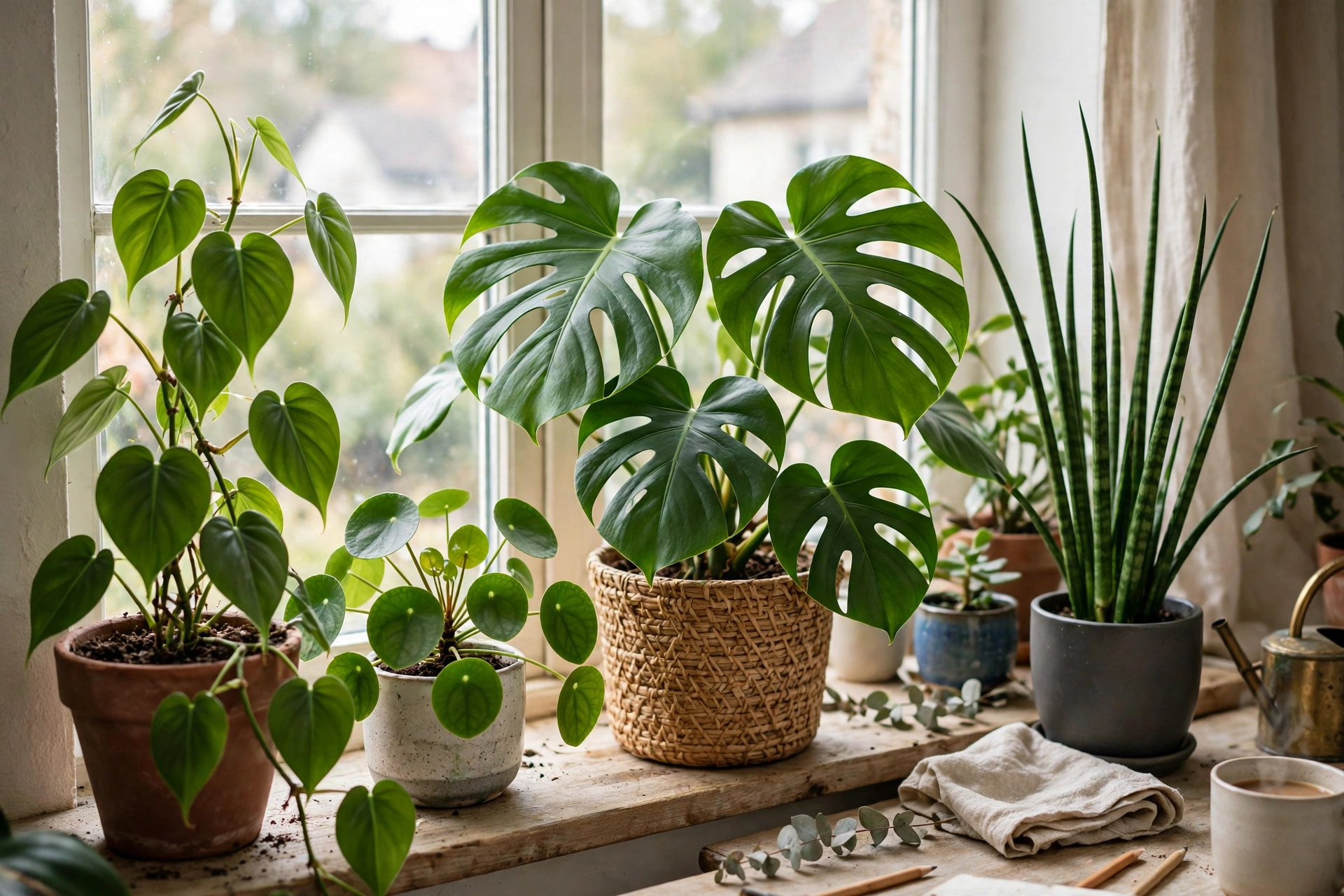
Walk into any plant shop and you will see dozens of houseplants that look completely different from one another: glossy heart-shaped leaves, long strappy blades, round coins of green, and dramatic split leaves the size of dinner plates. Those shapes are not decoration. A leaf's shape tells you a great deal about where the plant comes from, how much light and water it needs, and how to keep it alive. Learning to read leaf shape is one of the quickest ways to identify a houseplant and to give it the care it actually wants.
Many houseplants arrive without a label, or with a name that means little to a beginner. Yet if you can describe the leaf, you are most of the way to identifying the plant. Is it thick and fleshy, thin and papery, or leathery and dark? Are the edges smooth, wavy or toothed? Does it grow on a trailing stem, an upright stalk, or in a rosette close to the soil? Each of these clues narrows the possibilities, and together with the plant's size and growth habit they usually point to a clear answer. This guide explains how to use leaf shape to identify common houseplants and match each one to the right care.
Why Leaf Shape Matters
Leaves are shaped by the environment a plant evolved in. In the dim light of a tropical forest floor, plants often grow large, broad leaves to catch every scrap of light, while plants from hot, dry places grow thick, fleshy leaves that store water. Plants from windy or exposed habitats may have narrow or deeply divided leaves that let the wind pass through without tearing them. When you bring a plant indoors, those same shapes still reveal what it needs: broad, thin leaves generally mean the plant likes humidity and indirect light, while thick, waxy leaves suggest it can cope with dry air and bright sun.
Broad, Heart-Shaped and Round Leaves
Some of the most popular houseplants have broad, heart-shaped or round leaves, and they are often the easiest to recognise. The philodendron, with its glossy heart-shaped leaves on trailing or climbing stems, is a classic. It likes bright, indirect light and watering when the top few centimetres of soil have dried out. Its cousin, the pothos, has similar heart-shaped leaves, often marbled with cream or gold, and trails beautifully from a shelf or hanging basket. Pothos is one of the most forgiving houseplants, tolerating lower light and occasional forgotten waterings.
Round-leaved plants include the pilea, often called the Chinese money plant, whose flat, coin-shaped leaves sit on long stalks, and the peperomia, whose small, thick, round leaves come in green, silver or variegated forms. Pilea likes bright, indirect light and regular watering, and it produces baby plants around its base that you can pot up and share. Peperomia prefers to dry out between waterings, since its thick leaves store water, and it dislikes being overwatered more than almost anything else.
Another broad-leaf favourite is the calathea, whose large, patterned leaves often have purple undersides and striking markings in green, pink and cream. Calatheas are fussier than most: they need humidity, soft water if possible, and protection from direct sun, which can bleach their patterns. Their leaves fold upwards at night, a movement that gives them the nickname prayer plants, shared with their close relative the maranta.
Long, Narrow and Strappy Leaves
Long, narrow leaves usually belong to plants that come from brighter, drier or more exposed places. The snake plant, or sansevieria, is the best-known example: upright, sword-like leaves in green and yellow that store water and tolerate neglect. It is happy in low light and needs watering only every few weeks, making it ideal for beginners and for rooms that other plants would hate. Its only real enemy is overwatering, which rots the roots.
The spider plant also has long, arching, strappy leaves, often striped with white or cream, and it produces trailing plantlets on long stems that look like spiders on a thread. It likes bright, indirect light and regular watering, and it is famously good at producing new plants you can pot on. The dracaena family, with their long, pointed leaves on woody stems, includes the dragon tree and the corn plant, both of which suit bright rooms and dislike soggy compost.
Split, Lobed and Unusual Leaves
Some houseplants are instantly recognisable by leaves that look as though they have been cut, torn or folded. The monstera deliciosa is the most famous: huge, glossy leaves with deep splits and oval holes, known as fenestrations. It is a climber in the wild, so it appreciates a moss pole or trellis to climb, bright indirect light, and watering when the top of the soil dries. Wipe its big leaves occasionally so dust does not block the light.
The fiddle-leaf fig has large, leathery, violin-shaped leaves on a single upright stem and has become a favourite statement plant. It is more demanding than its popularity suggests: it wants a stable spot with bright, indirect light, consistent watering and no draughts, and it dislikes being moved. Brown spots often signal overwatering or inconsistent watering rather than disease.
Thick, Fleshy Leaves: The Succulents
Thick, fleshy leaves are the signature of succulents, plants that store water in their leaves to survive dry spells. Jade plants, with their plump, oval, dark green leaves on woody stems, are among the easiest succulents to keep indoors. They need bright light, ideally some direct sun, and watering only when the soil is thoroughly dry. The same goes for echeveria, whose leaves form neat rosettes in shades of green, blue and pink, and for aloe vera, whose thick, spiky leaves contain a soothing gel.
Matching Care to Leaf Type
Once you can read a leaf, you can make a good guess at a plant's care needs. Thin, soft, large leaves generally mean the plant likes humidity and regular water, and it will suffer in dry, centrally heated air. Thick, waxy or fleshy leaves mean the plant stores water and prefers to dry out between waterings. Dark green leaves often tolerate lower light, while variegated leaves, with their white or cream patches, need brighter light to keep their colour, since the pale areas cannot photosynthesise.
Common Identification Mistakes
The most frequent mistake is confusing plants with similar leaves. Pothos and philodendron are often mixed up, but pothos leaves are usually thicker and more variegated, with a waxy feel, while philodendron leaves are thinner, softer and more uniformly green, with a more pronounced heart shape and a longer leaf stalk. Snake plants and aloe vera are sometimes confused when young, but snake plant leaves are flat and upright, while aloe leaves are thick, curved and toothed along the edges.
Finally, do not rely on leaf shape alone. Check the stem, the growth habit and the way the leaves are arranged. Are they opposite each other on the stem, or alternating? Do they grow from a central crown or along a trailing vine? Taking a clear photograph of the whole plant as well as a close-up of a leaf will make identification far more reliable, especially if you use an identification tool to confirm your guess.
Frequently Asked Questions
Can I identify a houseplant from a single leaf? Often, yes, especially for distinctive plants like monstera, pilea or snake plant, but a single leaf is not always enough. A photograph showing the whole plant, the stem and the arrangement of the leaves gives a much more reliable identification than a leaf alone.
Why are my houseplant's new leaves smaller than the old ones? Smaller new leaves usually mean the plant is not getting enough light, or it has outgrown its pot and needs feeding or repotting. Move it to a brighter spot, check that the roots are not crowded, and feed it lightly during the growing season.
How often should I water houseplants with thick, fleshy leaves? Much less often than leafy plants. Let the compost dry out completely between waterings, then water thoroughly and allow the excess to drain away. In winter, many succulents need watering only once a month or even less.
Conclusion
Leaf shape is a practical, everyday tool for identifying houseplants and understanding what they need. Broad, thin leaves point to humidity and shade; thick, fleshy leaves point to drought tolerance and bright light; long, strappy leaves often belong to tough, forgiving plants. By learning to look closely at the leaves in front of you, feeling their texture and noting how they grow, you will soon be able to name the plants in your home and give each one the light, water and care it truly needs. A plant that is correctly identified is a plant that is far more likely to thrive.
Not sure what the plant on your windowsill is? Try the plant identifier at aitreeidentier.site and identify it from a photo in seconds.