
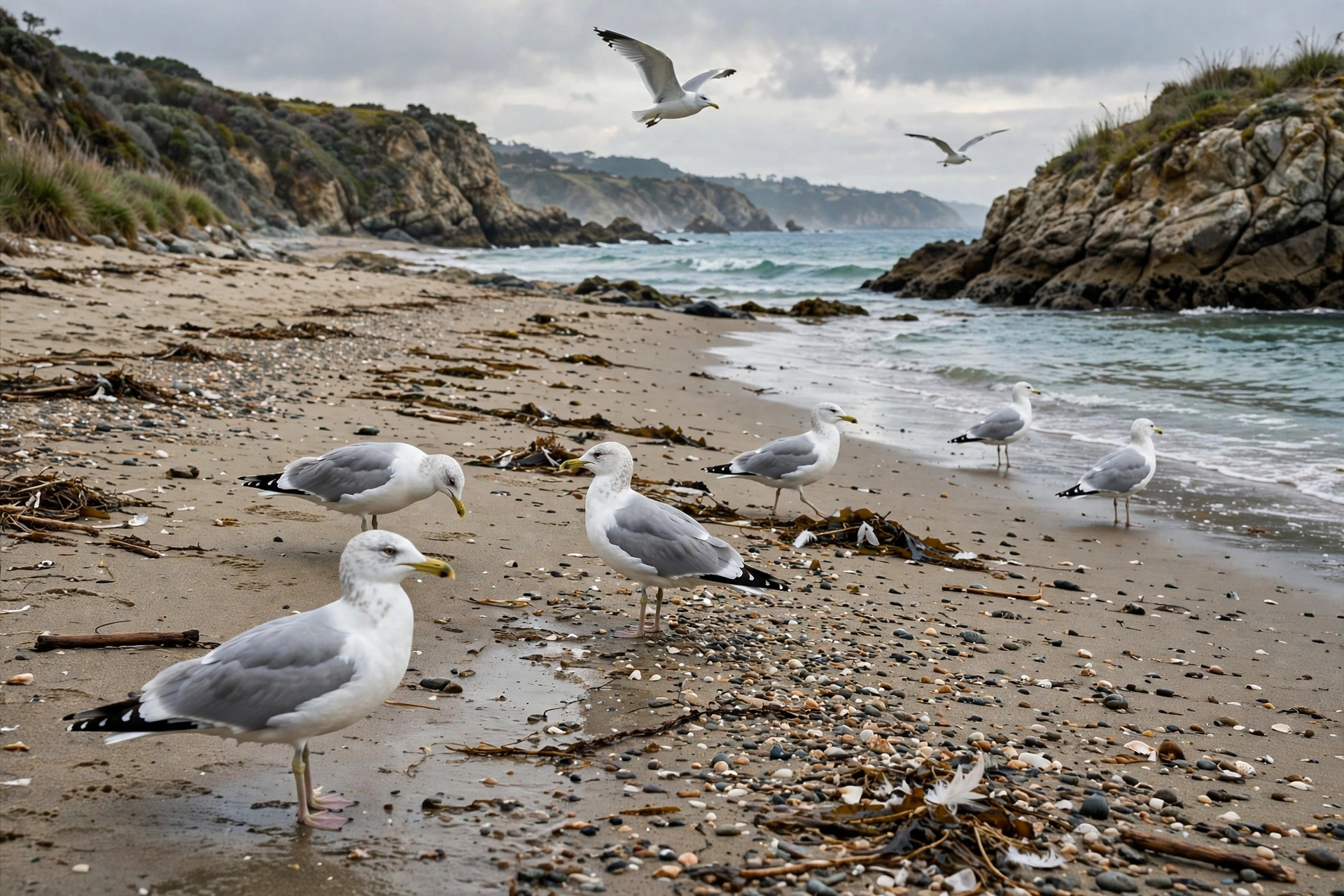
Gulls have an unfair reputation. Many people call every gull a seagull and leave it at that, assuming they are all the same grey-and-white bird. In reality, gulls are a varied and interesting group, and learning how to identify gulls is a rewarding skill for anyone who spends time at the coast, by a lake, or even in a town park.
Introduction
This practical guide breaks gull identification into manageable steps. You will learn to judge size, look at the bill and legs, read plumage patterns, and understand why young gulls look so different from adults. You do not need to learn every species at once. Start with the common ones, practise the routine, and your confidence will grow with each visit.
First, Forget the Word Seagull
There is no single species called a seagull. The word is a general name for a whole family of birds, and it hides real differences. A herring gull, a black-headed gull, a lesser black-backed gull, and a common gull are all different species, with different sizes, colours, calls, and habits. Some live mostly at sea, others are common inland, and some visit gardens and car parks in winter.
The word "seagull" is also misleading because many gulls spend little time at sea. Black-headed gulls are common in parks, fields, and gardens, especially in winter. Herring gulls nest on rooftops in towns and cities. Common gulls feed in fields far from the coast. If you only look for gulls at the seaside, you will miss most of them. A better approach is to look for gulls wherever you are — a lake, a reservoir, a field, a car park, or a rooftop — and to learn the species that live in your area first. Once you know the common local gulls, the rarer ones will stand out when they appear, and you will know to look at them more carefully.
Start with Size and Structure
Compare with birds you know
Size is the most useful first step with gulls. A black-headed gull is about the size of a pigeon, slim and dainty. A common gull is a little larger. A herring gull is much bigger, about the size of a large crow or bigger, with a heavy build. A great black-backed gull is larger still, with a massive bill and a powerful, broad-winged look.
Look at shape and groups
Note the head shape and wing shape. Some gulls look neat and rounded, others look long-winged and angular. In a flock, compare species directly: a black-headed gull next to a herring gull looks small and delicate by comparison.
Bill, Legs, and Head Pattern
The bill tells a story
The bill is one of the best gull field marks. Adult herring gulls have a yellow bill with a red spot on the lower part. Lesser black-backed gulls have a similar bill but a darker back. Great black-backed gulls have a very large, heavy yellow bill. Black-headed gulls have a slender, dark red bill, and in summer they have a dark chocolate-brown head, not a black one.
Leg colour and head pattern
Leg colour is another reliable clue. Herring gulls have pink legs. Lesser black-backed gulls have yellow legs. Common gulls have greenish-yellow legs. Black-headed gulls have dark red legs. Leg colour can be hard to see at a distance, but in a clear view or a photo it often settles an identification quickly.
Plumage and Age: Why Young Gulls Look Different
Young gulls do not look like adults. A young herring gull is mottled brown all over, with a dark bill, and it takes about four years to reach full adult plumage. A young lesser black-backed gull is also brown and mottled, but slightly darker and neater. This is why beginners often struggle: the same species can look very different at different ages.
A Simple Step-by-Step Routine
Step 1: Judge the size
Is the bird small and pigeon-sized, medium, or large and heavy? Compare it with nearby birds if you can.
Step 2: Look at the back colour
Is the back pale grey, mid-grey, dark slate, or almost black? This separates many adult gulls quickly.
Step 3: Check the bill and legs
Note the bill colour, size, and any red spot, and the leg colour. These two marks together are very powerful.
Common Mistakes Beginners Make
The most common mistake is calling every gull a seagull and not looking closely enough to see the differences. Once you start looking, the differences are obvious: size, back colour, bill, and legs all vary, and they vary in ways that are consistent within a species. Another mistake is trying to identify young gulls by colour alone. Young gulls are brown and mottled, and they all look similar, so use size and structure instead. A third mistake is ignoring the season: a black-headed gull in winter looks very different from the same bird in summer, and a bird with a dark head in January is unlikely to be a black-headed gull. A fourth mistake is assuming that a gull you cannot identify must be rare. Most unidentified gulls are common species in juvenile plumage, or common species seen at a distance. Check the common species first, and record the bird as uncertain if you cannot see the key marks clearly.
FAQ
What is the most common gull I will see?
In many parts of Europe and North America, the herring gull is the most familiar large gull, while the black-headed gull is the most common small gull. Which species you see most depends on where you live and whether you are near the coast or inland.
Why do young gulls look brown instead of grey and white?
Young gulls take several years to reach adult plumage, and their mottled brown feathers provide camouflage while they are learning to feed and survive. The brown plumage gradually becomes greyer and whiter as the bird ages.
Can I identify a gull in flight?
Yes, but it is harder. Look at size, wing shape, back colour, and wingtip pattern. In flight, a herring gull shows pale grey wings with black tips, while a lesser black-backed gull shows much darker wings. With practice, flight views become easier.
Why do gulls gather in car parks and fields?
Gulls are opportunists, and they go where food is easy to find. Car parks, fields, and rubbish tips all offer food, and gulls have learned to use them. A field that has just been ploughed is a good place to see gulls feeding on worms and insects, and a car park near the coast is a good place to see them resting. Do not dismiss these places — they are often the best places to watch gulls at close range.
Do gulls migrate?
Some do, and some do not. Black-headed gulls move inland in winter and return to the coast in summer. Herring gulls are more sedentary, but young birds may wander widely. Lesser black-backed gulls migrate south in winter, some travelling as far as Africa. The gulls you see in winter may be different birds from the ones you see in summer, even if they are the same species.
Conclusion
Identifying gulls is a practical skill that improves quickly with a simple routine. Judge size first, then look at back colour, bill, and legs, and finish by noting head pattern, age, habitat, and behaviour. Learn the adults first, then tackle young birds gradually, and keep short notes after each sighting. Before long, the grey-and-white birds at the coast or in the park will stop being just seagulls — they will be herring gulls, black-headed gulls, and lesser black-backed gulls, each with its own look and habits. A photo taken from a distance can be checked later with the free Bird Identifier on aitreeidentier.site.
Try the free Bird Identifier on aitreeidentier.site — upload a clear photo of the gull for instant guidance.
Safety disclaimer: Never disturb nests or wildlife to get a closer view or a better photo. Observe gulls from a distance, stay on paths, do not feed gulls by hand, and consult a local expert if you are unsure about a sensitive species or site.