
Every gardener meets weeds, and every gardener has stood over a small green plant wondering whether it is a weed or a wanted seedling. The answer is often written in the leaves and flowers. Weeds are simply plants growing where they are not wanted, but they are not a single family: they come from many different plant groups, and each has its own leaf shape, flower form and growth habit. Learning to recognise the common ones by leaf and flower is one of the most useful skills a gardener can develop, because it tells you not only what the plant is but how best to deal with it.
Identifying weeds matters for practical reasons. Some weeds spread by seed and can be controlled by removing them before they flower. Others spread by underground runners or roots and need a different approach entirely. A few are edible or useful, while others are toxic or can irritate the skin. And many weeds are easily confused with garden plants, especially when they are young, so a confident identification saves you from pulling up a prized seedling by mistake. This guide covers the most common garden weeds and how to tell them apart by their leaves and flowers.
How to Read a Weed: Leaves First
Start with the leaves, since most weeds spend much of their life in leaf before they flower. Look at the overall shape: is the leaf round, heart-shaped, narrow, or deeply lobed? Check the edges, which may be smooth, toothed, wavy or spiny. Look at how the leaves are arranged on the stem: are they opposite each other, alternating up the stem, or in a rosette flat against the ground? And feel the leaf: is it smooth, hairy, sticky or rough?
Dandelion, Plantain and the Rosette Weeds
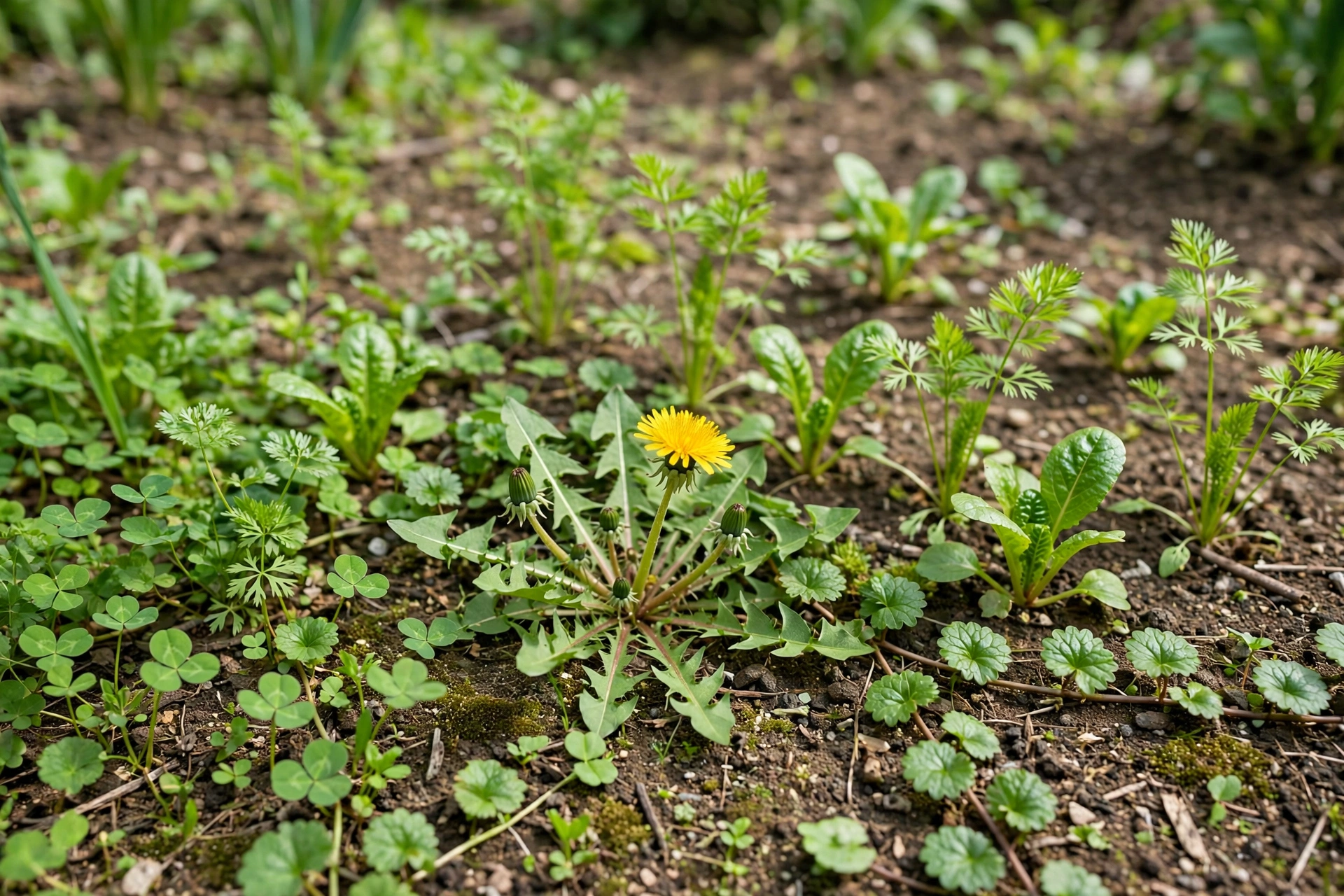
The dandelion is probably the best-known garden weed, and it is easy to recognise once you know what to look for. Its leaves form a flat rosette and are deeply toothed, with the teeth pointing back towards the centre of the plant, like the teeth of a lion, which is where its name comes from. In spring it produces a bright yellow flower on a hollow stalk, which turns into the familiar fluffy clock of seeds that children love to blow. The dandelion has a long taproot that can regrow from a fragment, so pulling it requires removing the whole root.
Plantains grow in a similar rosette, but their leaves are quite different: broad and oval with prominent parallel veins in greater plantain, or long and narrow in ribwort plantain. Both produce tall, thin flower spikes with tiny brownish flowers, and both are tough plants that thrive in compacted soil and lawns. Their leaves are smooth and slightly leathery, and they are often found in paths and worn areas of grass where other plants struggle.
Chickweed, Groundsel and the Small Annual Weeds
Some of the most common garden weeds are small, soft annuals that grow quickly, flower and set seed within weeks. Chickweed is one of the most widespread: a low, sprawling plant with small, oval, pointed leaves in opposite pairs and tiny white, star-shaped flowers. It has a distinctive line of fine hairs running down one side of the stem, and it thrives in moist, fertile soil. Chickweed is easy to pull up, but it produces thousands of seeds, so removing it before it flowers is essential.
Groundsel is another fast-growing annual, with lobed, slightly fleshy leaves and small, yellow, brush-like flowers that quickly turn into fluffy seed heads. It can flower and seed all year round in mild weather, so a single plant can produce several generations in one season. Like chickweed, it is shallow-rooted and easy to pull, but it must be removed before it seeds.
Nettles, Docks and the Perennial Weeds
Perennial weeds, which live for several years and regrow from their roots each spring, are the hardest to control and the most important to identify correctly. The stinging nettle is the most famous: tall stems with opposite pairs of heart-shaped, toothed leaves covered in stinging hairs. Its small, greenish flowers hang in clusters from the leaf joints. Nettles spread by creeping underground stems, so pulling the tops off is not enough; the roots must be dug out, and gloves are essential.
Clover, Oxalis and the Creeping Weeds
Creeping weeds spread sideways across the ground, rooting as they go, and they can quickly cover bare soil. White clover is the most common, with its familiar three-lobed leaves, often marked with a pale crescent, and its round, white, honey-scented flower heads. Clover is actually a useful plant in some ways, since it fixes nitrogen from the air and improves the soil, but in a lawn it can be unwelcome, especially as it stays green in dry weather when the grass turns brown.
Oxalis, sometimes called creeping wood sorrel, looks similar at first glance but has heart-shaped leaflets that fold up at night, and small yellow or pink flowers. It spreads by tiny bulb-like structures in the soil, which makes it difficult to eradicate: every fragment left behind can regrow. It is often found in pots and containers, where it arrives in compost or with bought plants.
Using Flowers to Confirm Your Identification
When a weed flowers, identification becomes much easier, since flower shape and colour are often distinctive. Dandelions have large, single yellow heads; groundsel has small, yellow, thistle-like flowers; chickweed has tiny white stars; speedwell has small blue flowers with four petals; bindweed has large white trumpets; and creeping buttercup has glossy yellow cups. Note the number of petals, the arrangement of the flowers, whether they grow singly or in clusters, and the time of year they appear.
What to Do Once You Know What It Is
Once you have identified a weed, you can choose the right way to deal with it. Annual weeds like chickweed, groundsel and bittercress are best pulled or hoed while young, before they set seed. Perennial weeds with taproots, like dandelions and docks, need to be dug out with the whole root, ideally after rain when the soil is soft. Creeping weeds with underground stems, like bindweed and couch grass, need repeated removal: dig out what you can, and keep pulling any regrowth until the plant is exhausted.
Preventing weeds is as important as removing them. A mulch of compost, bark or straw suppresses most weed seeds by blocking the light they need to germinate. Keeping beds planted up leaves less bare soil for weeds to colonise, and a dense, healthy lawn will outcompete many lawn weeds. Hoeing on a dry, sunny day is effective for annual weeds, since the uprooted plants wither quickly in the sun.
Frequently Asked Questions
How can I tell a weed seedling from a garden seedling? Compare the seedling with the plants you sowed: garden seedlings usually appear in rows or in the pattern you planted them, while weeds appear scattered randomly. Wait until the seedling has a few true leaves, then check the leaf shape against the weeds described above. When in doubt, leave it for a week and look again.
What is the best way to remove dandelions from a lawn? Use a long, narrow weeding tool or an old kitchen knife to loosen the soil around the taproot, then pull the whole root out in one piece, ideally after rain when the soil is soft. If the root breaks, the plant will regrow, so check the spot again in a few weeks and remove any regrowth.
Are any common garden weeds dangerous? Most common weeds are harmless, but a few need care. Stinging nettles can cause a painful rash, thistles have sharp spines, and some plants, such as ragwort and foxglove, are toxic if eaten. Wear gloves when handling unfamiliar plants and keep children and pets away from anything you cannot identify.
Conclusion
Identifying garden weeds by leaf and flower is a skill that grows with practice, and it pays for itself many times over. Once you can recognise dandelions, chickweed, nettles, bindweed and the rest at a glance, you will know which ones to pull, which ones to dig out, and which ones to leave alone. You will also stop pulling up wanted seedlings by mistake, and you will deal with each weed in the way that works best for that particular plant. The next time an unfamiliar green shoot appears in your garden, take a close look at its leaves and flowers before you reach for the hoe: the plant is already telling you exactly what it is.
Found an unfamiliar plant in your garden? Try the plant identifier at aitreeidentier.site to identify it from a photo in seconds.