
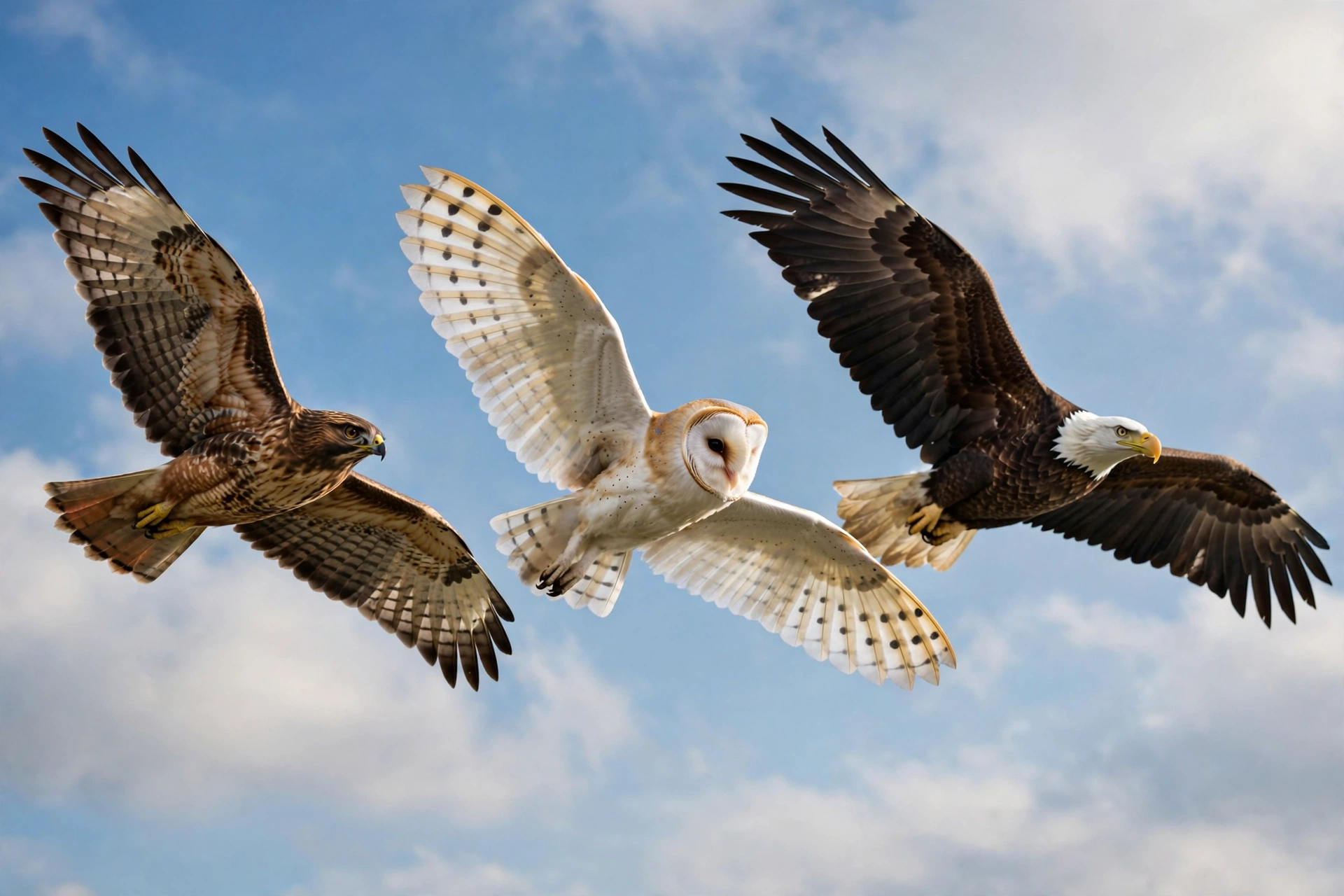
Birds of prey — raptors — are among the most exciting birds to see. They are powerful hunters with hooked bills, strong talons, and keen eyesight. They are also often elusive, seen briefly in flight or perched at a distance, which makes identification challenging. Learning to identify them is less about colour and more about size, shape, flight style, and habitat.
Introduction: Powerful, Elusive, and Worth Learning
This guide focuses on the principles that help beginners separate hawks, owls, and eagles, and recognise common species safely and confidently. It is not a substitute for a field guide, but it will help you know what to look for when a raptor appears.
Raptors reward patience more than any other group of birds. You may wait all morning and see nothing, and then, in a single minute, a buzzard soars overhead, a kestrel hovers over a field, and a sparrowhawk dashes through the trees. Those moments are worth the wait, but only if you know what to look for when they happen. The key is to learn flight style first: a soaring bird, a hovering bird, and a dashing bird are three different kinds of raptor, and once you can tell those apart, you have already narrowed the possibilities enormously. Colour, by contrast, is almost useless with raptors — a buzzard can be dark brown, pale, or almost white underneath, and a juvenile eagle can look like a buzzard. Learn the shapes and the flight, and the rest will follow.
Step 1: Start with Size and Silhouette in Flight
Hawks and Buzzards
In flight, look at wing shape and tail length. A common buzzard has broad, rounded wings, a short, fanned tail, and often soars in circles on rising air. It is a medium-large raptor, often seen over fields and woodland edges. A sparrowhawk has shorter, rounded wings and a long tail, built for fast, agile flight through trees. It often flies low and fast, with a flap-flap-glide pattern.
The red kite is another common large raptor, and it is one of the easiest to recognise once you know it: it has long, angled wings, a deeply forked tail that twists as it turns, and a graceful, buoyant flight. It often soars over farmland and roads, and it is a scavenger as much as a hunter, so you may see it circling over fields or even over motorways. The kestrel is much smaller, and it is best known for hovering: it hangs in the air, wings beating rapidly, tail fanned, head still, as it watches for voles below. If you see a small raptor hovering over a field or a roadside verge, it is almost certainly a kestrel. The marsh harrier is a larger bird of wetlands, with long wings held in a shallow V, gliding low over reedbeds as it hunts. Each of these flight styles is distinctive, and learning them is the fastest way to identify raptors at a distance.
Eagles
Eagles are larger, with very broad wings, a large head and bill, and a powerful, steady flight. A golden eagle has broad wings held flat or slightly raised, a long tail, and a golden nape. A white-tailed eagle is even larger, with very broad wings, a short, wedge-shaped white tail in adults, and a large, pale head. Eagles are often seen over mountains, moorland, and coast, soaring for long periods without flapping much. Size alone is not enough — a buzzard can look large at a distance — so check wing shape, tail shape, and flight style together.
Step 2: Look at Perched Birds Carefully
When a raptor is perched, note its size against a branch or post, its posture, and its head and bill shape. A kestrel perched on a wire is small and upright, with a distinctive face pattern. A buzzard perched on a post is bulky, with a short, hooked bill and mottled brown plumage. An owl perched in a tree is upright, with a large, round head and forward-facing eyes.
Step 3: Learn Owl Clues — Time, Call, and Shape
Owls are mostly nocturnal or crepuscular, so you are more likely to hear them than see them. A tawny owl has a classic "twit-twoo" call, with the female's "ke-wick" and the male's hooting "hoo-hoo." A barn owl has a harsh screech, not a hoot, and a pale, heart-shaped face. A little owl is small, often seen in daylight on a post or branch, with a flat head and yellow eyes.
A Practical Identification Routine
1. Note size, wing shape, tail shape, and flight style first. 2. Note habitat, time of day, and what the bird was doing. 3. If perched, note posture, head shape, and bill size from a distance. 4. Listen for calls, especially at dawn and dusk for owls. 5. Take a photo if you can do so without disturbing the bird, and check it later. 6. Compare with a field guide, focusing on shape and flight, not just colour.
It helps to practise this routine on the commonest raptor in your area, which in many places is the buzzard. The next time you see a buzzard, run through the steps deliberately: broad wings, short fanned tail, soaring in circles, over fields and woodland edge, in the middle of the day. Say each observation out loud or write it down. Doing this with a familiar bird makes the routine automatic, so when an unfamiliar raptor appears — a kite, a harrier, or a sparrowhawk — you will not panic or guess. You will simply run through the same steps, and the answer will often be clear. Keep a note of every raptor you see, with the date, the place, and the flight style, and you will soon have a personal record that shows which raptors are common in your area and when they appear.
Common Mistakes
The most common mistake is calling every large raptor an eagle. Buzzards, red kites, and marsh harriers are all large and can look eagle-like at a distance. Check tail shape, wing shape, and flight style before deciding. Another mistake is identifying from colour alone — buzzards vary greatly in plumage, from dark brown to almost white underneath. A third mistake is approaching too closely or disturbing a nest site. Raptors are sensitive to disturbance, especially during breeding, and some species are legally protected. Always observe from a distance and follow local guidance.
FAQ
What is the easiest bird of prey to identify? The red kite, because of its forked tail and graceful soaring flight, and the kestrel, because of its hovering. Both are distinctive once you have seen them.
How can I tell a buzzard from an eagle? Check size, wing shape, and tail. Eagles are much larger, with broader wings and a larger head and bill. Buzzards are more common and more variable in colour.
Are owls active during the day? Some, like the little owl and short-eared owl, are active in daylight. Most owls are mainly active at dawn, dusk, and night, so listen for their calls.
What should I do if I find an injured bird of prey? Do not handle it yourself. Contact a local wildlife rescue or vet for advice, and keep a safe distance.
Where is the best place to watch birds of prey? Open country with good views is best: a hilltop, a coastal headland, a large wetland, or a nature reserve with a viewpoint. Raptors use rising air to soar, so hills and ridges are good places to watch, especially on a sunny day when warm air is rising. Early morning and late afternoon are often the most active times.
Do I need a telescope to watch raptors? No, but it helps for distant birds. A good pair of binoculars is enough to start, and many raptors come close enough to identify with binoculars alone. A telescope is useful at wetlands and estuaries, where raptors may be far away, but it is not essential for a beginner.
Conclusion
Identifying birds of prey is about shape, flight, and habitat more than colour. Learn the flight styles — soaring buzzard, hovering kestrel, dashing sparrowhawk, fork-tailed kite — and the calls and habits of owls, and you will be able to identify many raptors with confidence. Be patient, watch from a distance, and enjoy the moment when a raptor appears. Those sightings are often the highlight of a day's birdwatching.
Try the free Bird Identifier on aitreeidentier.site — upload a clear photo of the bird for instant guidance.
Safety disclaimer: Never disturb nests or wildlife, especially birds of prey. Observe from a distance, do not approach nest sites, and consult a local expert if you are unsure about a species or a sensitive site.