
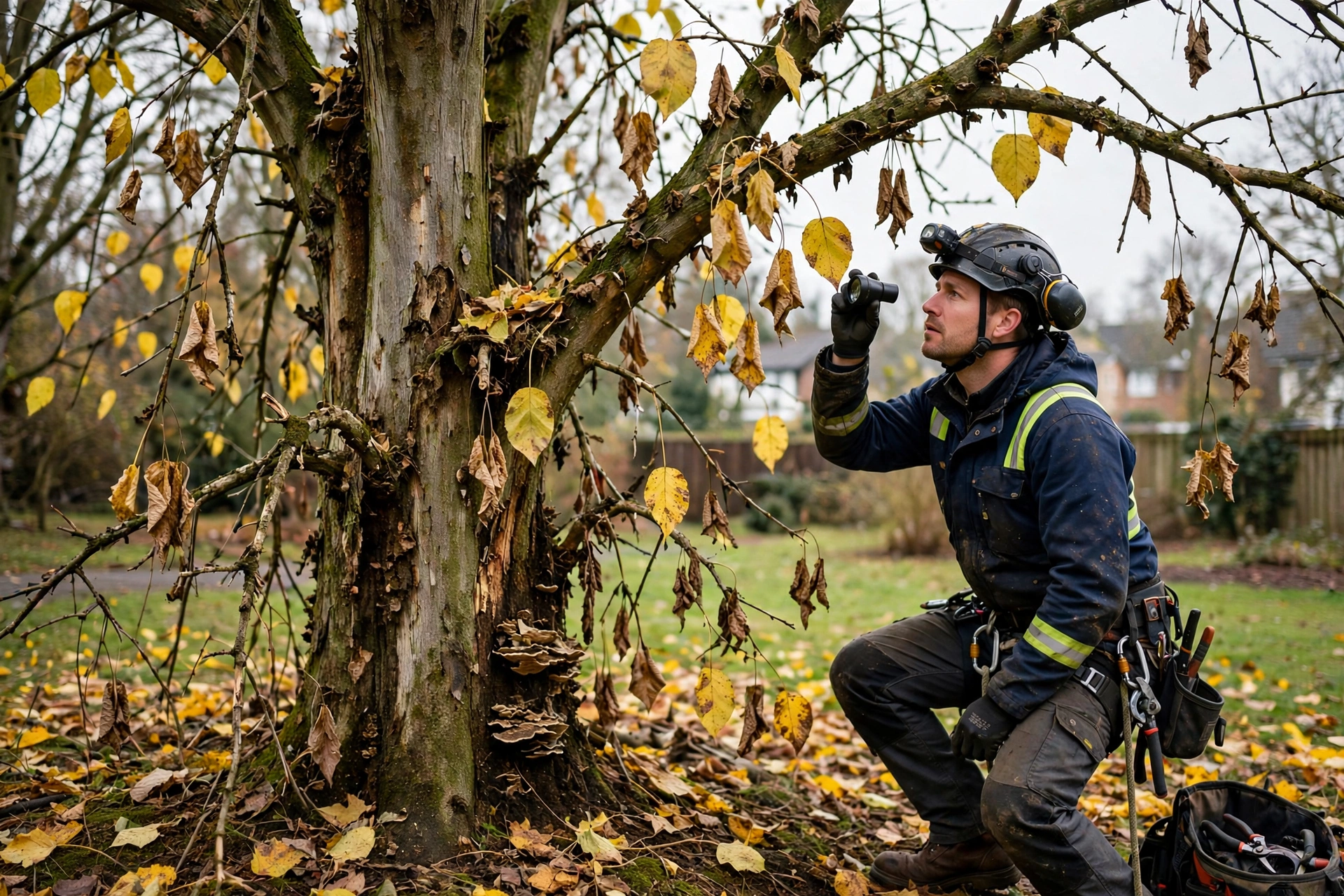
A sick tree can be worrying. Leaves turn yellow, branches die back, bark peels, or fungi appear at the base. You may want to fix it quickly, but the wrong cut, the wrong timing, or working at height can make the problem worse — or put you at risk. Some tree problems are simple and safe to manage at home. Others signal structural weakness, root disease, or a pest that needs professional care.
A sick tree is not always a dying tree. Many trees recover from a bad season, a pest attack, or a dry summer if the cause is found early and the tree is given the right care. The skill lies in telling a problem that will pass with a little help from a problem that is spreading, weakening the structure, or putting people at risk. That judgement, made calmly from the ground, is what this guide is about.
Try it: Try the free Tree Identifier on aitreeidentier.site — identify a sick tree first, so you can look up the problems and treatments that apply to that species.
Signs a Tree May Be Sick
Look for changes over time rather than a single symptom. Early signs include leaves that are smaller than usual, yellowing or browning, early leaf drop, or wilting even when the soil is moist. Dead branches in the crown, known as dieback, are another warning sign. Cracks in the trunk, peeling bark, oozing sap, sawdust, holes, or mushrooms growing on the trunk or at the base can point to decay or root problems.
Check the ground too. Soil that stays soggy, roots that are exposed or damaged, or a tree that leans more than before can indicate instability. A tree that has suddenly leaned after a storm, lost large limbs, or has a split trunk needs urgent professional attention. Take dated photos so you can track changes and share them with an expert.
How to Assess a Sick Tree from the Ground
Never climb a sick tree to inspect it. Work from the ground with binoculars if needed, and keep a safe distance from hanging or cracked branches.
Step 1: Observe the whole tree. Stand back and look at the shape, lean, crown density, and any dead wood. Note whether the problem is on one branch or across the whole tree.
Step 2: Photograph symptoms clearly. Take photos of affected leaves, bark, fungi, and the base of the trunk. Photograph in daylight and include a wide shot of the whole tree for context.
Step 3: Get a first clue. Use the Tree Disease Identifier on aitreeidentier.site to compare your photos with common problems. Treat the result as a starting point, not a diagnosis.
Step 4: Check simple causes. Consider recent drought, waterlogging, construction damage, lawn mower or strimmer damage, or a change in soil level around the trunk. Many tree problems start with stress, not infection.
Step 5: Decide whether it is a small job or a professional job. Small, low, dead twigs on a healthy young tree may be safe to prune. Anything involving height, a ladder, a chainsaw, a large limb, a leaning tree, or a tree near a house, road, or power line should be left to a professional.
Step 6: Keep records. Note dates, weather, photos, and any work you do. This helps an arborist see the pattern and give better advice.
Safe Pruning for Small Problems
If you decide to prune a small, low branch, prepare properly. Wear gloves, eye protection, a helmet if there is overhead dead wood, and sturdy shoes. Use clean, sharp secateurs or loppers, and clean them with disinfectant or diluted bleach between cuts and between trees to avoid spreading disease.
Cut just outside the branch collar — the slightly swollen ring where the branch meets the trunk — and do not leave a long stub or cut flush into the trunk. Remove only dead, damaged, or clearly diseased wood, and avoid heavy pruning in one session. Never prune in wet weather if disease may spread, and never use a chainsaw unless you are trained and equipped for it. If a branch is too thick for loppers, too high to reach from the ground, or over a roof or path, stop and call a professional.
Dispose of diseased material in sealed bags in household waste where local rules allow, rather than composting it or leaving it under the tree. Clean and oil your tools after use.
Common Mistakes to Avoid
Climbing a sick tree. A weakened tree can fail without warning. Never climb it, and never work under a hanging branch.
Over-pruning. Removing too much live wood stresses a tree and can make it more vulnerable to pests and disease. Prune lightly and only what is needed.
Using dirty tools. Dirty secateurs can spread infection from one tree to another. Clean tools before and after each tree.
Painting or sealing wounds. Most tree wounds heal best when left open to air. Do not paint cuts unless an arborist advises it for a specific disease.
A Simple Monitoring Plan After Pruning or Treatment
One visit is rarely enough. After you prune a sick branch or treat a tree, set a simple monitoring plan so you can tell whether the tree is improving or getting worse. Take dated photos from the same spot every few weeks: one wide shot of the whole tree and one close-up of the affected area. Note the date, the weather, and anything you did, such as watering, mulching, or pruning. A short note on your phone is enough.
Look for new growth in spring, leaves that stay green through summer, and fewer signs of the original problem. Also watch for the opposite: more dead wood, larger cankers, new oozing, or dieback spreading to other branches. If the tree is not improving after one growing season, or if symptoms are spreading, call the arborist back rather than trying a stronger treatment yourself. A second opinion early is cheaper than emergency work later.
Costs, Quotes, and What to Ask an Arborist
Cost worries stop many people from calling an arborist, but a first assessment is often less expensive than expected, and it is far cheaper than removing a fallen tree or repairing a damaged roof. Ask for a written quote before work starts, and make sure it says what will be done, what will be left behind, and how the waste will be removed. A good arborist will explain the options — monitor, prune, treat, or remove — and the risks of each, rather than pushing the most expensive one.
Before you agree, ask three questions: are you qualified and insured, what experience do you have with this species and this problem, and what will the tree look like after the work? Be wary of anyone who recommends topping the tree, who offers a large discount for cash on the day, or who cannot explain their plan in plain language. A written quote from two different arborists, for the same job, is a reasonable way to compare — and a professional will not mind being asked.
FAQ
Can I prune a sick tree myself? You can prune small, low, dead branches on a young tree if you can do it safely from the ground with clean hand tools. Leave anything high, large, leaning, or near buildings and power lines to a professional.
How do I know if a tree is dangerous? Warning signs include a sudden lean, split trunk, large dead limbs, hanging branches, fungi at the base, exposed roots, and soil cracking or lifting. If you see these, keep your distance and call an arborist.
Should I water or feed a sick tree? Water during dry periods if the soil is dry, but avoid overwatering. Do not feed a stressed tree heavily without advice, as fertiliser can add stress. An arborist can advise on watering and mulching for your species and soil.
How long does a sick tree take to recover? It depends on the cause and the species. A tree stressed by drought may show new growth within one season, while a tree with a fungal disease or root damage may take two or three years, or may not recover at all. An arborist can give a realistic timescale after seeing the tree.
Conclusion
Handling a sick tree safely means knowing your limits. Observe from the ground, photograph symptoms, get a first identification clue, prune only small low branches with clean tools, and call a professional for anything large, high, leaning, or uncertain. A careful, patient approach protects both you and the tree.
Safety Disclaimer: Never eat or use a plant, mushroom, or fruit based on AI identification alone. AI results can be wrong. Always consult a local expert or qualified arborist before pruning, treating, or removing a sick tree. This article is general information only and is not medical advice.