
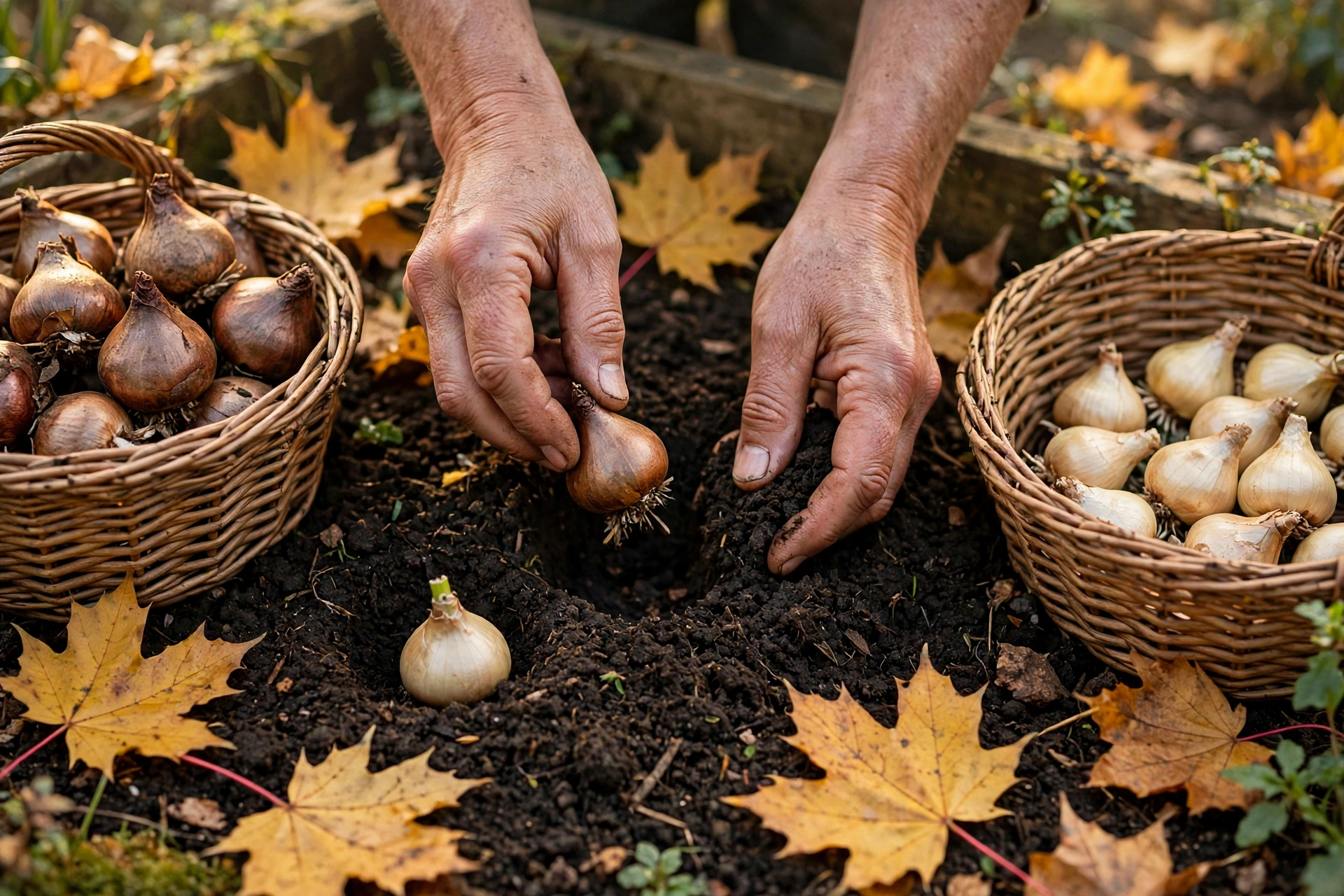
Autumn looks like the end of the gardening year, but for spring colour it is the most important planting season of all. The bulbs you plant now, while the soil is still warm from summer and the air is turning cool, will spend winter underground growing roots. In spring they will repay that patience with tulips, daffodils, crocuses, hyacinths and alliums in colours no seed sown in spring can match. This guide explains what to plant now, when to plant it, and how to get it right, whether you have a large garden, a small border, or only a balcony with pots.
A spring-flowering bulb is a complete plant in miniature, with a flower already formed inside, waiting for cold and then warmth to tell it when to grow. Planted in autumn, it grows roots while the soil is warm, rests through the cold, then shoots up as soon as the days lengthen. Planted in spring, the same bulb would have no time to root and would flower weakly, if at all. The rule is simple: if it flowers in spring, plant it in autumn.
When to Plant Bulbs in Autumn
The best time for most spring bulbs is late September to late November, when the soil has cooled to around 10 degrees Celsius but has not yet frozen. In warmer areas you can plant into early December; in colder areas aim for the earlier part of that window so bulbs root before the ground freezes. A useful guide is to plant when night temperatures regularly fall below 10 degrees but the soil can still be dug easily. If the ground is frozen, it is too late for that year.
Not all bulbs want the same timing. Daffodils are best planted earliest, in September and October, because they need a long rooting period. Tulips are the exception and prefer November, because planting them too early in warm soil can encourage tulip fire, a fungal disease. Crocuses, hyacinths, muscari and alliums are happy any time from September to November. As a general rule, plant daffodils first, then crocuses and hyacinths, and leave tulips until last.
What to Plant Now for Spring Colour
Daffodils are the easiest and most reliable spring bulbs, and the best choice if you are planting for the first time. They come back year after year, they are rarely eaten by mice or squirrels, and they naturalise well in grass and under trees. Yellow varieties are classic, but there are also white, cream, orange and pink types, and small miniatures that suit pots. Plant them in drifts of at least ten together for a natural look, rather than in single rows.
Tulips give the boldest spring colour, in almost every colour except true blue. Single early tulips flower first, followed by tall, strong Darwin hybrids, then late tulips and fringed parrot tulips. Many gardeners treat tulips as annuals and plant fresh bulbs every autumn, because they often flower less well in their second year. If you want tulips to return, choose Darwin hybrids or species tulips, which are more reliable perennials.
Crocuses are often the first bulbs to flower, appearing in February while snow is still on the ground. They are small, so plant them in large groups of twenty or more, in lawns, under trees, or along path edges where their purple, yellow and white flowers can be seen at close range. Snowdrops flower even earlier, but they are best bought and planted in the green, just after flowering in spring, rather than as dry bulbs in autumn, because dry snowdrop bulbs dry out quickly and often fail.
Hyacinths are the most fragrant spring bulbs, and a few pots by a door will scent a whole room. Outdoors they work best in formal beds and containers, where their stiff, upright flower spikes look tidy. Alliums, the ornamental onions, flower later in spring and into early summer, and their tall purple globes are a wonderful contrast to tulips and daffodils. They are easy to grow, rarely eaten by pests, and their dried seed heads look good long after the flowers finish.
Choosing Good Bulbs
Always buy firm, heavy bulbs that feel solid in your hand. Avoid any that are soft, mouldy, or light for their size, because they have probably dried out or rotted. Larger bulbs usually give larger flowers, so it is worth paying a little more for top-size bulbs, especially for tulips and hyacinths. If you cannot plant them straight away, keep them in a cool, dry, dark place with good air circulation, in a paper bag or an open tray, never in a sealed plastic bag, where they will sweat and rot.
Where and How Deep to Plant
Most spring bulbs need a sunny or lightly shaded spot with soil that drains freely. They will rot if they sit in wet soil over winter, so avoid the lowest, wettest part of the garden and heavy clay unless you improve drainage first. Dig coarse grit or sharp sand into the bottom of the planting hole in heavy soil. In very wet gardens, bulbs are often better in pots or raised beds, where you can control drainage.
Plant a bulb at a depth of three times its own height, measured from the base of the bulb to the soil surface. A daffodil bulb 5 centimetres tall should be planted about 15 centimetres deep, while a small crocus corm 2 centimetres tall needs only 6 centimetres of soil above it. Planting too shallowly is one of the commonest mistakes: shallow bulbs are more likely to be eaten, to dry out, or to be pushed out by frost. Space bulbs about two bulb-widths apart, or closer in pots. In the ground, plant in irregular drifts, not straight lines. A good trick is to throw a handful of bulbs gently onto the soil and plant them where they land.
Dig each hole with a trowel or bulb planter, place the bulb with the pointed end up and the flat base down, cover with soil, firm gently, and water if the soil is dry. If you cannot tell which end is which, plant the bulb on its side; it will usually sort itself out. In pots, put gravel at the bottom for drainage, fill with compost mixed with grit, plant as described, water well, and stand the pot in a sheltered spot. Pots can dry out in autumn and freeze in winter, so check them regularly.
Aftercare Through Winter and Spring
Once planted, bulbs need very little care. Do not water them again unless there is a long dry spell in autumn, and do not feed them until shoots appear in spring. If squirrels or mice are a problem, cover the bed with chicken wire for the first few weeks. In spring, feed with a balanced liquid fertiliser when shoots are about 10 centimetres tall, and again just after flowering, to help the bulb build up food for next year.
Common Mistakes to Avoid
The commonest mistakes are planting too late after the soil has frozen, planting bulbs kept too warm indoors, planting in soil that stays wet all winter, planting too shallowly, and forgetting to label varieties. All are easy to avoid once you know about them. Another mistake is cutting leaves off too soon after flowering, which weakens the bulb for next year.
Frequently Asked Questions
Can I plant bulbs in December? Yes, if the soil is not frozen and you can still dig it. Tulips are often planted in November and December. Daffodils planted very late may flower a little later in their first year, but they usually recover in the second year.
Can I plant bulbs in pots on a balcony? Yes. Use a pot at least 20 centimetres deep with drainage holes and a mix of compost and grit. Plant in layers for a longer display, and keep pots watered in dry weather and sheltered from hard frost.
How many bulbs do I need? Plant at least ten daffodils or tulips together, and twenty or more crocuses, for a good display. In a pot you can plant bulbs almost touching for a dense show.
Conclusion
Autumn bulb planting is one of the simplest and most rewarding jobs in the garden. A few hours of work now, while the soil is still warm, will give you months of colour in spring, from the first crocuses in February to the last alliums in June. Choose firm, healthy bulbs, plant them at the right depth in soil that drains freely, and let them do the rest. If you plant daffodils, tulips, crocuses, hyacinths and alliums this autumn, your garden will wake up in spring with colour in every bed, border and pot.
Try it on aitreeidentier.site — use the Garden Plant Identifier to check a plant you are unsure about before you plant it, and the Plant Identifier to confirm the leaves you see in spring belong to the bulbs you planted. Try the plant identifier at aitreeidentier.site