
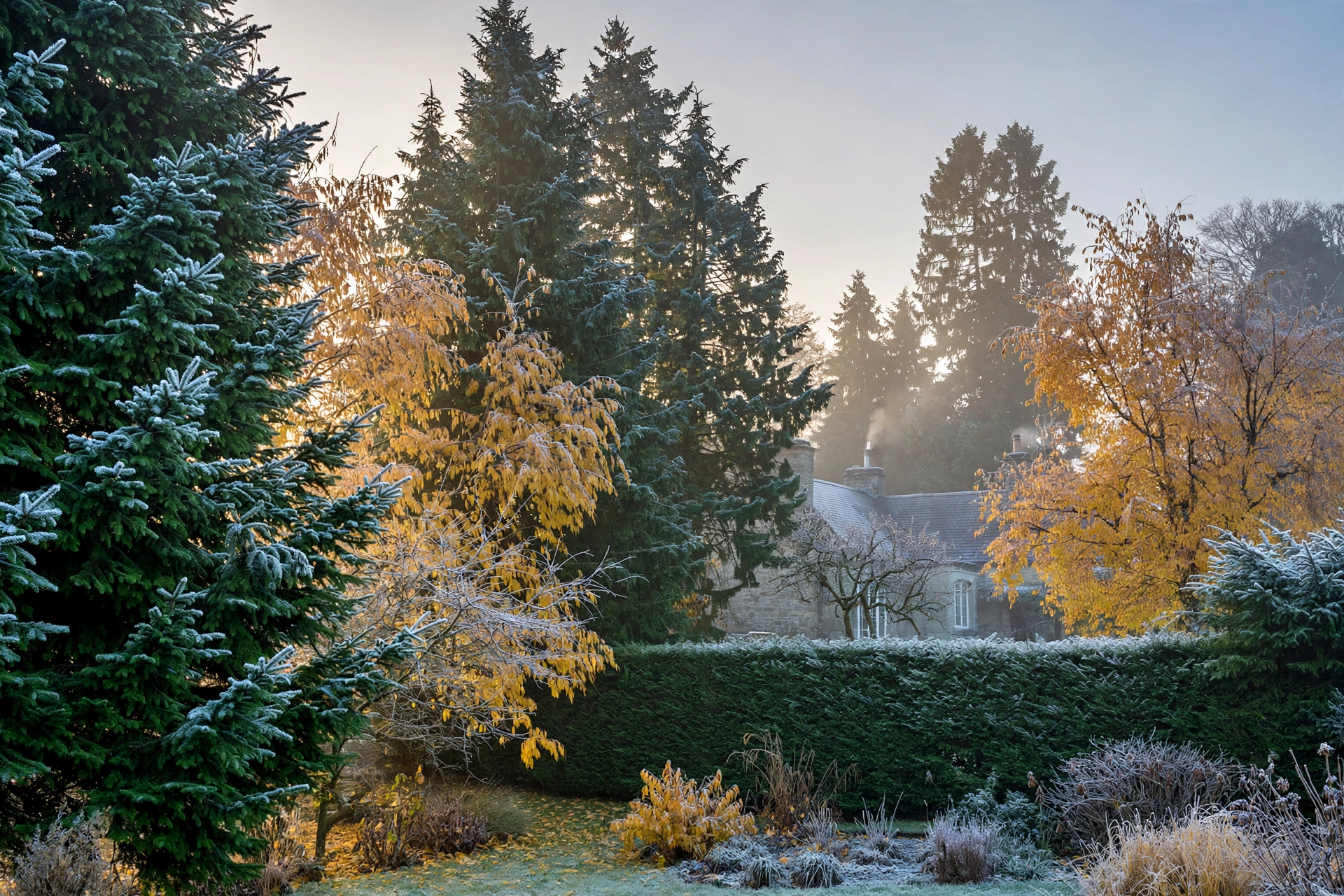
When the leaves fall and the garden turns grey, evergreens earn their place. They hold their colour through winter, screen a house from the road, shelter birds, and give a garden its shape when everything else is bare. The best evergreen trees for winter colour and privacy do more than stay green: they bring gold, blue, red, and bronze to the cold months, and they grow into a living screen that is softer and more alive than any fence. This guide looks at the evergreens that do both jobs well, how to choose between them, and how to plant and care for them so they thrive.
An evergreen tree keeps most of its leaves through winter, though it sheds old leaves gradually. It is not the same as a conifer, though most conifers are evergreen. Some broadleaf trees, such as holly and laurel, are also evergreen. When you choose an evergreen for privacy, you want a tree that is dense, that keeps its lower branches, and that grows at a speed you can manage. When you choose one for winter colour, you want foliage, bark, or berries that look good in low winter light.
What Makes a Good Evergreen for Privacy?
A good privacy tree is dense from the ground up. Trees that keep their lower branches, such as yew, holly, and western red cedar, are better for privacy than trees that lose them as they grow, such as many pines.
Growth rate matters too. A fast-growing tree gives you privacy sooner, but it may also grow too big for the space. Leyland cypress is famous for this: it grows quickly and makes a dense screen, but it can reach twenty metres if it is not pruned, and it can shade a neighbour's garden. Slower trees, such as yew and holly, take longer to fill in, but they are easier to keep at the height you want, and they live for centuries.
Width matters as much as height. A tree that grows wide needs more space, and a narrow, upright tree fits a small garden better. Italian cypress is very narrow and upright, but it is not very dense at the base in cold climates. Western red cedar is conical and dense, and it is one of the best all-round privacy conifers for a temperate garden. Bay laurel is a broadleaf evergreen that can be clipped into a dense hedge or grown as a small tree.
Evergreens with Winter Colour
Green is not the only winter colour an evergreen can offer. Some evergreens change colour in cold weather, and others carry coloured berries, bark, or new growth that stands out against the winter garden.
Yew (Taxus baccata) is dark green all year, with soft, flat needles and red berries in autumn on female plants. It is one of the best privacy trees because it is very dense, tolerates shade, and can be clipped hard, even back to old wood. It grows slowly, about 30 centimetres a year, so it takes time to make a screen, but it is long-lived and easy to keep at any height. All parts of yew except the red flesh of the berry are poisonous, so keep it away from grazing animals and warn children not to eat the seeds.
Holly (Ilex aquifolium) brings glossy, spiny, dark green leaves and bright red berries in winter. The berries only appear on female plants, so plant a male nearby if you want berries, or choose a self-fertile variety. Holly is dense, slow-growing, and very tough. It makes a good privacy screen and a good security hedge, because its spines deter intruders. In winter, the contrast of red berries against dark green leaves is one of the best colour combinations in the garden.
Western red cedar (Thuja plicata) has soft, scale-like foliage that is rich green in summer and turns a warm bronze-green in winter. It grows quickly, about 60 centimetres a year, and makes a dense, conical screen. It tolerates shade and damp soil better than most conifers, and it can be clipped into a hedge. The variety 'Atrovirens' is a good choice for a tall screen, while 'Smaragd' is a smaller, neater form.
Blue spruce (Picea pungens 'Glauca') brings a striking blue-grey colour to winter. Its stiff, sharp needles are a cool blue, and the tree keeps a neat, conical shape. It is slow to moderate in growth and needs a sunny, open position. It is not as dense at the base as yew or cedar, so it is better as a specimen tree or a windbreak than as a close privacy screen, but its colour is unmatched.
Golden Lawson cypress (Chamaecyparis lawsoniana 'Golden Wonder' or 'Stardust') has bright golden-yellow foliage that glows in low winter sun. It grows into a tall, conical tree and makes a good screen, though it needs a sheltered position and does not like very cold, exposed sites. Plant it where the winter sun will catch it, and it will light up a dull corner.
Planting Evergreens for Privacy
Plant in autumn or early spring, when the soil is moist and the tree can establish roots before summer heat or winter cold. Dig a hole twice as wide as the root ball and the same depth, so the top of the root ball sits level with the soil surface. Do not plant too deep: a tree planted too deep will struggle, and its roots may rot.
For a hedge or screen, space the trees according to their mature width. For a dense screen, plant them closer together than you would for specimen trees, but not so close that they compete for light and water. As a rough guide, plant yew 60 centimetres apart for a hedge, western red cedar 75 centimetres apart, and Leyland cypress one metre apart. Water well after planting, and mulch around the base with bark or compost, keeping the mulch away from the trunk.
Water new evergreens regularly in their first two summers, especially in dry weather. Evergreens lose water through their leaves all year, even in winter, so a dry winter can damage them too. A newly planted evergreen that turns brown in its first winter has often dried out, not frozen. Water it in dry spells, even in winter, if the ground is not frozen.
Feed sparingly. Most evergreens do not need much fertiliser, and too much nitrogen can make soft, sappy growth that is easily damaged by frost. A mulch of compost in spring is usually enough. If the foliage looks pale, a balanced fertiliser in spring may help, but check the soil first: pale foliage can also be a sign of waterlogging or poor drainage.
Try it with the AI identifier on aitreeidentier.site: photograph an evergreen in your garden and see what the tool identifies.
Frequently Asked Questions
What is the fastest evergreen for privacy?
Leyland cypress is one of the fastest, growing up to a metre a year in good conditions, but it can grow very large and needs regular clipping. Western red cedar is a better choice for most gardens: it grows about 60 centimetres a year, makes a dense screen, and is easier to keep at the height you want.
Which evergreen is best for a small garden?
Yew and holly are good for small gardens because they grow slowly and can be clipped to any size. A narrow form of western red cedar, such as 'Smaragd', is also a good choice. Avoid Leyland cypress in a small garden unless you are prepared to clip it every year.
Can I plant evergreens in shade?
Yes, some can. Yew and holly tolerate shade well, and western red cedar tolerates partial shade. Blue spruce and golden cypress need sun to keep their colour. Check the label for light requirements before you buy.
Are yew berries poisonous?
Yes, all parts of yew except the red flesh of the berry are poisonous, including the seeds. The berries are attractive to birds, which pass the seeds unharmed, but people and livestock should not eat them. Teach children not to eat yew berries, and keep yew away from grazing animals.
Conclusion
The best evergreen for your garden is the one that fits your space, your soil, and your light, and that gives you both privacy and winter colour. Yew and holly are slow, dense, and long-lived. Western red cedar is fast, dense, and forgiving. Blue spruce and golden cypress bring colour that no green tree can match. Plant them well, water them in their first two years, and prune them to keep them dense from the ground up. Do that, and your garden will have shape, shelter, and colour in the middle of winter, when you need it most.
Disclaimer: This article is for general education only. Yew and some other evergreens are poisonous. Do not eat any part of a plant unless you are certain of its identity and safety, and confirm with an expert before use.