
You do not need to travel to a nature reserve to start birdwatching. A garden, balcony, or local park can host a surprising variety of birds, especially if there is food, water, and shelter nearby. Learning the 15 birds below gives you a solid foundation — once you know these, you will spot the differences when a less common visitor arrives.
Introduction: Your Garden Is a Great Classroom
Start with the birds you see every day. A robin on a fence post, a blackbird on a lawn, or a magpie crossing the garden are all easy to recognise, and each one teaches you something: how big it is, how it moves, what it sounds like. Learn five birds well, then add five more, and your garden will soon feel full of familiar faces.
The 15 Common Garden Birds
1. Robin
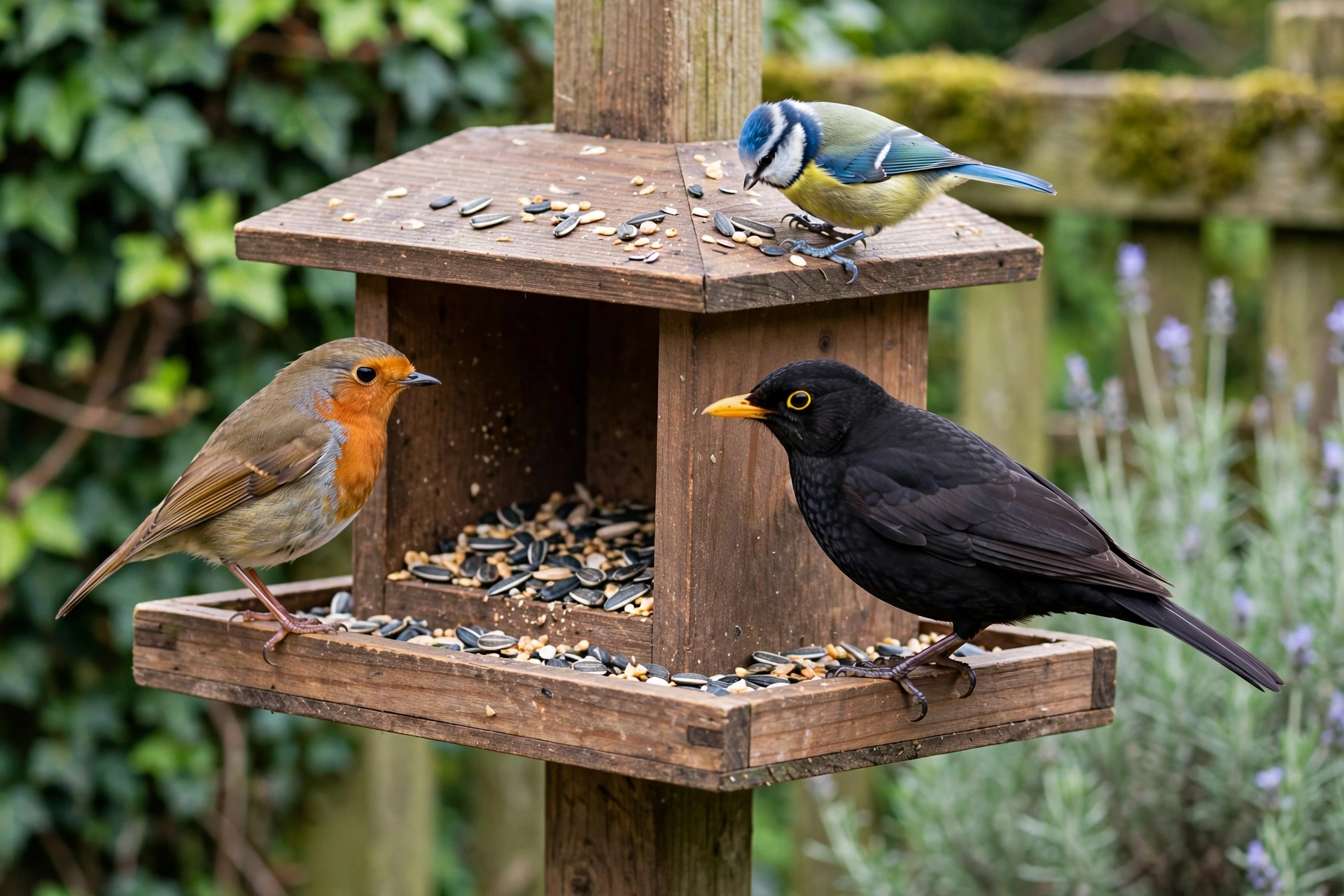
Small, round, and upright, with a bright orange-red breast and face, brown upperparts, and a thin bill. Robins are bold and territorial, often singing in winter and approaching gardeners. Their song is a sweet, warbling phrase.
2. Blackbird
The male is glossy black with a bright yellow-orange bill and eye ring. The female is dark brown and speckled. Blackbirds feed on lawns, run then pause, and sing a rich, fluty song from rooftops and trees.
3. Blue Tit
Tiny and colourful, with a blue cap, white face, black eye stripe, and yellow breast. Blue tits are lively and acrobatic, often hanging upside down on feeders. Their call is a thin, high-pitched "tsee-tsee."
4. Great Tit
Larger than a blue tit, with a black head, white cheeks, green back, and yellow breast with a bold black stripe down the centre. Its song is a clear, two-note "teacher-teacher." Great tits are confident at feeders.
5. Chaffinch
The male has a pinkish breast, blue-grey head, chestnut back, and white wing bars and outer tail feathers. The female is browner and plainer. Chaffinches often feed on the ground under feeders and have a loud, descending song.
6. Goldfinch
Unmistakable, with a red face, black-and-white head, golden wing bars, and a tinkling, twittering song. Goldfinches love seeds, especially thistle and sunflower, and often visit in small, chattering flocks.
7. House Sparrow
The male has a grey crown, black bib, and chestnut nape; the female is plain brown with a pale eyebrow. Sparrows are sociable, noisy, and often feed in groups near houses and hedges.
8. Dunnock
A quiet, brown, sparrow-like bird with a fine bill, grey head and breast, and streaked back. Dunnocks creep along the ground under bushes and sing a thin, high, warbling song. They are often overlooked.
9. Song Thrush
Warm brown above with a pale, heavily spotted breast. Song thrushes repeat each phrase two or three times in a loud, clear song. They feed on lawns and smash snails on stones.
10. Magpie
Large, long-tailed, black-and-white, with a glossy green and purple sheen on the wings and tail. Magpies are bold, intelligent, and noisy, with a harsh chattering call. They are unmistakable in flight.
11. Woodpigeon
Large and grey, with a white neck patch and a pinkish breast. Woodpigeons have a soft, cooing "coo-coo-coo" song and a loud wing clatter when they take off. They often feed on lawns and in trees.
12. Collared Dove
Pale grey-buff, slim, with a black collar on the back of the neck and a long tail. Its song is a steady, three-note "coo-coo-coo." Collared doves are gentle and often perch on wires and rooftops.
13. Starling
In winter, starlings are speckled; in summer, they are glossy black with a purple-green sheen and a yellow bill. They gather in large, noisy flocks and mimic other birds. Their flight is fast and direct.
14. Wren
Tiny, round, and brown, with a short cocked tail, pale eyebrow, and a surprisingly loud, rattling song. Wrens creep through undergrowth and low bushes, often disappearing quickly.
15. Long-tailed Tit
Small and round, with a very long tail, black-and-white head, and pinkish breast. Long-tailed tits move in busy, chattering flocks through trees and bushes, rarely staying still for long.
Learning the Birds in Groups
Trying to memorise all 15 at once is hard. It is easier to learn them in small groups based on where and how you see them. Start with the birds that visit feeders: blue tit, great tit, goldfinch, and house sparrow. These four are easy to compare side by side, because they often feed together, and their differences — size, colour, and bill shape — stand out clearly when you see them at the same feeder. Spend a week watching just these, and you will know them well.
Next, learn the ground feeders: blackbird, song thrush, dunnock, and chaffinch. Watch how they move on a lawn. A blackbird runs and pauses, head cocked, listening for worms. A song thrush hops and pecks, and you may see it smashing a snail on a stone — a behaviour that gives it away even before you see its spotted breast. A dunnock creeps quietly along the base of a hedge, almost mouse-like, while a chaffinch hops under feeders picking up fallen seed. Once you can tell these four apart by behaviour alone, you have learned a skill that works even when the light is poor and the colours are hard to see.
Finally, learn the big, obvious birds — magpie, woodpigeon, collared dove, and starling — and the two tiny ones, wren and long-tailed tit. The large birds are easy to spot at a distance, so use them to practise judging size: is the bird bigger than a blackbird, or about the same size as a pigeon? The wren and long-tailed tit teach you to look in different places: the wren low in tangled undergrowth, the long-tailed tit high in trees in a busy, chattering flock. Learning in these groups means every walk gives you a small, achievable goal instead of an overwhelming list.
How Garden Birds Change Through the Seasons
The same garden can look and sound very different in January and in June, and knowing what changes to expect will stop you from being confused. In winter, gardens fill with birds that have moved in from the countryside looking for food: redwings and fieldfares may join blackbirds on berry bushes, and goldfinches gather in larger flocks. Juvenile starlings are brown and spotty, and young robins have no red breast at all — they are speckled brown, and many beginners mistake them for a different species entirely. In spring, males sing more loudly and more often, and birds you have known all winter suddenly look brighter and behave differently as they defend territories and find mates.
Common Mistakes
A common mistake is confusing a dunnock with a house sparrow, or a female chaffinch with a female house sparrow. Look at the bill — dunnocks have a fine, pointed bill, while sparrows have a thick, seed-eating bill — and at the head pattern. Another mistake is assuming every small brown bird is a sparrow. Many garden birds are brown, so check size, bill, and behaviour before deciding.
FAQ
What is the easiest garden bird to recognise first? The robin, because of its red breast, upright posture, and bold behaviour. The magpie is also easy due to its size and black-and-white pattern.
How can I attract more garden birds? Offer food, clean water, and shelter. Native trees, shrubs, and a small pond help, as does leaving some areas a little wild.
Do garden birds change through the year? Yes. Some birds visit mainly in winter, others in summer, and juveniles can look different from adults. Keep notes through the seasons to learn the changes.
What should I do if I see a bird I cannot identify? Note its size, shape, field marks, behaviour, and habitat, take a photo if possible, and check it later with a guide or the Bird Identifier.
When is the best time of day to watch garden birds? Early morning is usually best, because birds are hungry after the night and sing and feed actively. Late afternoon is also good, as birds feed again before roosting. Midday is often quieter, especially in summer heat.
Conclusion
These 15 common garden birds are the foundation of garden birdwatching. Learn them one at a time, use size, field marks, song, and behaviour together, and you will soon recognise them at a glance. Your garden will feel richer for it — and when a rarer visitor arrives, you will know it is different because you know what is usual.
Try the free Bird Identifier on aitreeidentier.site — upload a clear photo of the bird for instant guidance.
Safety disclaimer: Never disturb nests or wildlife. Observe from a distance, keep feeders clean, and consult a local expert if you are unsure about a species or a sensitive site.