
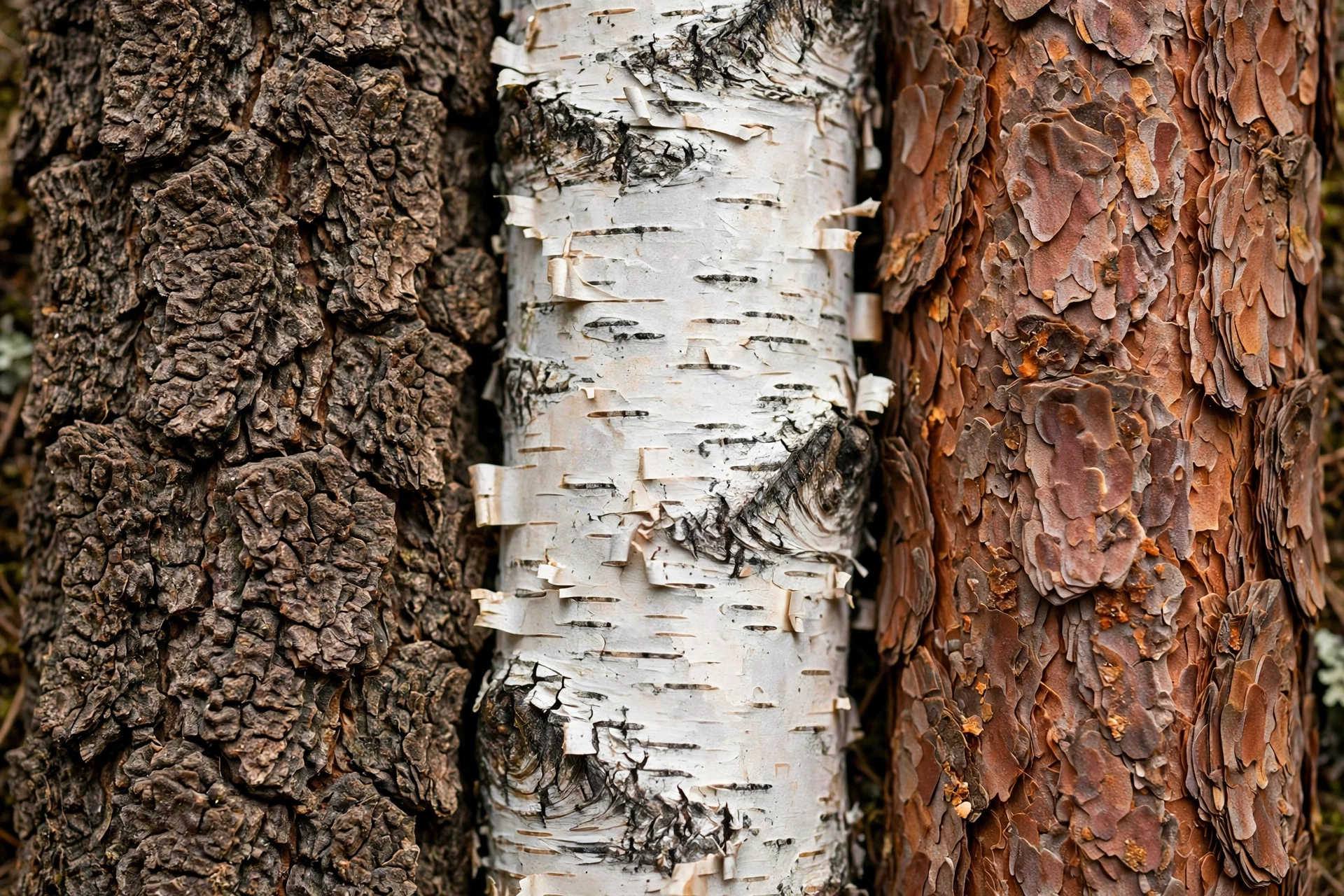
Try it: Photograph the bark up close and try the free Bark Identifier on aitreeidentier.site — it can help narrow down the species in seconds.
Introduction
In winter, when leaves have fallen and flowers are months away, bark becomes the tree identifier's best friend. Unlike leaves, bark is there all year round, and it changes in distinctive ways as a tree ages. A birch's white, peeling bark, an oak's deeply fissured grey-brown ridges, a cherry's shiny bands — each is a clue, and together they can identify a tree with surprising confidence. Bark identification takes practice, but it is a skill anyone can learn.
What Bark Is and Why It Varies
Bark is the tree's protective skin. The outer bark shields the living tissue inside from drying out, frost, fire, insects, and disease. As the trunk grows wider, the outer bark must stretch, crack, or peel to make room. How it does that depends on the species, and that is why bark looks so different from one tree to another. Young bark is often smooth, thin, and pale. As the tree ages, bark thickens, darkens, and develops ridges, fissures, plates, or scales.
The Key Features to Describe
When you look at bark, describe four things: colour, texture, pattern, and feel. Colour: Note the main colour and any secondary colours. Is it grey, brown, black, white, silver, reddish, or greenish? Wet bark often looks darker than dry bark, so note the conditions. Texture: Is the bark smooth, rough, flaky, scaly, ridged, or furrowed? Run your hand over it — carefully, and watch for thorns or splinters. Pattern: Look at the shapes the bark makes.
Bark Patterns of Common Trees
Learning a few classic examples helps you build a mental library. Silver birch has striking white bark with black diamond-shaped marks, peeling in thin papery sheets. Young trees have brown bark that turns white as they age. Oak has grey-brown bark with deep vertical fissures and ridges that become more pronounced with age. Sweet chestnut has bark that twists in a spiral as the tree ages, with deep fissures that spiral around the trunk.
More Bark Patterns to Learn: Beech, Cherry, Pine, and Plane
Once you know birch, oak, and sweet chestnut, add a few more classics to your mental library. Beech bark is smooth, silver-grey, and almost unmarked, even on old trees — it looks like the skin of an elephant, and it is one of the easiest barks to recognise. Cherry bark is shiny and dark, with horizontal bands called lenticels that look like neat, pale stripes around the trunk; as the tree ages, the bark becomes rougher and peels in horizontal strips. Scots pine has bark that is reddish-brown and flaky at the top of the trunk, becoming grey and deeply fissured lower down, so the same tree can show two very different barks depending on where you look. London plane is famous for shedding its bark in large, camouflage-like patches of cream, green, and brown, leaving a patchwork that is unmistakable once you have seen it.
Other useful examples include ash, whose bark starts smooth and grey-green, then becomes finely fissured into a diamond pattern as it ages, and hornbeam, whose bark stays smooth and grey but develops a fluted, muscular look, as if the trunk were made of twisted ropes. Lime bark is grey-brown and becomes fissured with age, and it often carries small burrs and epicormic shoots at the base. Learning these patterns is like learning faces: at first they all look similar, but after a few weeks of looking, you will recognise old friends at a glance, even from a distance.
Photographing Bark for Identification
A good bark photograph is worth more than a vague description, whether you are using an app or asking an expert. Take the photo in daylight, without flash, and fill the frame with the bark so the pattern is clear. Take a second photo from a few steps back, showing the whole trunk and the base of the tree, and a third of the buds or twigs at the end of a low branch. Include something for scale, such as your hand or a coin, but keep it at the edge of the frame so it does not hide the bark. Note whether the bark was wet or dry when you photographed it, because wet bark looks much darker, and record the date and location. With those three photos — close-up, whole trunk, and buds — an identifier, human or digital, has a far better chance of giving you the right answer.
How to Use Bark in Winter Identification
Bark alone is rarely enough for a certain identification, but it is powerful when combined with other clues. In winter, look at the bark, then look at the buds, twigs, overall shape, and any fruit, seeds, or leaves still on the ground. A tree with smooth silver-grey bark, a massive trunk, and beech mast on the ground is almost certainly a beech. A tree with white peeling bark and small cones on the ground is likely a birch.
Bark Changes with Age — A Warning
The biggest trap in bark identification is age. A young tree's bark can be smooth, pale, and unremarkable, while the same species at 100 years old can be deeply fissured and dark. Always consider the size and age of the tree when you compare bark to a photo or description.
Common Mistakes to Avoid
- Relying on bark alone: Use bark with buds, twigs, shape, and habitat for a confident ID.
- Ignoring age: Young and old bark of the same species can look very different.
- Confusing colour in wet and dry conditions: Wet bark is darker — compare like with like.
- Forgetting lichen and moss: They can hide the true bark colour and pattern.
- Damaging bark to see underneath: Never strip bark from a living tree. It wounds the tree and can let disease in.
- Trusting a single photo: Bark varies within a species. Look at several examples.
FAQ
Can you identify a tree from bark alone? Sometimes, for very distinctive species such as silver birch or London plane, yes. For most species, bark gives a strong hint that needs to be confirmed with buds, twigs, shape, or other clues.
Why does bark peel? As the trunk grows, outer bark must split or peel to make room. Some species shed bark in thin sheets or plates, which also helps the tree shed lichens, moss, and pests.
Is bark a reliable clue in summer too? Yes. Bark is present all year, so it is useful in every season. In summer, use it alongside leaves, flowers, and fruit for a fuller identification.
Should I touch bark to identify a tree? Gently touching bark to feel its texture is fine, but do not strip, cut, or peel bark from a living tree. Take photos instead, and wash your hands afterwards.
Does bark change colour in different seasons? Bark colour changes mainly with wetness and light, not with the season. Wet bark is darker, and bark in deep shade can look greyer than the same bark in sunlight. The pattern and texture stay the same all year, which is why bark is such a reliable winter clue.
Can I identify a tree from a fallen piece of bark? A fallen piece can help, but it is much less reliable than bark on the living tree, because you cannot be sure which tree it came from, and bark changes as it dries. Always try to photograph the bark on the standing tree as well.
Conclusion
Bark is a year-round identification clue that rewards close looking. Learn to describe colour, texture, pattern, and feel, and build a mental library from a few common trees — birch, oak, beech, cherry, plane, and pine are good places to start. Always combine bark with other clues, remember that bark changes with age, and photograph the trunk and the buds together. With practice, you will find you can name many trees in winter that you once walked past without noticing.
Safety note: Never eat or use any part of a tree based on an AI identification alone. Do not strip or damage bark to identify a tree, and consult a local expert if you are unsure about a species or its safety.