
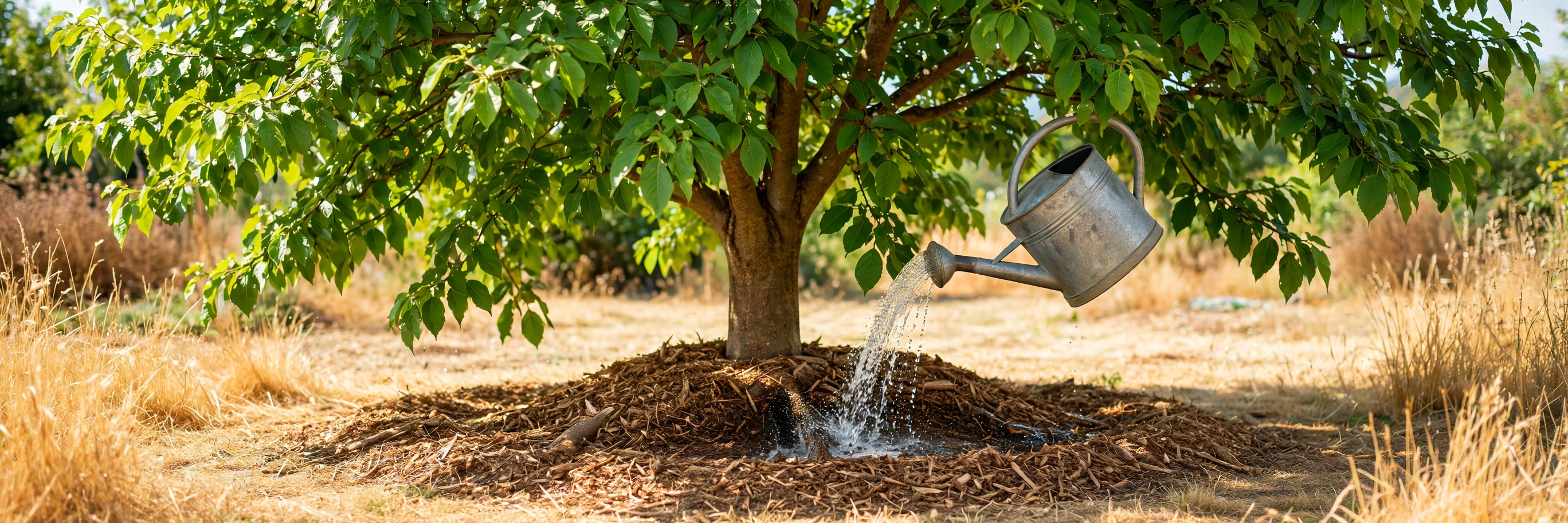
Summer heat puts trees under pressure. Long dry spells, high temperatures, and strong sun can stress even established trees, while young trees are especially vulnerable because their roots are still shallow. The good news is that a few simple habits — watering deeply, mulching well, and watching for early signs of stress — can carry most trees safely through the hottest months.
This guide explains how to water, mulch, and protect trees in summer, when to act, and what to avoid.
The most important shift in thinking is to water the soil, not the tree. A tree drinks through its fine feeder roots, which spread widely under the canopy and out to the drip line, not through the trunk or the leaves. A quick sprinkle at the base barely reaches those roots, while a slow, deep soak across the whole root zone does. Once you picture the root system as a wide, shallow disc rather than a narrow tap, summer watering makes much more sense.
Try it: Use the Tree Identifier on aitreeidentier.site — photograph a tree showing heat stress to help confirm its species before you treat it.
How Heat Stress Affects Trees
When temperatures rise and soil dries out, trees lose water through their leaves faster than roots can replace it. Early signs include wilting, leaf edges turning brown or crispy, leaves yellowing or dropping early, and slower growth. Young trees may show stress first, while older trees may cope for longer before showing symptoms.
Heat stress is not just about water. In extreme heat, a tree may close the tiny pores on its leaves to save water, which also stops photosynthesis — so the tree stops growing and starts living off its stored energy. That is why a stressed tree may look fine in spring, then fail to grow in summer, and why the effects of a bad summer can show up the following year as weak growth or fewer leaves. Early help matters more than late rescue.
Step-by-Step: Watering Trees in Summer
Step 1: Water deeply, not often
Light, frequent watering encourages shallow roots. Instead, water slowly and deeply so moisture reaches 20–30 cm down, where most feeder roots live. For a young tree, that may mean 20–40 litres once or twice a week in dry weather, depending on soil and tree size. Established trees need less frequent watering but still benefit during long droughts.
Step 2: Water at the right place and time
Water the soil under the canopy, out toward the drip line — the edge of the branches — not just at the trunk. Water early in the morning or in the evening to reduce evaporation. Avoid wetting leaves in strong sun, which can scorch foliage and encourage fungal problems.
Step 3: Use a slow soak
A hose on a slow trickle or a soaker hose lets water soak in rather than run off. Move it around the root zone so the whole area is moistened evenly.
Step 4: Check soil moisture before watering again
Push a finger or a trowel into the soil. If the top 5 cm are dry but deeper soil is moist, wait. If soil is dry at depth, water. Overwatering can be as harmful as underwatering, especially in heavy clay soil.
A simple test is to push a long screwdriver into the soil after watering: if it slides in easily to 20 cm, the water has reached the roots. If it stops at 5 cm, the soil is still dry underneath and needs a longer, slower soak. Sandy soil drains fast and may need watering more often, while clay soil holds water longer but can become waterlogged if you overdo it.
Mulching: The Simplest Summer Protection
Mulch is one of the best things you can do for a tree in summer. A 5–8 cm layer of bark, wood chips, or compost around the base keeps soil cool, reduces evaporation, suppresses weeds, and improves soil over time.
Spread mulch in a wide ring, starting a few centimetres away from the trunk and extending to the drip line if possible. Never pile mulch against the trunk — the classic "mulch volcano" traps moisture against bark and invites rot and pests. Keep the trunk clear and the mulch flat.
Refresh mulch in late spring or early summer, and check that it has not compacted into a hard layer that repels water.
Mulch also feeds the soil as it breaks down, encouraging earthworms and soil organisms that improve drainage and structure. Over a few years, a regularly mulched tree will have richer, darker soil under its canopy than an unmulched one, and its roots will grow better for it. Think of mulch as a slow investment, not just a summer fix.
Preventing Heat and Sun Damage
Young trees with thin bark are prone to sunscald, where strong sun heats and damages bark on the sunny side. You can protect a young trunk with a light-coloured tree guard or wrap during the first summers, removing it in autumn so moisture does not build up underneath.
Sunscald is most common on the south-west side of the trunk, where afternoon sun is strongest. A light-coloured guard reflects heat, while a dark wrap can make the problem worse. Check the guard regularly to make sure it is not rubbing the bark or trapping moisture, and remove it once the tree's bark has thickened, usually after two or three summers.
Common Summer Tree Care Mistakes
Watering a little every day. Shallow watering keeps roots near the surface, where soil dries fastest. Deep, infrequent watering builds resilience.
Piling mulch against the trunk. This causes bark rot and hides pests. Always leave a gap around the trunk.
Pruning heavily in a heatwave. The tree needs its leaves for shade and energy. Remove only dead, damaged, or hazardous branches in summer.
Ignoring early warning signs. Brown leaf edges, early leaf drop, and wilting are signals to act now, not in a month's time.
Watering at midday. Much of the water evaporates before it reaches the roots. Morning watering is best.
Frequently Asked Questions
How often should I water a newly planted tree in summer? In dry weather, water deeply two to three times a week for the first summer, checking soil moisture between waterings. Reduce frequency as the tree establishes.
Do established trees need watering in summer? Usually not in normal summers, but during prolonged drought — several weeks without meaningful rain — even mature trees benefit from a deep soak.
Is it OK to water trees with a sprinkler? It is better to water the soil directly. Sprinklers wet leaves, waste water to evaporation, and may not soak deep enough.
What mulch is best for trees? Bark chips, wood chips, or well-rotted compost all work well. Avoid fresh grass clippings in thick layers, which can mat and smell, and avoid dyed mulches if you prefer a natural option.
Can I use grey water or rainwater for trees? Rainwater from a water butt is ideal. Grey water from washing can be used with care on ornamental trees, but avoid it on fruit trees and do not use water containing harsh detergents or bleach.
Should I fertilise a heat-stressed tree? No. Fertiliser pushes soft new growth that a stressed tree cannot support, and it can burn dry roots. Wait until the tree has recovered and the weather has cooled.
Conclusion
Summer tree care comes down to three habits: water deeply and at the right time, mulch widely but keep it off the trunk, and watch for early signs of stress. Young trees need the most attention, but even mature trees appreciate help during a long dry spell. Do the simple things well, avoid heavy pruning and fertilising in heat, and your trees will come through summer stronger and ready for autumn.
Safety note: Never eat or use any part of a tree or plant based on AI identification alone. If a tree looks seriously diseased or unstable, consult a local arborist or tree expert.