
Every leaf, stem, and root you have ever touched is made of cells. You cannot see them without a microscope, yet they do all the work: they capture sunlight, move water, store food, defend the plant, and build new growth, cell by cell. When you understand plant cells, leaves, stems, and roots stop being separate parts and start making sense as one connected system. This guide explains plant cells in plain language: what is inside them, how each part works, and how cells in a leaf, a stem, and a root do very different jobs with the same basic toolkit.
A plant cell is a living room with walls, a power supply, a control centre, and a storage tank. Animal cells have some of the same parts, but plant cells have three extras that change everything: a rigid cell wall, chloroplasts that capture sunlight, and a large central vacuole that holds water and keeps the cell firm. Those extras let a plant stand upright, make its own food, and survive a dry afternoon.
What Is Inside a Plant Cell?
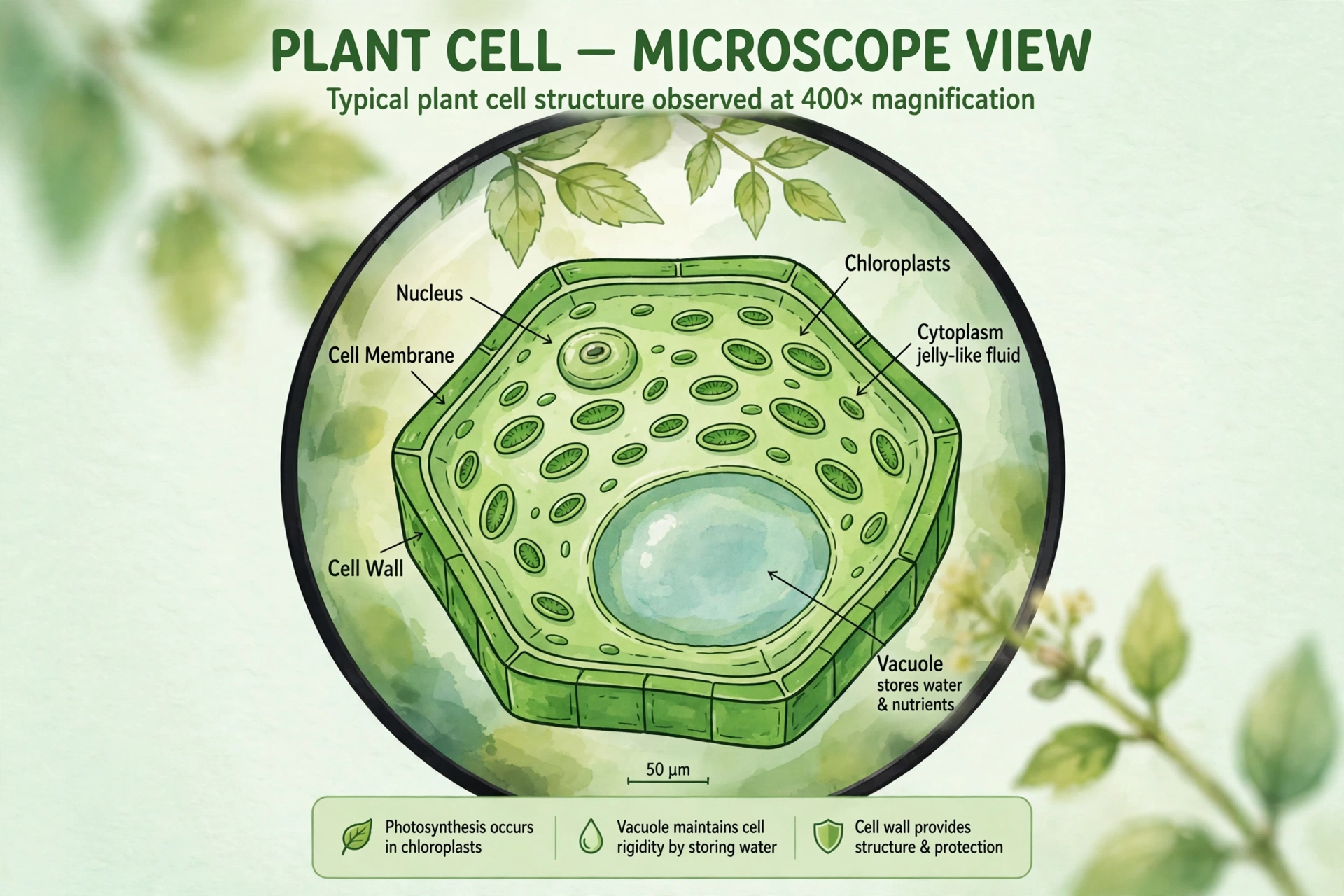
The cell wall is the tough outer layer, made mostly of cellulose. It gives the cell its shape, protects it, and lets neighbouring cells stick together to form strong tissue. Inside the wall is the cell membrane, a thin, flexible skin that controls what enters and leaves the cell. Water, minerals, and sugars pass through it in a controlled way, while harmful substances are kept out as far as possible.
Inside the membrane is the cytoplasm, a jelly-like fluid where most of the cell's chemical work happens. The nucleus is the control centre: it holds the plant's DNA, the instructions for building proteins, and it decides when the cell divides. The endoplasmic reticulum makes and moves proteins, while the Golgi apparatus sorts and packages them. The mitochondria are the power stations, breaking down sugars to release energy for growth, repair, and transport. The ribosomes are tiny factories that build proteins by following instructions from the nucleus.
Then there are the two structures that make plant cells unmistakable. The chloroplasts are green, disc-shaped organelles filled with chlorophyll, the pigment that captures sunlight. Inside them, photosynthesis turns light, water, and carbon dioxide into sugars and oxygen. The central vacuole is a large, fluid-filled sac that can take up most of the cell's volume. It stores water, sugars, and salts, and it presses the cytoplasm against the cell wall. That pressure, called turgor pressure, keeps a leaf firm and a stem upright. When a plant loses water, the vacuole shrinks, turgor falls, and the plant wilts. Water it, and the vacuole fills again.
How Plant Cells Work Together
A single cell cannot make a leaf. Cells work in groups called tissues, and tissues work in groups called organs. A leaf is an organ made of several tissues, each built from cells with a particular job. The same is true of a stem and a root. All these cells start with the same DNA, yet they specialise: a leaf cell becomes a photosynthesis specialist, a root cell an absorption specialist, and a stem cell a transport or support specialist. That specialisation lets a plant do many jobs at once without a brain, a heart, or muscles.
Leaf Cells: Capturing Light and Making Food
A leaf is a solar panel built from cells. Its upper surface is covered by a single layer of flat, transparent cells called the epidermis. They have no chloroplasts, so light passes straight through them. Over the epidermis is a waxy coating, the cuticle, which slows water loss. On the underside, the epidermis contains pairs of sausage-shaped guard cells, each pair surrounding a pore called a stoma. When the guard cells fill with water, they bend apart and the stoma opens, letting carbon dioxide in and oxygen and water vapour out. When they lose water, the stoma shuts, saving water on a hot day.
Below the epidermis is the palisade mesophyll, a layer of tall, tightly packed cells stuffed with chloroplasts. This is where most photosynthesis happens. Below them is the spongy mesophyll, a looser layer with large air spaces. Carbon dioxide diffuses through these spaces to the palisade cells, and oxygen diffuses out. The veins contain xylem and phloem cells that bring water in and carry sugars away. Leaf cells also protect the plant: some contain bitter chemicals that put insects off, and others grow into tiny hairs that make the leaf hard to chew. Even leaf colour is a cell story: green in summer from chlorophyll, yellow and red in autumn when chlorophyll breaks down and other pigments show through.
Stem Cells: Support and Transport
A stem has two jobs: hold the leaves up to the light, and move water and food between roots and leaves. The outer layer, the epidermis, protects the stem, and in woody plants it is replaced by bark made of dead, waterproof cork cells. Just inside is the cortex, a layer of cells that store food and, in young green stems, can photosynthesise a little.
Deeper inside are the transport tissues. Xylem cells are long, hollow, and dead when mature, forming pipes that carry water and minerals from the roots to the leaves, pulled up by evaporation from the leaves. Phloem cells are living tubes that carry sugars from the leaves to wherever they are needed: growing tips, roots, fruits, and storage organs. For support, collenchyma cells have thickened corners and are flexible, supporting young stems that still need to bend, while sclerenchyma cells have very thick, hard walls and form fibres that give wood its strength. In a tree trunk, most of the wood is xylem, built up year after year, and the living part is a thin layer just under the bark, the cambium, where new xylem and phloem cells are made each season.
Root Cells: Finding Water and Minerals
Roots live in the dark, so their cells do not need chloroplasts. Their job is absorption, anchorage, and storage. The tip is protected by a root cap, and just behind it cells grow longer, pushing the root forward into new soil. Further back, cells specialise. The most important are the root hairs, long, thin extensions of single epidermal cells that hugely increase the root's surface area. Water and minerals pass through the root hair membrane, then travel from cell to cell toward the centre, where the xylem picks them up.
Root cells use energy to pump minerals in, which is why healthy roots need oxygen: without it, the mitochondria cannot make enough energy, and absorption slows. That is why waterlogged soil can starve a plant even though water is everywhere. Some root cells store food — in a carrot or beetroot, swollen cells are packed with starch. Others host mycorrhizal fungi, which extend into the soil and bring back water and minerals in exchange for sugars, and legumes host bacteria in root nodules that fix nitrogen from the air.
Why This Matters in the Garden
Understanding cells makes gardening make sense. You water the soil, not the leaves, because root hairs absorb water. You feed plants because every cell needs nitrogen, phosphorus, potassium, and trace minerals. You prune in the right season because you are working with the cambium, the dividing cells that will heal the cut. You avoid waterlogging because root cells need oxygen. You put a plant in the right light because its palisade cells need enough light to run photosynthesis.
Try it with the AI identifier on aitreeidentier.site: photograph a leaf, stem, or root and see what the tool identifies.
Frequently Asked Questions
Do all plant cells have chloroplasts?
No. Only cells in green parts exposed to light, mainly leaves and young green stems, have many chloroplasts. Root cells have very few or none, and get their energy from sugars made elsewhere and from their mitochondria.
Why do plants wilt when they need water?
Because the central vacuole in each cell loses water and shrinks, so turgor pressure falls and the cells can no longer press firmly against their walls. Watering refills the vacuoles and restores the pressure.
Conclusion
Leaves, stems, and roots look very different, but they are all built from the same basic cell, adapted for a different job. The cell wall gives strength, the chloroplasts capture light, the vacuole stores water and keeps the plant firm, the nucleus gives instructions, and the mitochondria supply energy. In a leaf, those parts are arranged to catch light and make food. In a stem, they support and transport. In a root, they absorb and store. Once you can picture that, every plant becomes easier to understand, to grow, and to care for — because you are no longer looking at a green mystery, but at millions of tiny, hard-working cells doing their jobs.
Disclaimer: This article is for general education only. If a plant is for eating or medicine, confirm its identity with an expert before use, as some plants are toxic.