
Introduction: Why Leaves Are Clues
When botanists identify a plant, they rarely start with the flower. Flowers are seasonal, but leaves are present for much of the year, and they carry a surprising amount of information. Shape, edge, size, texture, vein pattern, and how leaves sit on a stem can narrow a plant down from hundreds of possibilities to just a few.
This guide explains the main leaf features botanists use, in plain language. You will learn the common shapes and margins, how to observe a leaf properly, and how to combine clues to make a confident identification in the field or garden.
Leaf Basics: Simple, Compound, and Arrangement
Before looking at shape, check the overall structure. A simple leaf has one blade on its stalk. A compound leaf has several leaflets on a shared stalk, which can look like many small leaves. A common beginner error is mistaking a leaflet for a whole leaf.
Why Leaf Shape Varies: Function Behind the Form
Leaf shape is not decoration; it is engineering shaped by climate. Deeply lobed leaves, such as those of oaks, shed heat and let wind pass through, which reduces the risk of overheating and tearing in exposed sites. In tropical rainforests, many leaves end in a pointed drip tip that sheds rainwater quickly, preventing a film of water that would block light and encourage fungal growth. In dry, hot places, leaves tend to be small, thick, or divided into leaflets, reducing the surface area exposed to sun and wind and so limiting water loss.
Compound leaves, where the blade is split into separate leaflets, offer another advantage: they can fold or droop in intense heat or at night, and if a leaflet is damaged by an insect or hail, the rest of the leaf keeps working. Leaf size also follows a pattern with temperature: leaves are generally larger in warm, moist climates and smaller in cold or dry ones, a trend botanists call the leaf size and temperature relationship. Once you know these patterns, leaf shape becomes a clue not only to identity but to the climate the plant evolved in.
Common Leaf Shapes
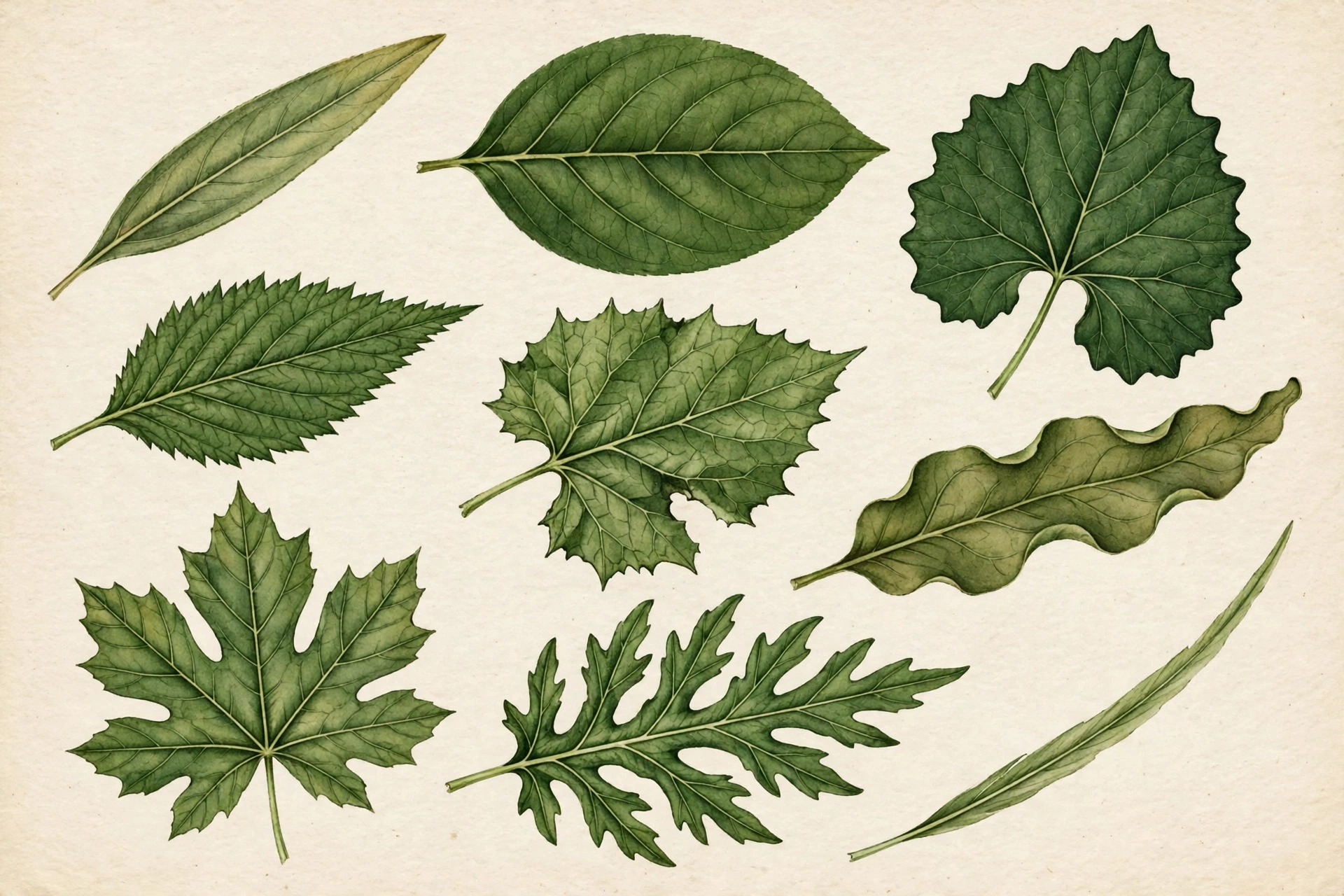
Botanists use a shared vocabulary for shape so they can describe a leaf precisely. These are the shapes you will meet most often:
- Ovate: Egg-shaped, wider near the base, like many lilac and beech leaves.
- Lanceolate: Long and narrow, tapering to a point, like willow or oleander.
- Elliptical: Oval, widest in the middle, like many magnolia leaves.
- Cordate: Heart-shaped, with a notch at the base.
- Orbicular: Almost round, like nasturtium.
- Linear: Very long and narrow, like grasses.
- Palmate: Hand-shaped, with lobes spreading from one point, like maple.
- Needle-like: Thin and pointed, like pine and spruce.
Leaf Margins: The Edge Tells a Story
The margin is the edge of the leaf blade. Learning a few margin terms will make plant guides much easier to use:
- Entire: Smooth, with no teeth or lobes.
- Serrate: Sharp teeth pointing forward, like a saw, as in many roses and nettles.
- Dentate: Teeth pointing outward rather than forward.
- Crenate: Rounded, scalloped teeth.
- Lobed: Deeply cut into sections, but not divided into separate leaflets, as in oak and maple.
- Undulate: Wavy edge, common in some hollies and beech.
- Spiny: Sharp points along the edge, as in holly.
Veins, Texture, and Other Clues
How to Identify a Plant from Its Leaves: Step by Step
1. Photograph the whole plant first. Include the stem, branching, bark or overall shape, and the habitat. 2. Photograph a mature leaf from above and below. Make sure the photo is in focus, well lit, and fills the frame. 3. Note the arrangement. Is it opposite, alternate, or whorled? Is the leaf simple or compound? 4. Describe the shape and margin. Use the terms above: ovate, lanceolate, serrate, entire, lobed, and so on. 5. Check veins and texture. Note whether veins are net-like or parallel, and whether the leaf is smooth, hairy, or waxy. 6. Use the Leaf Identifier. Upload a clear leaf photo to the Leaf Identifier on aitreeidentier.site and compare its suggestions with your own observations. 7. Cross-check with two or three features. Do not rely on shape alone. A match should agree on arrangement, margin, veins, and habitat. If it does not, keep looking.
Common Mistakes
Using one leaf only. Leaves vary by age, light, and position on the plant. Always examine several leaves from different parts of the plant.
Confusing leaflets with leaves. In compound leaves, each leaflet can look like a small simple leaf. Look for the bud at the base of the whole leaf stalk to tell the difference.
Ignoring arrangement. Arrangement is one of the most reliable features, yet beginners often skip it. Make it your second check after simple versus compound.
Identifying from a blurry photo. A blurry or shadowed photo hides margin and vein details. Take the photo again in natural daylight, with the leaf flat and still.
A Field Routine: Reading a Leaf in 60 Seconds
When you find an unknown plant, work through the same checks every time. First, look at arrangement: are leaves opposite each other on the stem, alternate, or whorled in rings? Next, decide whether the leaf is simple, with one blade, or compound, with several leaflets. Then note the shape, such as oval, heart-shaped, lance-shaped, or lobed, and run your finger along the margin to feel whether it is smooth, toothed, or wavy.
Then look closer: check the vein pattern, whether veins branch from a central midrib or fan out from the base, and feel the texture, whether the leaf is glossy, hairy, leathery, or papery. Crush a small piece gently and note any smell, since crushed leaves can be strongly aromatic in herbs and some trees. Photograph the leaf with a coin for scale, and take a second photo of the whole plant and its bark. These six checks take about a minute and, recorded together, are usually enough to narrow an unknown plant to a handful of candidates.
Frequently Asked Questions
Can you identify any plant from a leaf alone?
Often, yes, especially trees and common garden plants, but not always. Some species have very similar leaves and need flowers, fruit, bark, or location to separate them. Treat leaf identification as a strong lead, not always a final answer.
What is the difference between a lobed leaf and a compound leaf?
A lobed leaf is one blade cut into sections, but the cuts do not reach the midrib. A compound leaf is divided into separate leaflets, each with its own small stalk. This distinction matters a great deal for identification.
Should I pick a leaf to identify it?
If it is your own garden plant, a single leaf is usually fine. In parks, nature reserves, and other people's gardens, photograph the leaf in place instead of picking it, and follow local rules.
Why do leaves on the same tree look different?
Leaves in sun and shade on the same tree can differ greatly: sun leaves are often smaller, thicker, and more lobed, while shade leaves are larger and thinner to catch more light. Young trees and vigorous shoots also produce unusually shaped leaves, and some species, such as ivy and mulberry, are famous for changing leaf shape as they age.
Can leaf shape change with the seasons?
The shape of an individual leaf is fixed once it is fully grown, but the tree's overall leaf display changes through the year. Spring leaves may be softer and lighter, summer leaves are at their full size, and autumn leaves often curl and distort as they dry, which is why identification is easiest in late spring or summer.
Conclusion
Leaf shape, margin, arrangement, veins, and texture form a practical identification toolkit that anyone can learn. Start with the simple questions — simple or compound, opposite or alternate, smooth or toothed — and build from there. With clear photos, careful notes, and a tool such as the Leaf Identifier on aitreeidentier.site, you will soon recognise familiar species at a glance and approach unfamiliar ones with a method, not a guess. Practice on plants you already know, and your confidence will grow leaf by leaf.
Try it: Try the free Tree Researcher on aitreeidentier.site — identify a tree from a photo and learn more about the science behind it.
Safety note: This guide is for general learning only. Never eat or use a plant based on AI identification alone, and consult a local expert before using any plant for food or medicine.