
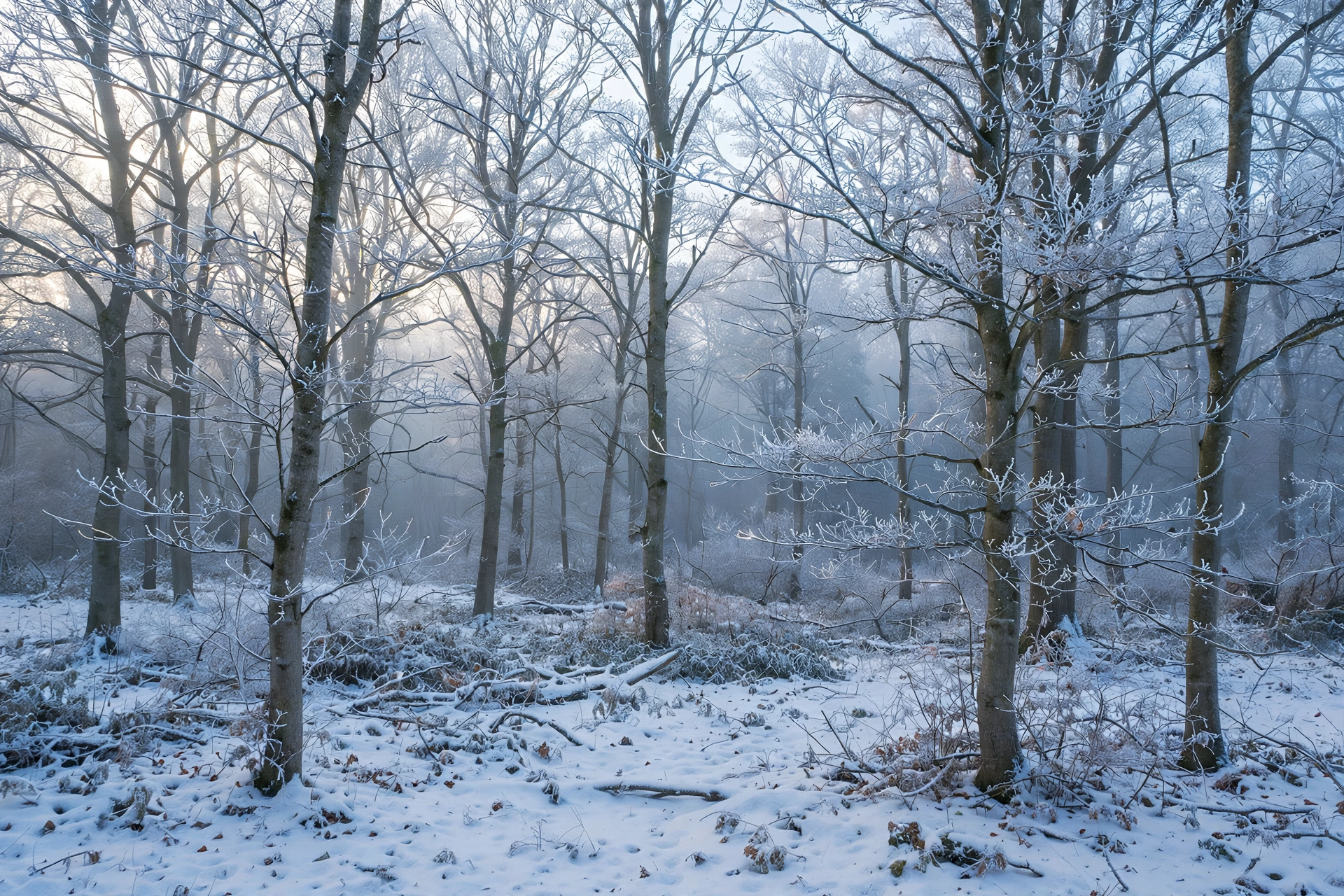
When the first frosts arrive and the leaves fall, a bare winter tree can look lifeless. The branches are empty, the bark is cold to the touch, and nothing seems to be happening at all. Yet beneath that still surface, the tree is alive and working hard. Winter survival is one of the most remarkable feats in the plant world, and it depends on a carefully timed sequence of changes that begins long before the cold arrives. Trees do not simply endure winter; they prepare for it for months, shutting down growth, changing the chemistry of their cells, and protecting the delicate living tissues that will burst back into leaf in spring.
Understanding how trees survive winter helps gardeners make better decisions too. It explains why autumn watering matters, why a sudden early frost can damage a tree that a much colder January night cannot, and why some species thrive in cold climates while others fail. The science of winter survival is a story of dormancy, sap, and cold protection, three processes that work together to keep a tree alive through months of freezing temperatures, drying winds, and short days.
What Dormancy Really Means
Dormancy is often described as a tree going to sleep, but that image is misleading. A dormant tree is not switched off. Its buds, roots, and cambium layer remain alive, breathing slowly and carrying out essential maintenance at a very low level. What dormancy really means is that growth has stopped on purpose, so the tree's energy can be directed towards survival instead of producing new leaves and shoots.
This shutdown is triggered mainly by day length. As nights grow longer in late summer and early autumn, trees sense the change through light-sensitive pigments in their leaves and buds. Falling temperatures reinforce the signal, but light is the primary cue, which is why trees in a mild autumn still drop their leaves on schedule. Once the signal is received, the tree begins hardening off: growth hormones fall, leaves stop producing food, and nutrients move from the leaves down into the trunk and roots for storage.
There are two stages to dormancy, and both matter. The first is endodormancy, a deep internal rest during which the buds will not grow even if the weather turns warm. This is a safety lock: without it, a mild spell in November could trick a tree into leafing out, only for the new growth to be killed by the next frost. The second stage is ecodormancy, a lighter rest in late winter when the internal lock has been released and the tree is simply waiting for warm enough weather. The shift between the two is controlled by chilling hours, the number of cold hours a tree needs before it is ready to wake up.
How Trees Prepare in Autumn
Preparation for winter begins in late summer, well before the first leaf turns colour. As days shorten, deciduous trees withdraw chlorophyll, the green pigment that powers photosynthesis, from their leaves. The green fades and the yellows, oranges, and reds underneath are revealed. This is not just a pretty display. It is the tree recovering nitrogen and other nutrients from its leaves before they are shed, storing them for the spring flush of growth.
At the same time, the tree seals off the connection between each leaf and its branch. A layer of corky cells forms across the base of the leaf stalk, cutting off the flow of water and nutrients. When the seal is complete, the leaf drops, and the scar left behind is sealed with a waterproof layer. Evergreen trees go through a similar hardening process, but because they keep their needles, their preparations focus more on changing cell chemistry than on shedding leaves.
The Science of Sap in Winter
Sap is the lifeblood of a tree, carrying water and nutrients from the roots to the leaves in spring and summer, and sugars from the leaves down to the roots in autumn. In winter, sap behaves very differently. As temperatures fall, the flow of sap slows to a trickle and then effectively stops in the above-ground parts of the tree. The tree is not pumping water upwards because there are no leaves to lose it through transpiration, and cold soil makes it hard for roots to take up water anyway.
What remains in the tree is not ordinary water. During hardening off, the tree changes the composition of the fluid inside its cells. It converts stored starches into sugars, mainly sucrose, and these sugars dissolve in the cell sap. Sugar water freezes at a lower temperature than pure water, so this change alone gives the tree a few extra degrees of protection. It also helps the cells hold on to water, reducing the risk of dehydration when the ground is frozen.
Some trees also produce special proteins that act as antifreeze. These antifreeze proteins bind to the tiny ice crystals that begin to form inside the tree and stop them from growing larger. Large, sharp ice crystals can puncture cell walls and kill the cell, while small crystals are far less damaging. Birch is famous for its cold tolerance and produces antifreeze proteins that help it survive temperatures far below freezing.
Antifreeze Compounds and Cold Hardiness
The combination of sugars, antifreeze proteins, and controlled dehydration gives each tree species a limit of cold hardiness, the lowest temperature it can survive. This limit is not fixed. A tree that can survive minus thirty degrees in January might be killed by minus five degrees in October, because in October it has not yet hardened off. Cold hardiness builds gradually through autumn, peaks in midwinter, and declines again in spring as the tree prepares to grow.
Conifers such as pine, spruce, and fir are among the toughest winter survivors. Their needle leaves have a thick waxy coating that limits water loss, and their cells accumulate high levels of sugars and protective compounds. Some Arctic and alpine conifers can survive temperatures below minus forty degrees, their cells entering a glassy, almost solid state in which ice simply cannot form.
The Dangers of Freeze and Thaw
Paradoxically, one of the greatest dangers to a tree in winter is not extreme cold but the cycle of freezing and thawing. When the sun warms the south-facing side of a trunk on a cold winter day, the bark and the tissues beneath it can thaw and become active, only to freeze again when the sun sets. This repeated expansion and contraction can split the bark, a problem known as frost cracking. Young trees and thin-barked species such as maple and cherry are especially vulnerable, and gardeners often protect them by wrapping the trunk or painting it with a light-coloured wash that reflects the sun.
How Trees Wake Up in Spring
The end of winter is as carefully managed as its beginning. As days lengthen and temperatures rise, the tree reverses the changes of autumn. The chilling requirement is met, the internal lock on the buds is released, and stored starches are converted back into sugars that fuel new growth. Water starts to move again, and in some trees, such as maple and birch, the rising sap is so strong that a cut branch will drip in late winter, a phenomenon used for centuries to collect maple syrup and birch sap.
Frequently Asked Questions
Do trees drink water in winter? Yes, but very slowly. Evergreen trees lose some water through their needles all winter, and deciduous trees lose a little through their bark and buds. Roots can take up water whenever the soil is not frozen, which is why autumn watering matters and why winter drought can damage trees.
Why do some trees survive much colder winters than others? Cold hardiness depends on the species and on how well it has hardened off. Trees native to cold climates produce more sugars and antifreeze proteins, dehydrate their cells more effectively, and need more chilling hours before waking. A tree planted outside its natural climate range often lacks these adaptations.
Can frost kill a tree that looks healthy in autumn? Yes. An early frost before the tree has hardened off, a late spring frost after bud burst, or repeated freeze-thaw cycles can all kill or damage a healthy tree. Sudden temperature changes are often more dangerous than steady, deep cold.
Conclusion
For gardeners, understanding this hidden winter life changes how we care for trees. Autumn watering, mulching, careful pruning, and choosing species suited to the local climate all work with the tree's natural defences rather than against them. The next time you look at a bare tree in January, remember that it is not doing nothing. It is surviving, quietly and brilliantly, and getting ready for spring. If you are curious about the trees around you, Try the plant identifier at aitreeidentier.site to identify them from a photo and learn more about how each species handles the cold.