
Try it: Not sure what you just planted? Try the free Tree Identifier on aitreeidentier.site — upload a leaf photo and confirm the species.
Introduction
Planting a tree looks simple: dig a hole, drop the tree in, fill it back up. In practice, the details matter enormously. A tree planted too deep, in a hole that is too narrow, with roots left circling, or without enough water in its first year, may survive but never thrive. It may grow slowly, lean, suffer in drought, or die in its second summer when you thought it was established.
When to Plant
The best time to plant most trees is when they are dormant — late autumn to early spring — when the soil is moist and the tree is not in leaf. Autumn planting is often ideal because the soil is still warm, roots can grow through winter, and the tree is ready to grow strongly in spring. Bare-root trees must be planted in the dormant season.
Bare-Root, Container-Grown, and Root-Balled: What Is the Difference?
Trees are sold in three main forms, and each needs slightly different handling. Bare-root trees are dug up while dormant and sold without soil around their roots. They are the cheapest option, they establish quickly because their roots have not been circling in a pot, and they are light and easy to handle — but they must be planted in the dormant season, and their roots must never be allowed to dry out. Keep them in a cool, damp place, or heel them into a trench of soil, until you are ready to plant, and soak the roots for a few hours before planting.
Container-grown trees are sold in pots and can be planted at almost any time of year, which makes them the most flexible choice. Their disadvantage is that roots can circle the pot, and a tree that has been in a pot too long may be pot-bound, with a dense mat of roots that needs teasing out or pruning before planting. Root-balled trees are field-grown, then dug up with a ball of soil wrapped in hessian. They are heavier and more expensive, but they establish well and are a good choice for larger specimens. Whatever form you buy, check the roots before planting: they should be firm, pale, and moist, not black, slimy, or dry.
Choosing the Planting Spot: Light, Shelter, and Space
Before you dig, spend a few minutes checking the spot at different times of day. A place that looks sunny at noon may be in deep shade by mid-afternoon, and a fruit tree that gets only three hours of sun will fruit poorly. Watch where the wind comes from, too: a spot that is sheltered by a fence or hedge will protect a young tree from drying winds and from frost. Think about what is above and below ground. Overhead wires, eaves, and gutters limit how tall a tree can grow, while drains, pipes, and foundations limit where its roots can go. A tree planted two metres from a house will become a problem; the same tree planted six metres away will become a pleasure. Take the time to measure, and to imagine the mature tree, before you pick up a spade.
Step 1: Prepare the Site and the Hole
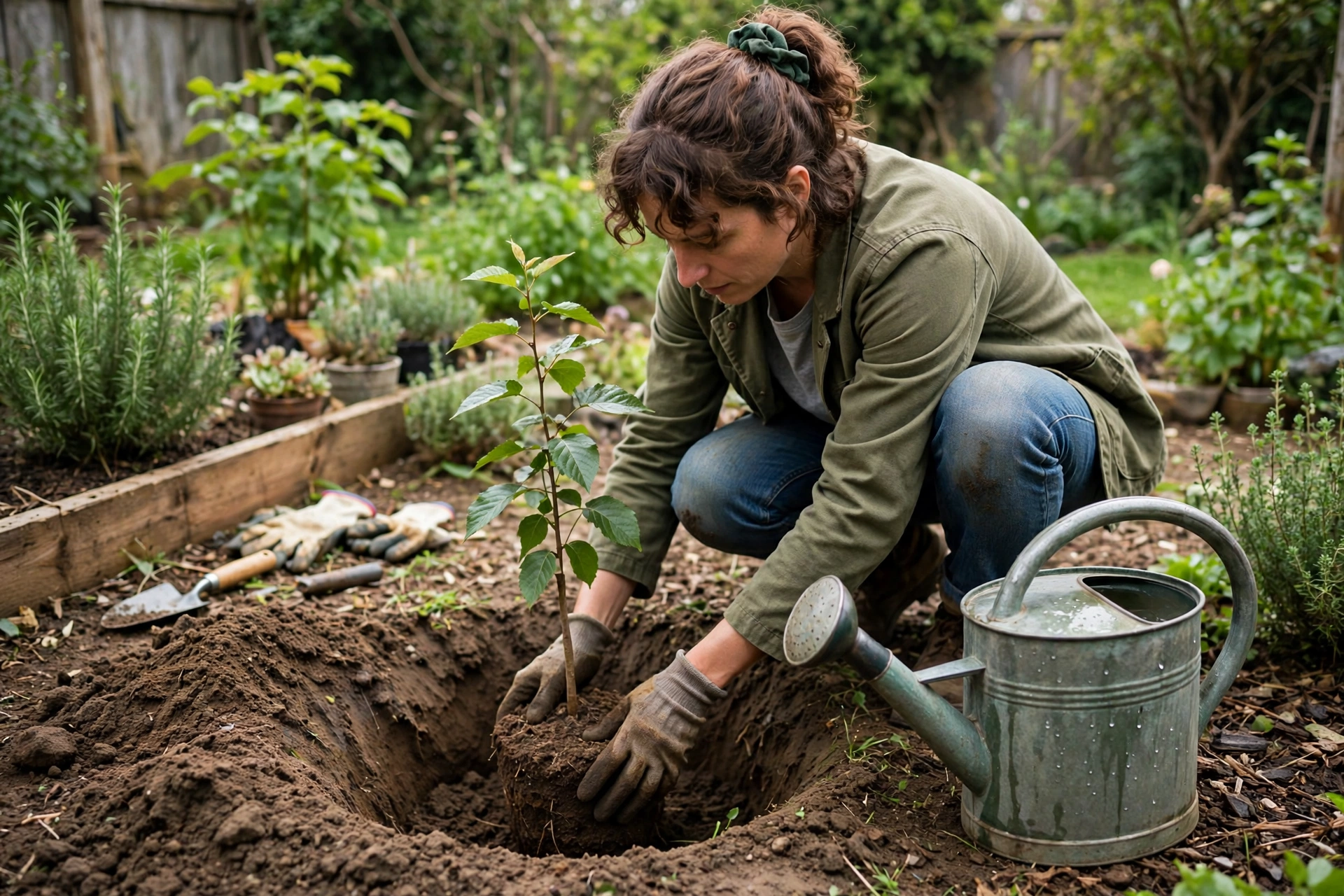
Choose the spot with the tree's mature size in mind, and check for underground pipes, cables, and drains before you dig. Clear grass and weeds from a circle at least one metre across. Grass competes fiercely with a young tree for water and nutrients. Dig a hole that is two to three times as wide as the root ball, but no deeper than the root ball. A wide, shallow hole lets roots spread outwards into loosened soil.
Step 2: Prepare the Tree
Water the tree well the day before planting, or soak a bare-root tree's roots in a bucket of water for a few hours. Remove the pot, hessian, or wrapping carefully. Inspect the roots and prune away any that are damaged, dead, or badly circling. If roots are tightly coiled around the pot, tease them out gently so they point outwards. This step is essential — a root that keeps circling can eventually strangle the tree.
Step 3: Plant, Water, and Mulch
Place the tree in the centre of the hole, with the root collar level with the surrounding ground. Lay a cane across the hole to check the level. Stand back and check the tree is upright and facing the way you want it. Backfill with the soil you dug out, firming gently as you go to remove large air pockets, but do not stamp it down hard.
Step 4: Stake Only If Needed
Many young trees do not need staking at all, especially in a sheltered garden. A tree that sways gently in the wind develops a stronger trunk and better roots. Stake only if the tree is top-heavy, the site is very windy, the root ball is unstable, or the tree is a standard with a tall, clear stem.
Aftercare in the First Two Years
The first two years are when most newly planted trees fail. Keep the base weed-free, water in dry spells, and check the tree after storms. Do not prune heavily in the first year — the tree needs its leaves to make energy and grow roots. Remove only dead, damaged, or crossing branches. Protect the trunk from strimmers and mowers, which can wound bark and let disease in. A simple guard or a mulch ring is often enough.
Common Mistakes to Avoid
- Planting too deep: The root flare should be visible at soil level.
- Digging too narrow a hole: Roots need loosened soil to spread into.
- Leaving circling roots: Tease them out or prune them before planting.
- Adding fertiliser to the hole: It keeps roots in the hole and can burn them.
- Mulch volcanoes: Keep mulch away from the trunk.
- Staking too high or too long: A stake should support, not immobilise, the tree.
- Watering lightly every day: Deep, infrequent watering builds deep roots.
FAQ
How much should I water a newly planted tree? In dry weather, give 10–20 litres once or twice a week in the first year, depending on tree size and soil. Water slowly so it soaks in, and check the soil 10 cm down — it should be moist, not wet or dry.
Should I prune a tree when I plant it? Only remove dead or damaged branches. Heavy pruning at planting reduces the leaves the tree needs to establish roots. Wait until the second year for shaping.
Can I plant a tree in summer? Yes, if it is container-grown and you water it well, but autumn or spring is easier and safer. Avoid planting in extreme heat or when the ground is frozen or waterlogged.
How long does it take for a tree to establish? A useful rule is one year per 2.5 cm of trunk diameter. A small tree may establish in a year; a large standard may take two to three years. Keep watering and weeding during that period.
Should I add compost to the planting hole? A little well-rotted compost mixed with the backfill soil can help, but do not fill the hole with pure compost or fertiliser. Roots that find rich soil in the hole may stay there instead of spreading into the surrounding ground, which makes the tree less stable.
How do I protect a young tree from animals? Rabbits, deer, and voles can strip bark from a young tree in a single winter. A plastic or wire guard around the trunk, and a fence if deer are a problem, will protect the tree until its bark thickens and it can defend itself.
Conclusion
Planting a tree correctly is mostly about resisting shortcuts. Dig wide, not deep. Plant at the right level, with roots spread out. Water deeply, mulch properly, and stake only if you must. Those habits, plus regular watering in the first two years, give a tree the start it needs to grow into a healthy, long-lived part of your garden.
Safety note: Never eat or use any part of a tree based on an AI identification alone. If you are unsure about a species or its safety, consult a local expert before planting it.