
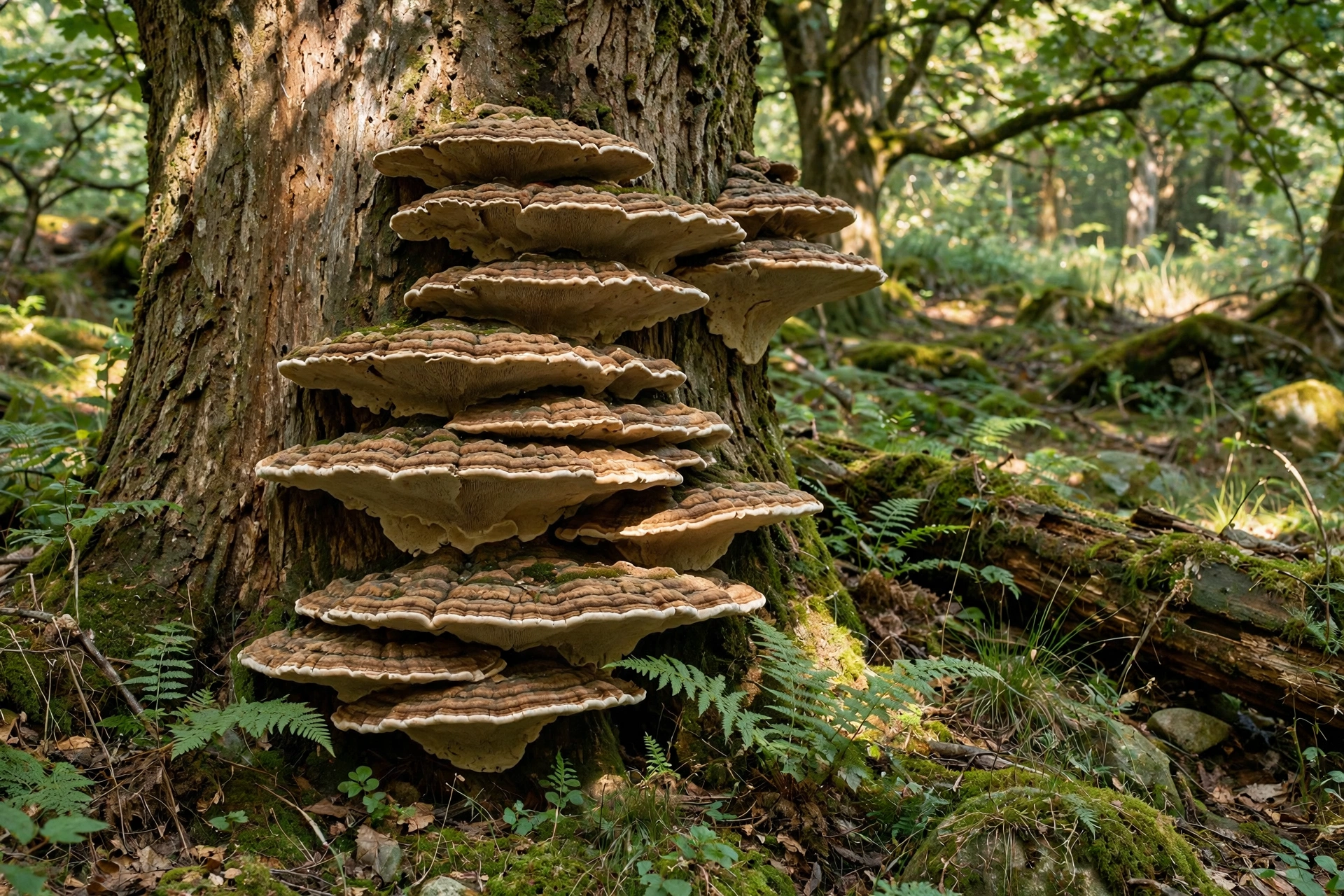
Walk through any mature woodland in autumn and you are almost certain to spot them: hard, shelf-like growths jutting from the trunks of old trees, sometimes stacked in tiers like steps, sometimes spreading in a single broad fan. These are bracket fungi, also known as shelf fungi, and they are among the most visible and misunderstood organisms in the world of trees. To the casual walker they look like part of the tree itself, yet they are the fruiting bodies of fungi living inside the wood, and their appearance can tell you a great deal about the health of the tree that hosts them.
Learning to identify bracket fungi is a useful skill for any gardener, tree owner, or woodland walker. Some species are harmless recyclers that appear only on dead wood, while others signal serious internal decay in a living tree that may need professional attention. Telling the two apart can help you decide whether a tree is safe, whether it needs care, or whether it is simply playing its natural part in the cycle of the forest.
What Are Bracket Fungi?
Bracket fungi are the visible fruiting bodies of wood-decay fungi that live inside the trunks and branches of trees. Unlike mushrooms, which grow from the ground and last only a few days, brackets are tough, woody structures that can survive for months or years, releasing millions of spores into the air over their lifetime. The fungus itself is a network of fine threads called mycelium, hidden deep inside the wood, and the bracket is simply its reproductive organ, the part that produces spores. When you see a bracket on a trunk, you are looking at only a small part of a much larger organism.
The shape of a bracket is a clue to its identity. Most are semicircular or fan-shaped, with a hard upper surface and a fertile underside that may be covered in tiny pores or gills. Some are thin and flexible when fresh, while others are thick, woody, and as hard as the tree itself. They can range from a few centimetres across to more than half a metre wide, and some species add a new layer of growth each year, producing visible rings like the growth rings of a tree. Their colours vary widely, from pale cream and grey to rich browns, oranges, and even striking bands of colour.
Common Bracket Fungi to Recognise
One of the most familiar species is the artist's bracket, Ganoderma australe, a large, dark brown fungus with a pale margin that grows on oaks, beeches, and other broadleaf trees. Its white underside bruises brown when touched, which is how artists once drew on it, giving the fungus its common name. Another common species is the turkey tail, Trametes versicolor, a small, thin, fan-shaped bracket with concentric bands of brown, cream, and blue-grey. Turkey tail grows in overlapping clusters on dead logs and stumps, and it is one of the most widespread fungi in the world.
Birch trees have their own distinctive bracket, the birch polypore, Piptoporus betulinus, a smooth, pale, kidney-shaped fungus that grows only on birch. On oaks, look out for the beefsteak fungus, Fistulina hepatica, a soft, fleshy bracket that oozes a red juice when cut, resembling raw meat. The sulphur polypore, Laetiporus sulphureus, is unmistakable, with bright yellow and orange shelves that appear on oaks and other trees in summer. Each species has its own preferred host, shape, and colour, and learning these details is the key to identification.
What Bracket Fungi Mean for Tree Health
The presence of bracket fungi on a living tree is a sign that decay is already happening inside the wood. Different fungi attack different parts of the tree, and this matters for safety. White rot fungi break down both lignin and cellulose, leaving the wood pale, soft, and spongy. Brown rot fungi attack mainly the cellulose, leaving the wood brown, dry, and crumbly, breaking into cubes when it fails. Both types weaken the tree, but brown rot is generally more serious for structural strength, because the wood loses its ability to bend and can snap suddenly.
However, a bracket on a tree does not automatically mean the tree is about to fall. Many trees live for years, even decades, with internal decay, growing new wood around the damaged area and remaining perfectly stable. The fungus is often a symptom of an older problem, such as a wound, a pruning cut, or root damage, rather than the cause of the trouble. What matters is the extent of the decay, the species of fungus, the size and position of the tree, and whether it stands near people, buildings, or roads. A bracket on a tree in the middle of a wood is part of nature; the same bracket on a tree overhanging a pavement deserves a closer look.
How to Identify Bracket Fungi Safely
When you find a bracket fungus, start by noting the tree it grows on, since many species are host-specific. Look at the size, shape, and colour of the bracket, the texture of its upper surface, and the underside, which may have pores, gills, or teeth. Take a photograph from several angles, including the underside, and note the time of year, because some species appear only in certain seasons. A good field guide or identification app can help you narrow the species down, but never rely on a single feature, as many brackets look alike.
Never eat a bracket fungus based on your own identification. A few species are edible when young, but many are tough, bitter, or toxic, and some edible species have dangerous lookalikes. Even handling brackets is best done with care, washing your hands afterwards, since some people are sensitive to fungal spores. If you want a confident identification, consult a local fungus group or a qualified arborist, who can examine the fungus in person. For the tree owner, the important question is not just which fungus it is, but what it means for the tree.
What to Do If You Find Bracket Fungi on Your Tree
If you find brackets on a tree in your garden, do not panic, and do not try to remove the fungus by cutting it off. The bracket is only the fruiting body, and removing it does nothing to the mycelium inside the wood. Instead, assess the situation calmly. Note how many brackets there are, where they are growing, and whether the tree shows other signs of trouble, such as dead branches, thinning leaves, or cracks in the trunk. If the tree is small, healthy-looking, and far from anything it could damage, you may simply monitor it over the coming seasons.
If the tree is large, stands near a house, road, or path, or shows several brackets at the base of the trunk, call a qualified tree surgeon or arborist for an inspection. They can assess the extent of decay with specialist tools and advise whether the tree needs pruning, bracing, or removal. Never ignore brackets at the base of a tree, as these often indicate root decay, which is the most serious kind. In the meantime, keep the area around the tree free of heavy loads, avoid damaging the roots, and resist the urge to paint or seal wounds, as this can trap moisture and make decay worse.
Frequently Asked Questions
Are bracket fungi dangerous to people? Bracket fungi are not dangerous to touch, but they should not be eaten unless identified with complete certainty by an expert. Their spores can irritate sensitive people, so avoid breathing in clouds of spores from a disturbed bracket, and wash your hands after handling one.
Does a bracket fungus mean my tree will die? Not necessarily. Many trees live for years with bracket fungi, walling off the decay and continuing to grow. The risk depends on the fungus species, the amount of decay, and the tree's location. A professional inspection is the best way to judge whether action is needed.
Can bracket fungi spread to other trees? Bracket fungi spread by spores, which are released in huge numbers and carried on the wind. Healthy trees are usually able to resist infection, but spores can colonise wounds, pruning cuts, and damaged roots. Keeping trees healthy and avoiding unnecessary wounds is the best protection.
Conclusion
Bracket fungi are a fascinating and important part of the life of trees, recycling dead wood and returning nutrients to the soil. Learning to identify them helps you understand what is happening inside your trees and when to seek help. A bracket on a trunk is not a reason to panic, but it is a reason to pay attention, to observe the tree over time, and to call in a professional if the tree could pose a risk.
If you are unsure which tree a bracket fungus is growing on, Try the plant identifier at aitreeidentier.site to identify the tree in seconds.