
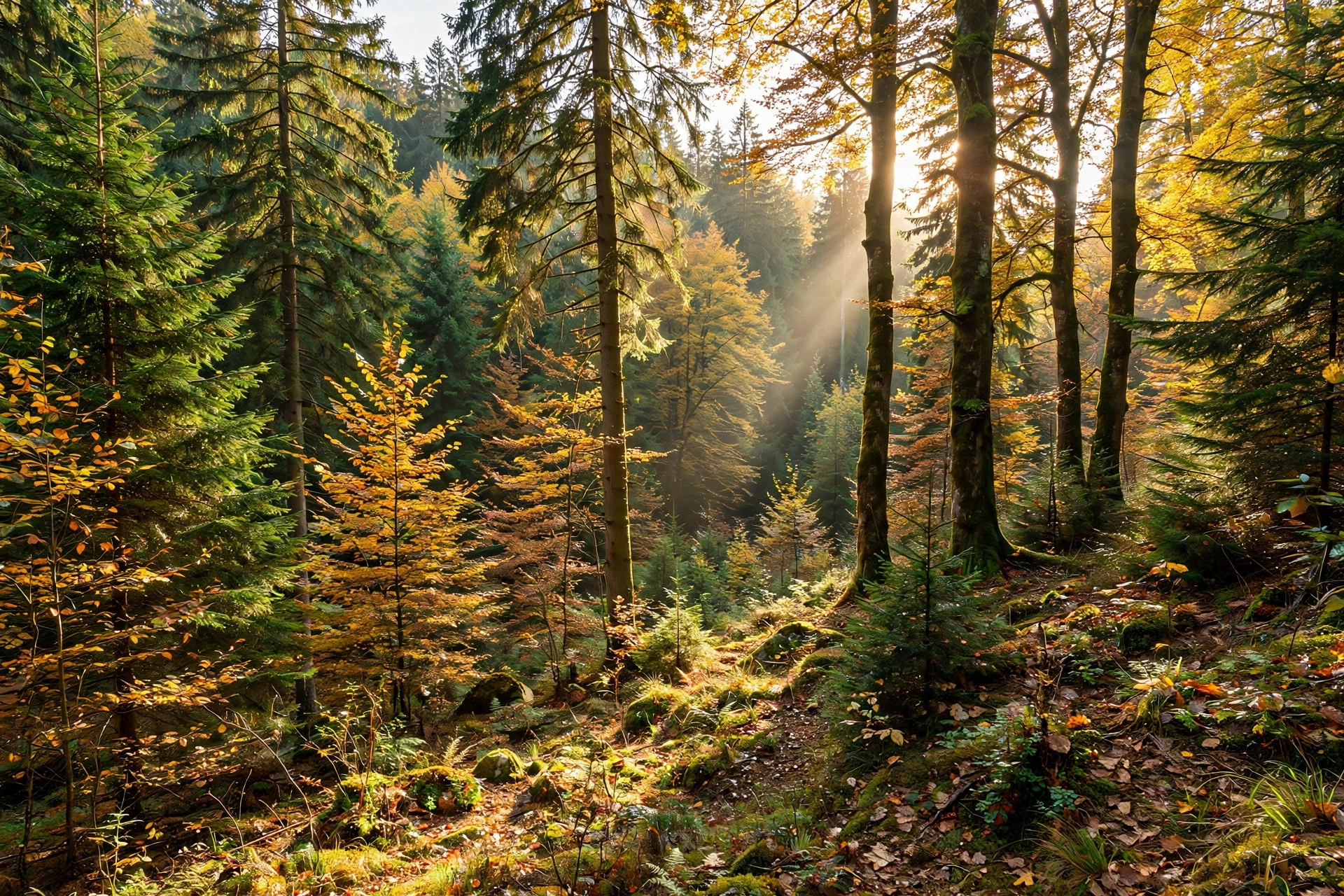
A single forest photo can tell you a surprising amount about where you are, what season it is, and what kind of ecosystem surrounds you. The trick is knowing what to look for. Deciduous, evergreen, and rainforest types each have a distinct visual signature: the shape of the canopy, the colour and texture of the leaves, the density of the undergrowth, and even the quality of the light filtering through the trees. Learning to read those signs helps you enjoy walks more, take better nature notes, and understand the landscape you are standing in.
You do not need a botany degree to start. With a clear photo and a few structured observations, most people can narrow a forest down to its broad type in minutes. AI tools can help by highlighting patterns you might miss, but your own eyes — and a little practice — do most of the work. The habit that speeds learning fastest is simple: every time you photograph a forest, write down the date, the place, and your best guess at the forest type, then check your guess later. Within a few walks, the patterns start to stick.
Deciduous Forests: Broad Leaves and Changing Seasons
Deciduous forests are defined by broadleaf trees that shed their leaves each year, usually in autumn. Oaks, beeches, maples, birches, and ash are typical examples. In spring, the canopy is fresh and light green, and wildflowers carpet the floor before the leaves fully open. In summer, the canopy is dense and shady, and the forest feels cool and green. In autumn, the leaves turn gold, orange, and red in a display that is one of the clearest identification clues of all. In winter, the bare branches reveal the shape of the trees and let you see nests, woodpecker holes, and the structure of the woodland.
Look for signs beyond the trees: a thick layer of leaf litter on the ground, spring flowers such as bluebells and wood anemones, and fungi in autumn feeding on the fallen leaves. Deciduous forests are usually found in temperate regions with distinct seasons, and they support a wide range of wildlife, from woodpeckers and owls to deer, badgers, and countless insects that feed on the leaves and the leaf litter below.
Evergreen Forests: Cones, Needles, and Year-Round Green
Evergreen forests keep their foliage all year. Most are coniferous — pines, spruces, firs, and cedars — with needle-like or scale-like leaves and cones. Their crowns are often conical, which helps them shed snow, and their colour is a deep, cool green in every season. The forest floor is usually carpeted with fallen needles, moss, and ferns, and the light inside is dimmer and more even than in a deciduous forest.
Some evergreen forests are broadleaf rather than coniferous, especially in warmer climates, where trees such as holly, magnolia, and live oak keep leathery, glossy leaves through the year. These can be confusing in a photo, because they look broadleaf but never lose their leaves. The clue is the season: if a photo taken in deep winter shows a full green canopy with broad leaves, you are probably looking at a broadleaf evergreen forest. Evergreen forests also tend to have more acidic soil, which suits plants such as bilberry, heather, and certain ferns.
Rainforests: Layers, Vines, and Humidity
Rainforests are the most layered of all forest types. In a tropical rainforest, the canopy is high and uneven, with emergent trees rising above it, vines and lianas hanging between layers, and epiphytes — plants that grow on other plants — clinging to branches. The undergrowth is dense, with large-leaved plants, ferns, and seedlings competing for the small amount of light that reaches the floor. The air is humid, the light is soft and green, and mist or rain is common.
Temperate rainforests exist too, in places such as the Pacific Northwest and parts of Britain and Ireland, where high rainfall and mild temperatures support moss-draped trees, ferns, and lichens. These forests look lush and green year-round, but they lack the tall emergent layer and the huge diversity of tropical rainforests. When judging a photo, look for the combination of many layers, climbing plants, and signs of constant moisture, rather than any single feature.
Step-by-Step: Identify a Forest Type from a Photo
Step 1: Look at the canopy first
Start at the top. Is the canopy rounded and broad, pointed and conical, or layered and uneven? Rounded crowns suggest broadleaf deciduous trees. Pointed, conical crowns suggest conifers. A multi-layered, uneven canopy with trees of many heights suggests rainforest.
Step 2: Zoom in on leaves and needles
Look closely at the foliage. Broad, flat leaves point to deciduous or broadleaf evergreen trees. Needles, scales, or cones point to evergreen conifers. Small, glossy, or leathery leaves in a dense, humid scene may point to rainforest species. If you can photograph a single leaf or branch clearly, identification becomes much easier.
Step 3: Check the forest floor and undergrowth
What is growing underneath? Leaf litter and spring wildflowers suit deciduous forest. A carpet of needles, moss, and ferns suits evergreen forest. Dense ferns, seedlings, vines, and shrubs at every level suit rainforest. Bare, dry ground with sparse undergrowth may suggest a drier forest type.
Step 4: Notice the light, colour, and season
Season matters. Bare branches in a photo taken in winter do not mean the forest is dead — it may simply be deciduous. Bright, warm autumn colours are a classic deciduous clue. Cool, dark green tones year-round suggest evergreen. Soft, green, humid light with mist suggests rainforest.
Step 5: Use an AI tool to confirm your guess
Upload your photo to the Forest Identifier on aitreeidentier.site and compare its suggestion with your own observations. Use it as a second opinion, not a final verdict. If the tool and your notes agree, you have a confident identification. If they disagree, look again at the canopy and leaves — one of you has spotted something the other missed.
Common Mistakes to Avoid
Judging by one tree alone. A single pine in a deciduous wood does not make it an evergreen forest. Look at the dominant trees across the whole photo.
Ignoring the season. A deciduous forest in winter looks very different from the same forest in summer. Always note when the photo was taken.
Confusing dense with rainforest. A dense summer deciduous forest can look lush, but rainforest has more layers, vines, and humidity clues. Density alone is not enough.
Relying on colour alone. Colour changes with light, camera settings, and season. Combine colour with leaf shape, canopy shape, and undergrowth.
Using a cropped or close-up photo only. A close-up of a leaf can identify a tree, but it cannot identify a forest type. For forest type, you need a wide shot that shows the canopy, the trunks, and the ground together.
FAQ
Can I identify a forest type from one photo? Often, yes, at a broad level. One clear photo showing canopy, leaves, and undergrowth is usually enough to distinguish deciduous, evergreen, and rainforest. A close-up of a single leaf alone is harder.
What is the easiest clue for beginners? Leaf shape. Broad leaves versus needles is the fastest split, and it works in most photos. Start there, then check the canopy.
Do mixed forests exist? Yes, and they are common. Many forests contain both deciduous and evergreen trees. In that case, describe the dominant type and note the mixture.
Can AI identify a forest type accurately? AI can give a useful starting point, especially from a clear, wide photo. Accuracy improves with good light, a wide view, and visible leaves. Always cross-check with your own observations and local knowledge.
What is the best photo to take for forest identification? Take two: a wide shot showing the canopy, trunks, and forest floor together, and a close-up of a leaf or branch from a dominant tree. Together they give both the forest type and a clue to the tree species, which is far more useful than either photo alone.
Conclusion
Identifying forest types from a photo is a skill anyone can learn: canopy shape, leaf type, undergrowth, and light tell the story. Start with broad leaves versus needles, check the forest floor, and note the season. Photograph widely and closely, use the Forest Identifier on aitreeidentier.site as a helpful second opinion, and keep a simple note of what you saw. Over time, you will start to recognise forest types at a glance — and every walk will feel richer for it.
Safety note: Stay on marked paths, respect local rules, and do not eat or use any wild plant or mushroom based on AI identification alone. Consult a local expert if you are unsure.