
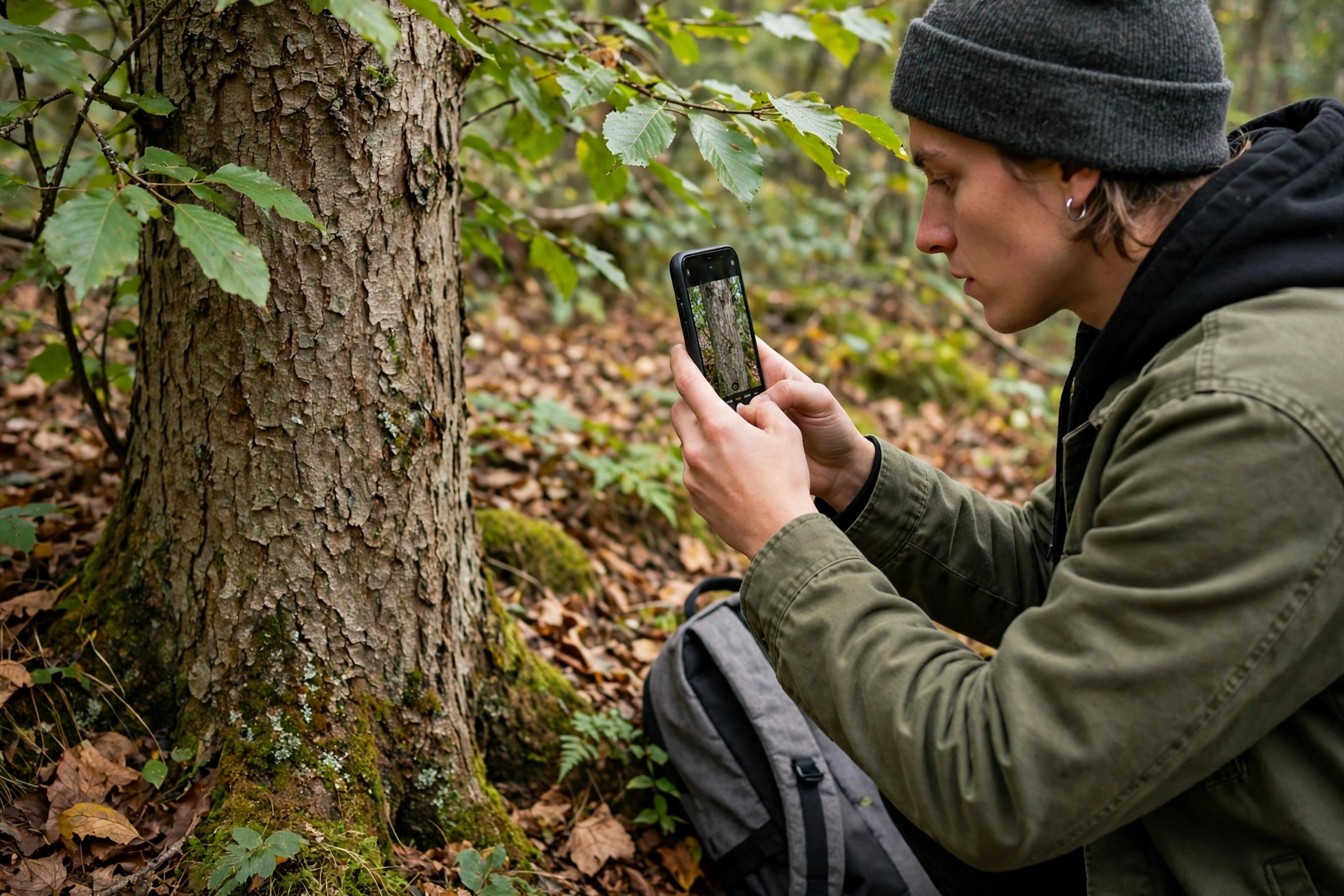
A tree you cannot name is easy to walk past and forget, yet learning its identity changes how you see a garden, a park, or a woodland walk. Identifying a tree from a photo is now something anyone can do, whether you are a curious beginner, a gardener planning new planting, a student, or a homeowner trying to work out what is growing beside a fence. You do not need a botany degree, a heavy field guide, or years of experience. You need a clear photo, a little patience, and a method for looking at the right features in the right order.
Trees reveal themselves through several clues at once. Leaves tell you about shape and arrangement, bark tells you about age and species, flowers and fruit confirm the identification at particular times of year, and the overall shape adds useful context. No single clue is always enough, especially in winter or when a tree is young, but together they narrow the possibilities quickly.
The method in this guide works in every season, though the clues change. In spring and summer, leaves and flowers do most of the work; in autumn, fruit and leaf colour help; in winter, bark, buds, and shape take over. Learning to use whichever clues the season offers is the key to identifying trees all year round.
How to Photograph a Tree for Identification
Good identification starts before you upload anything. A blurry, distant, or shadowy photo makes even the best tool guess, while a few clear close-ups make the answer far more reliable.
Take three kinds of photo. First, a whole-tree photo from a distance, showing the shape, height, and branching pattern. Second, close-ups of the most distinctive features: a mature leaf photographed flat in good light, a section of bark photographed straight on, and any flowers or fruit that are present. Third, a detail photo that shows something small but decisive, such as the underside of a leaf, the arrangement of buds, or the shape of a seed. Use natural daylight, avoid flash and deep shade, and fill the frame with the feature you want identified. Include a hand or coin for scale when the feature is small, and take several photos so you can choose the sharpest ones.
Step-by-Step: Identify a Tree from a Photo
Step 1: Start with the Leaves
Leaves are usually the fastest clue. First, ask whether the tree is broadleaved or coniferous. Broadleaved trees have flat leaves, while conifers usually have needles or scales. Next, look at leaf arrangement: are leaves opposite each other on the twig, or alternate? Opposite leaves are found on maples, ashes, and horse chestnuts, while alternate leaves are more common. Then look at shape — simple or compound, lobed or unlobed — and at the edge, which may be smooth, toothed, or wavy. Finally, check the veins, stalk length, and whether the leaf is hairy, glossy, or dull underneath.
Step 2: Check the Bark
Bark changes with age, so compare bark on a young branch with bark on the main trunk. Note the colour, whether it is smooth, rough, flaky, deeply furrowed, or peeling, and whether it has distinctive patterns such as horizontal lines, diamond shapes, or plates. Silver birch, for example, has striking white peeling bark, while oak bark becomes deeply ridged with age. Photograph bark straight on, without flash, and include a hand or coin for scale if that helps.
Step 3: Look for Flowers and Fruit
Flowers and fruit are often decisive. Note the colour, size, number of petals, scent, and time of year. Catkins, blossom, berries, nuts, cones, winged seeds, and pods each point to particular families. A tree with clusters of white blossom in spring followed by small red berries is a very different candidate from one with large woody cones. Photograph flowers and fruit from the side and from above, and note whether they grow singly or in clusters.
Step 4: Upload, Compare, and Confirm
Upload your clearest photo first — usually a mature leaf or a fresh flower — and read all the top suggestions, not just the first one. Compare each suggestion against the other features you recorded: bark, arrangement, fruit, size, and season. The best match should agree on several points. If the suggestions disagree, upload a second photo of a different feature, such as bark or fruit. If you can, return to the tree in another season and photograph its leaves, flowers, or fruit to confirm the identification.
Common Mistakes to Avoid
One common mistake is relying on a single leaf. Leaves vary within a tree, especially between sun and shade, young and old growth, and spring and autumn. Always check several leaves and another feature such as bark or fruit. Another mistake is photographing a tree from too far away, so the leaves become a green blur. Get close, and take separate photos for each feature. A third mistake is ignoring the season. A tree in autumn colour, in winter bud, or in spring blossom can look very different, and some features are only present for a few weeks. Finally, do not assume a planted garden tree is native. Gardens and streets contain many introduced species and cultivars that look similar to native trees but differ in important details.
Another mistake is using a leaf that has fallen to the ground. Fallen leaves may be faded, damaged, or blown in from another tree, and they lose the context of arrangement and stem. Always photograph a leaf still attached to the tree when you can, and note whether the leaves on the branch are opposite or alternate. Similarly, avoid photographing a leaf in strong backlight, which hides veins and colour, and avoid using a zoomed photo taken from a distance, which loses the fine detail that identification depends on.
Frequently Asked Questions
Can I identify a tree from just one photo?
Sometimes, yes, if the photo is clear and shows a distinctive leaf, flower, or fruit. In many cases, however, one photo is not enough. A leaf alone can be ambiguous, and bark alone can be misleading in young trees. For the best result, upload a clear leaf close-up plus a bark photo and, if available, a flower or fruit photo.
What is the best part of a tree to photograph?
A mature leaf photographed flat in good light is usually the best single photo. Add a bark photo and a whole-tree photo for context, and include flowers or fruit when they are present. Together, these give the most complete picture.
Can I identify a tree in winter when it has no leaves?
Yes, but it is harder. Focus on bark, buds, twig arrangement, overall shape, and any remaining fruit, cones, or seed cases. Opposite versus alternate buds, bud colour and size, and bark texture become especially useful in winter.
How do I tell a maple from an ash tree?
Both have opposite leaves, but maple leaves are usually simple and lobed, while ash leaves are compound, made of several leaflets along a central stalk. In winter, maple buds are small and pointed, while ash buds are large, dark, and blunt. Check both leaf shape and buds to separate them.
What if the tree is too tall to photograph its leaves?
Look for fallen leaves on the ground beneath the tree, but check that they belong to that tree by comparing them with leaves still on low branches. Photograph the bark at chest height, the overall shape, and any fruit or seeds on the ground. A pair of binoculars or your phone's zoom can also help you study leaves high in the canopy.
Conclusion
Identifying a tree from a photo is a skill anyone can learn, and it becomes easier with practice. Start with clear, well-lit photos of leaves, bark, flowers, and fruit, work through the features step by step, and check that several clues agree before you settle on a name. Use AI identification to narrow the possibilities quickly, then confirm with your own observations. Over time, you will start to recognise familiar species at a glance — and every walk will become more interesting.
Try it: Try the free Tree Identifier on aitreeidentier.site — photograph a leaf, bark, or flower for instant guidance.
Safety disclaimer: Never eat, use, or apply any part of a tree, plant, mushroom, or fruit based on AI identification alone. Some species are toxic or easily confused with lookalikes. Consult a local expert before any use.