
Try it: Worried your tree is diseased? Try the free Tree Disease Identifier on aitreeidentier.site — upload a photo of the leaves, bark, or damage.
Introduction
A tree that was once healthy can start to struggle — leaves turn yellow, growth slows, branches die back, or the canopy thins. It is worrying, especially if the tree is large, old, or sentimental. The good news is that many struggling trees can recover, provided the cause is found and addressed early.
Step 1: Look at the Whole Tree and Its History
Start by standing back and looking at the whole tree. Is the problem in one branch, one side, or the whole canopy? Is growth slow everywhere, or only in part? Are leaves small, pale, or sparse? Is there dead wood in the crown? Are there signs of damage to the trunk — wounds, cracks, fungal brackets, or bark falling away? Then think about history.
Recent Changes: The Questions That Solve Most Mysteries
When a tree starts to struggle, the cause is often something that changed recently, and the gardener who finds that change finds the answer. Has a driveway or patio been laid nearby, cutting off water and air to the roots? Has soil been piled against the trunk during building work? Has a trench been dug for a cable or pipe through the root zone? Has the lawn been treated with weedkiller, or has a neighbour sprayed something that drifted across the fence? Has there been a long dry spell, a flood, or a very cold winter? Even a change in mowing, such as strimming right up to the trunk every week, can wound the bark and let disease in over time.
Walk around the tree and look at the ground as carefully as the canopy. New hard surfaces, compacted soil from vehicles or foot traffic, and changes in drainage are among the most common causes of decline, and they are all underground, where they are easy to miss. If you can link the start of the problem to a date — the summer the extension was built, the winter the drain was replaced — you have a strong lead. Tell your arborist about that date when you call them, because it will focus their investigation and may save the tree.
Improving the Soil Around a Struggling Tree
Most recovery plans come back to the soil, because healthy roots are the foundation of a healthy canopy. Start by clearing grass and weeds from a wide ring around the base, at least a metre across for a young tree and out to the drip line for a mature one, and mulch that ring with 5 to 8 centimetres of compost or bark chips, kept clear of the trunk. If the soil is compacted, aerate it gently with a garden fork, pushing the fork in and wiggling it to open small channels for air and water, taking care not to damage large roots. Avoid heavy digging under the canopy, which can sever the very roots you are trying to save.
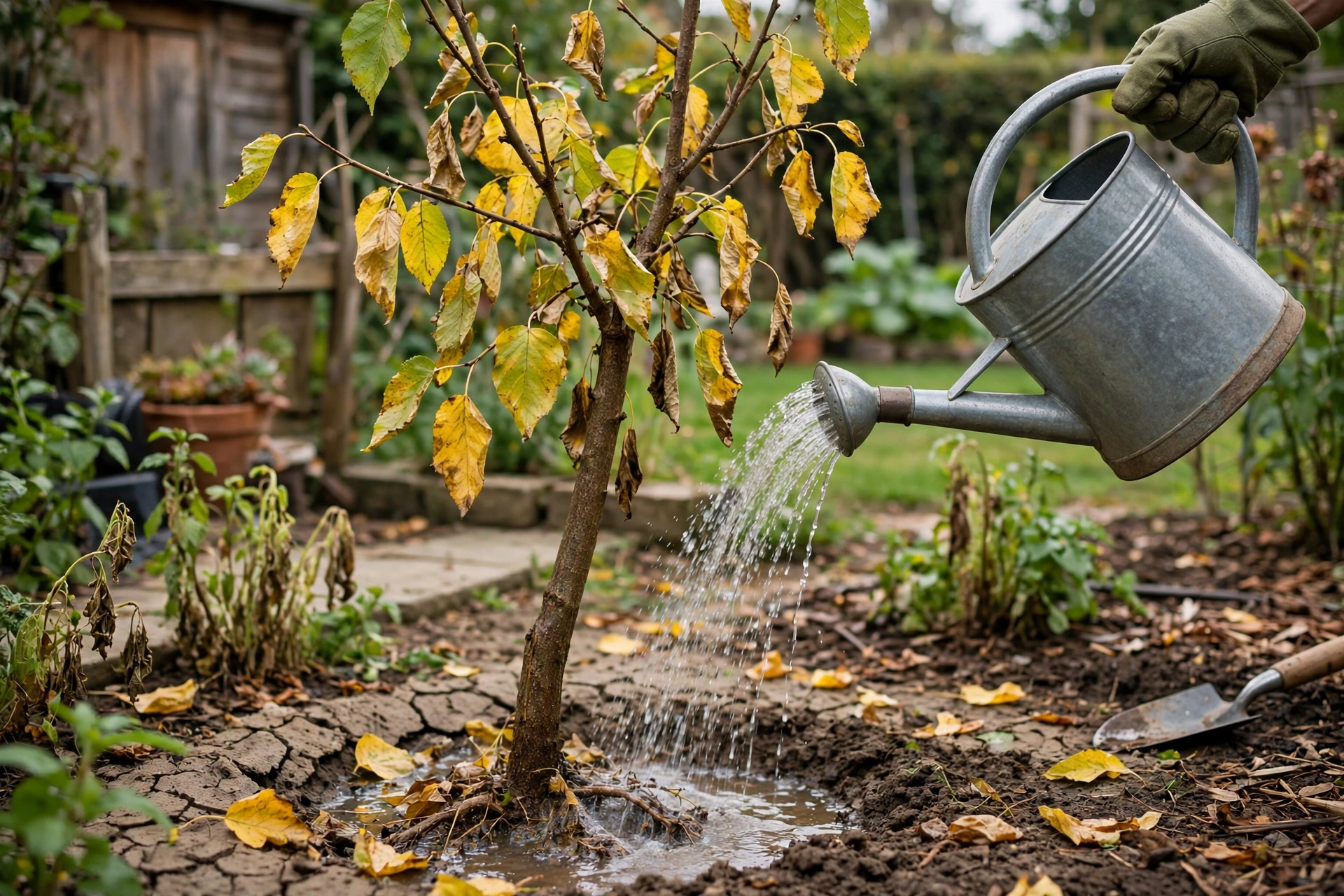
Do not reach for fertiliser first. A stressed tree cannot use extra nutrients well, and a flush of soft new growth is the last thing it needs. Compost and mulch feed the soil slowly and encourage the fungi and worms that help roots absorb water and nutrients. In very dry weather, water deeply once a week, soaking the whole root zone, and check the soil with a trowel before watering again. Recovery is slow work, but a tree that is given water, air, and mulch will often surprise you with new shoots in the second season.
Step 2: Check Water, Soil, and Roots
Water is the most common cause of tree decline, in both directions. Check the soil 10–20 cm down near the roots. Is it dry, moist, or waterlogged? Does water sit on the surface after rain? Is the soil compacted, so hard that a trowel will not go in?
Step 3: Check for Pests, Disease, and Damage
Look closely at leaves, twigs, bark, and buds. Are there spots, curling, holes, or discoloration? Are there insects, webs, or sawdust? Are there fungal brackets on the trunk or at the base — a sign of internal decay? Is bark falling away, or are there cankers — sunken, dead patches on branches?
Step 4: Make a Simple Care Plan
Based on your diagnosis, make a plan with a few clear actions, not a dozen at once. If the tree is dry: Water deeply once or twice a week in dry weather, mulch 5–8 cm thick in a wide ring, keeping mulch away from the trunk, and keep the base weed-free.
When to Call a Professional
Call a qualified arborist if the tree is large, if there are signs of structural failure — such as a leaning trunk, large dead branches, cracks, or fungal brackets at the base — if the tree is near a house, road, or power line, or if you are unsure about the diagnosis. An arborist can assess risk, take samples, and advise on whether the tree can be saved or needs to be removed for safety.
Monitoring Recovery
Recovery takes time. A tree may take a full growing season to show improvement, and two or three years to fully recover. Look for signs of progress: new shoots, larger leaves, better colour, and new growth at the tips of branches. Keep a photo record each season, and keep up the care plan — watering, mulching, and weeding — even when the tree starts to look better.
Common Mistakes to Avoid
- Treating symptoms, not causes: Spraying leaves will not fix dry roots or compacted soil.
- Overwatering a tree that is already waterlogged: Check the soil before you water.
- Feeding a stressed tree: Fix water and soil first, then feed only if a test shows a need.
- Pruning too much at once: Heavy pruning adds stress to an already struggling tree.
- Piling soil or mulch against the trunk: This causes bark rot and hides problems.
- Ignoring root damage: Many canopy symptoms start underground.
- Waiting too long to get help: Early advice from an arborist can save a tree that would be lost if left.
FAQ
How do I know if my tree is dead or just struggling? Scratch a small twig with your fingernail. If the tissue underneath is green and moist, the twig is alive. If it is brown and dry, that twig is dead. Check several branches. If the whole tree is brown and brittle, with no buds in spring, it is likely dead.
Can a tree recover from drought? Often, yes, if the drought was not too long and the tree was healthy before. Water deeply, mulch, and give it a full season to regrow. Some leaf loss and twig dieback is normal after drought.
Should I fertilise a struggling tree? Only if a soil test shows a deficiency. Feeding a tree that is dry, waterlogged, or diseased can make it worse. Focus on water, soil, and root health first.
How long should I wait before deciding a tree cannot be saved? Give a tree at least one full growing season of good care before deciding. If there is no new growth in spring, or if the tree shows signs of structural failure, seek professional advice sooner.
Can I prune a struggling tree to help it recover? Remove only dead, broken, or diseased wood, and do it carefully. Heavy pruning adds stress to a tree that is already weak, so leave structural pruning until the tree has recovered and is growing strongly again.
Is it worth saving an old tree that is declining? Often, yes. An old tree can live for many years with careful management, and even a declining veteran provides habitat for wildlife. Ask an arborist to assess its safety and its chances before deciding to remove it.
Conclusion
Helping a struggling tree recover starts with looking, not acting. Diagnose first: check the whole tree, its history, its water and soil, its roots, and its pests and diseases. Then make a simple care plan — water correctly, mulch properly, prune dead wood carefully, and improve soil conditions.
Safety note: Never eat or use any part of a tree based on an AI identification alone. Do not climb a large or unstable tree, and do not attempt to remove large branches yourself. If a tree is leaning, cracked, or near buildings or power lines, consult a qualified arborist urgently.