
Try it: Want a quick estimate from a photo and a few measurements? Try the free Tree Age Estimator on aitreeidentier.site.
Introduction
Every old tree has a story, and age is often the first question people ask. How old is that oak in the park? Was this pine planted before the house was built? The most accurate way to know is to count growth rings, but that usually means cutting the tree down or taking a core sample — neither of which is practical, or kind, for a living tree in a garden. Fortunately, you can make a good estimate without harming the tree at all.
Method 1: Measure the Girth and Use a Growth Factor
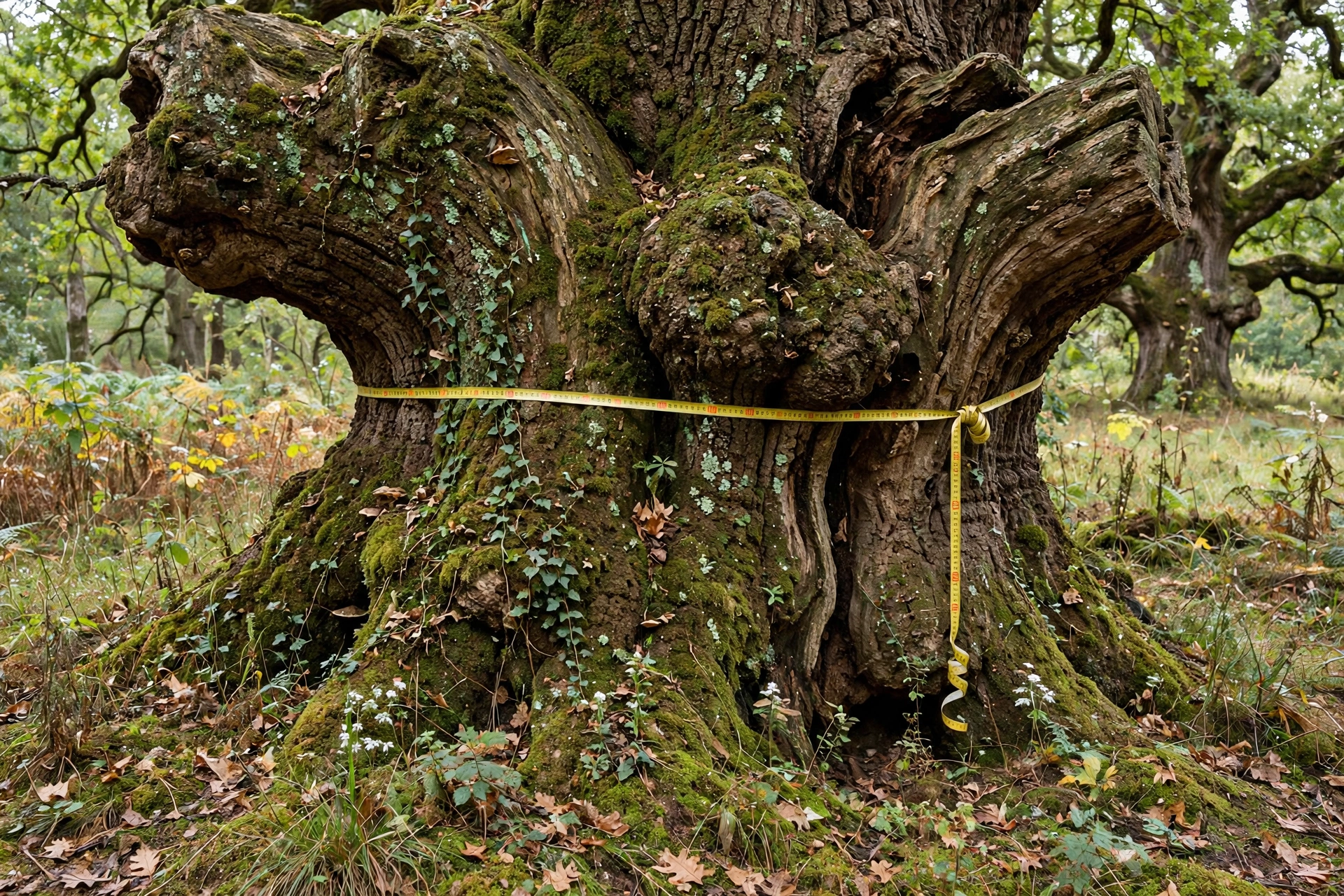
The most widely used non-destructive method is based on trunk girth. Trees lay down a new ring of wood each year, so as they age, their trunks get wider. Different species grow at different rates, so you need to know — or make a good guess at — the species first. Measure the trunk circumference at 1.3 to 1.5 metres above the ground, using a flexible tape kept level and snug. This standard chest height avoids the flare at the base.
Method 2: Count Rings on Fallen or Pruned Wood
If a branch has been pruned, or a nearby tree of the same species has fallen, count its rings and use that as a calibration. Count the rings on a branch of known diameter, work out how many rings per centimetre that species lays down in your area, and apply that rate to the living tree's trunk. You can also look for stumps, old fence posts, or timber from the same species.
Method 3: Look for Historical and Landscape Clues
Trees often outlive the records of the people who planted them, but the landscape around them can give strong hints. A tree planted as part of a Victorian garden, an avenue, a hedgerow, or a post-war housing estate will usually date from that period. Old maps, photographs, estate records, parish records, and local history societies can narrow a planting date to a decade. Other clues include the tree's position and form. A tree in the middle of a field may be a former hedgerow tree, left when the hedge was removed.
Working Through the Girth Calculation, Step by Step
The girth method sounds simple, but it is worth working through carefully, because a small error in measurement becomes a large error in age. Start by identifying the species as confidently as you can, using leaves, bark, buds, or fruit — the growth factor you use depends entirely on getting this right. Then measure the circumference at 1.3 metres above the ground on the uphill side if the tree is on a slope. Keep the tape level and snug, but not tight enough to press into the bark, and take the measurement twice to check it. If the trunk forks below 1.3 metres, measure each stem separately and note that the tree is multi-stemmed, because the calculation assumes a single trunk.
Next, divide the circumference by pi, about 3.14, to get the diameter, then divide the diameter by the average annual growth rate for that species to estimate the age. Published growth factors vary, but as a rough guide, a fast grower such as birch or willow may add 2 to 2.5 centimetres of diameter a year in good conditions, a medium grower such as oak or ash may add 1 to 1.5 centimetres, and a slow grower such as yew may add less than 1 centimetre. That means a 100-centimetre-diameter oak might be roughly 70 to 100 years old, while a birch of the same diameter could be half that age. Always treat the result as a range, and write down your assumptions — species, girth, growth rate, and site — so anyone else can check your working.
Other Clues: Veteran Features and the Shape of Old Trees
Very old trees often develop features that no young tree has, and these can confirm that your estimate is in the right range. Look for a hollow or partly hollow trunk, large dead branches in the crown, bark that is deeply fissured and peeling, and a crown that has become flattened or stag-headed, with bare, antler-like branches at the top. Old trees may also carry a rich community of fungi, lichens, mosses, and insects, and they may have layers of history written into them: old nails, wire, or fence posts grown into the bark, or a trunk that has fused with a neighbouring tree. None of these features proves an exact age, but together they are a strong sign that you are looking at a veteran, not a middle-aged tree.
Why Estimates Vary So Much
Two trees of the same species and same girth can differ in age by decades. Soil, water, light, competition, pruning, disease, and climate all affect growth rate. A tree in rich, moist, open soil grows far faster than the same species on thin, dry, exposed ground. Urban trees often grow more slowly because of compacted soil, limited root space, and pollution. That is why a single measurement is never enough. The best estimates combine girth, species, site conditions, and historical context.
Common Mistakes to Avoid
- Measuring at the wrong height: Measuring at the base, where the trunk flares, overstates the diameter and the age.
- Ignoring the species: A 100 cm girth means something very different for a birch than for an oak.
- Assuming steady growth: Trees grow fast when young and slow as they age. A simple linear calculation can overestimate a young tree and underestimate an old one.
- Forgetting past management: Pollarding, coppicing, and heavy pruning can make a tree look younger than it is.
- Treating an estimate as a fact: Always present an age as a range, such as 80–120 years, not a single precise year.
FAQ
How accurate is the girth method? For open-grown trees of known species in average conditions, it can be accurate within 10–20%. For woodland, urban, or previously managed trees, the error can be much larger. Use it as a guide, not a certificate.
Can I age a tree from its height? Height is a poor guide on its own. Trees reach most of their height relatively early, then grow mainly in girth. Two trees of the same height can differ in age by a century.
Do all trees produce one ring per year? In temperate climates, most trees produce one clear ring per year, with a light springwood band and a darker summerwood band. In tropical climates with no clear seasons, rings may be faint or absent.
What is the oldest tree I am likely to meet? In many temperate regions, yew, oak, sweet chestnut, and lime can live for several hundred years. Some ancient yews are thought to be over 1,000 years old, though exact dating is very difficult.
Can I use an increment borer to age a tree? An increment borer takes a thin core from the trunk, which can be counted like rings on a cut log. It is far less damaging than felling, but it still wounds the tree and should only be done by a trained person, with permission, and never on a rare or ancient tree.
Why do ancient trees sometimes look small? Old trees often stop growing taller and may even shrink as branches die back and the crown retrenches. A short, gnarled, hollow oak can be far older than a tall, straight oak nearby, so never judge age by height alone.
Conclusion
You do not need to cut a tree down to learn its age. Measure its girth at chest height, identify the species, consider the soil and setting, and look for historical clues in maps and photographs. Combine those pieces and you will have a sensible, honest estimate — usually a range rather than a single year. That range is enough to appreciate the tree, to plan its care, and to tell its story.
Safety note: Never eat or use any part of a tree based on an AI identification alone, and never cut or core a living tree to check its age without professional advice. If you need an accurate age for legal, planning, or safety reasons, consult a qualified arborist.