
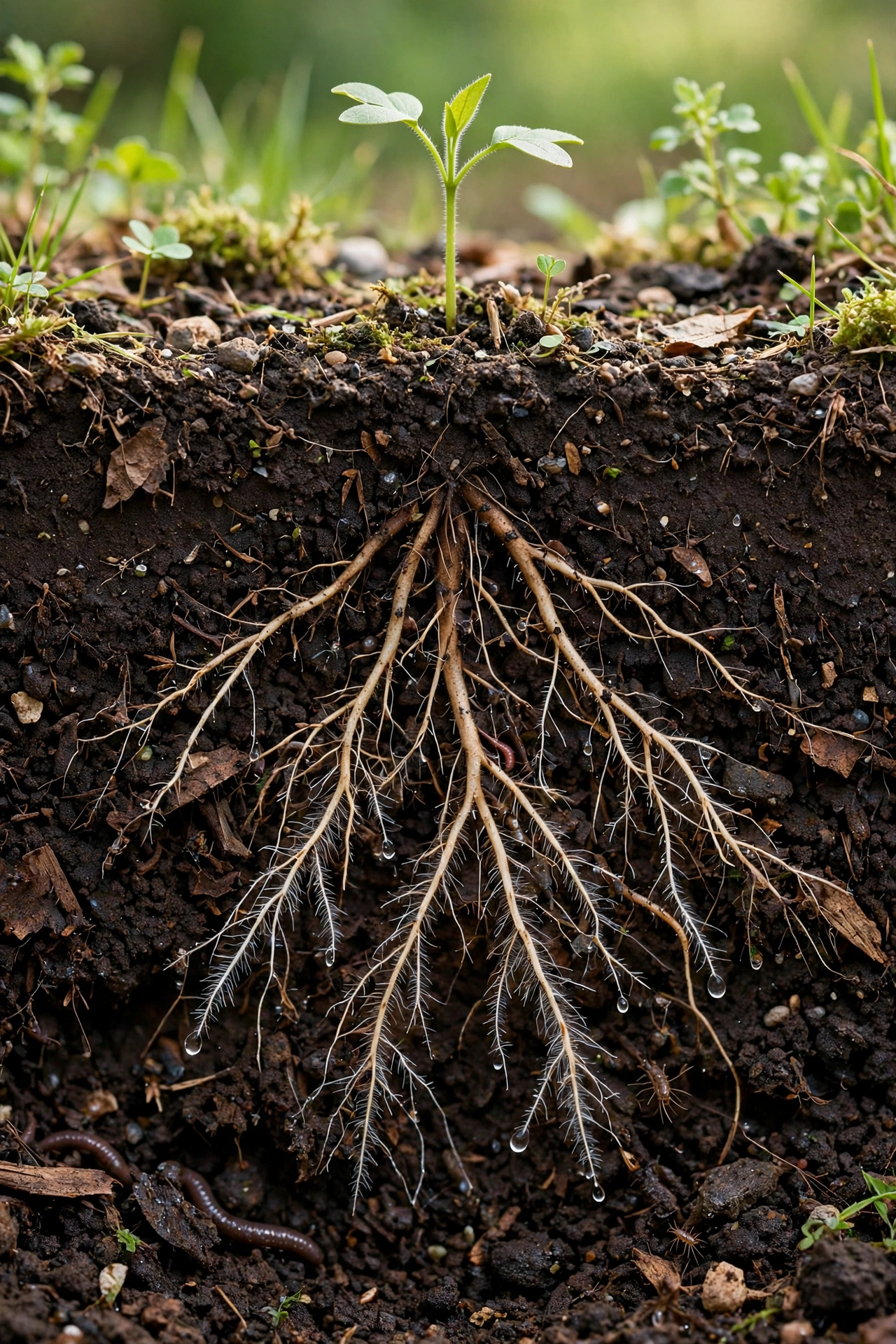
Every plant you see above ground is only half the story. Beneath the soil surface, a hidden network of roots is constantly at work, searching for the water and nutrients the plant needs to grow, flower and fruit. A healthy root system can spread far wider than the canopy above it, and its fine tips are remarkably sensitive, able to detect moisture, sense minerals and steer around obstacles. Understanding how roots find what they need will change the way you water, feed and care for your garden.
Roots do not wander at random. They respond to signals from the soil around them, growing towards water and nutrient-rich patches while avoiding dry, compacted or salty ground. This ability, known as tropism, is one of the cleverest tricks in the plant kingdom. A root tip can sense a difference in moisture across just a few millimetres and bend its growth in that direction. It is a slow process, measured in millimetres per day, but over a growing season it makes the difference between a plant that thrives and one that merely survives.
How Roots Sense Water in the Soil
Water in soil does not sit in pools. It clings to soil particles in thin films and hides in the tiny pores between them. After rain or watering, the larger pores drain first and the smaller ones hold on to moisture for longer. Roots must find these pockets of available water, and they do so through a process called hydrotropism, the growth of roots towards moisture.
The growing tip of each root is the sensing organ. Cells at the very tip detect differences in water availability, and when one side of the tip is drier than the other, growth on the drier side slows down while growth on the moister side continues. The result is a gentle bend towards the water. This happens alongside gravitropism, the root's response to gravity, which keeps roots growing generally downwards. The two signals work together: gravity sets the overall direction, while moisture fine-tunes the path, allowing roots to detour around dry patches and towards damp ones.
Root Hairs: The Fine-Tipped Workforce
Most of a plant's water and nutrient uptake happens not through the thick main roots but through root hairs, the tiny, almost invisible extensions that grow from the root surface just behind the tip. A single plant can have millions of them, and together they increase the absorbing surface of the root system many times over. Each root hair is a single elongated cell that presses itself against soil particles, drawing in water and dissolved minerals.
Root hairs are short-lived, usually lasting only a few days before they die back and are replaced by new ones further along the growing root. This constant renewal means the plant is always exploring fresh soil. As the root tip pushes forward into new ground, a fresh band of root hairs forms behind it, ready to absorb from soil that has not yet been drained of its resources. It is an efficient system, but it is also fragile. Root hairs are easily damaged by rough handling, which is why transplanted plants often wilt: their root hairs have been broken, and the plant cannot take up water properly until new ones grow.
How Roots Grow Towards Moisture
The growth of roots is not steady. It speeds up when conditions are favourable and slows or stops when the soil is too dry, too cold or too waterlogged. In dry weather, roots grow deeper, chasing moisture that has retreated down through the soil profile. This is one reason why deep, infrequent watering is better than light, frequent sprinkling: it encourages roots to grow down into the soil, where moisture is more stable, rather than staying near the surface where they dry out quickly.
In wet conditions, the picture changes. Roots need oxygen to respire and grow, and waterlogged soil has very little air in its pores. Roots in saturated soil can suffocate, which is why plants in poorly drained ground often develop yellow leaves and stunted growth despite having plenty of water. Good drainage is therefore just as important as watering itself. The ideal soil holds moisture in small pores while keeping larger pores open for air, a balance that is best achieved with plenty of organic matter.
Finding Nutrients: More Than Just Drinking
Nutrients are not spread evenly through the soil. They gather in patches, often where organic matter is decomposing or where fertiliser has been applied. Roots can detect these nutrient-rich zones and respond by branching more heavily into them. This is called root foraging, and it is why a plant given a band of compost will often produce a dense cluster of fine roots in exactly that spot.
Different nutrients are taken up in different ways. Nitrogen, usually present as nitrate, dissolves easily in soil water and moves with it, so roots can absorb it fairly readily. Phosphorus, by contrast, barely moves in soil at all, and a root must grow right up to a phosphorus particle to reach it. This is why phosphorus deficiency often shows first as poor root growth: the plant cannot reach what it needs without expanding its root system. Potassium sits somewhere in between, moving slowly through the soil but still requiring roots to explore widely.
Plants also change the chemistry of the soil around their roots to help themselves. The narrow zone of soil directly around a root, called the rhizosphere, is a hive of chemical activity. Roots release organic acids and other compounds that can dissolve locked-up minerals, making them available for uptake. They also release sugars that feed soil microbes, which in turn release nutrients from organic matter. The root is not a passive straw in the ground; it actively manages its own neighbourhood.
Mycorrhizal Fungi: The Underground Network
Many plants do not search for water and nutrients alone. They form partnerships with mycorrhizal fungi, whose thread-like hyphae spread through the soil far beyond the reach of the plant's own roots. These fungal threads are much finer than root hairs and can explore tiny soil pores that roots cannot enter. In exchange for sugars from the plant, the fungi deliver water and minerals, especially phosphorus, back to their host.
What This Means for Your Garden
Understanding how roots search can transform your watering and feeding habits. Water deeply and less often, so moisture reaches the lower soil and roots are encouraged to grow downwards. Water at the base of plants, where the roots are, rather than spraying the leaves. Feed the soil with organic matter rather than relying only on quick-release fertiliser, and give new plants time to establish their root hairs before expecting vigorous growth.
Frequently Asked Questions
How deep do plant roots grow when searching for water? It depends on the plant and the soil, but most garden plants concentrate their roots in the top 30 centimetres of soil, where water, air and nutrients are most available. Trees and deep-rooted perennials can send roots down a metre or more, especially in dry conditions, though the majority of a tree's feeding roots still sit in the upper soil layers.
Can roots find water in very dry soil? Roots can detect and grow towards moisture, but they cannot extract water from soil that is drier than the root cells themselves. When soil dries beyond a certain point, known as the permanent wilting point, the plant cannot pull water in at all, no matter how extensive its roots are. This is why consistent watering matters during drought.
Do roots grow towards fertiliser? Yes, roots branch more heavily in nutrient-rich patches, including where fertiliser has been applied. However, very concentrated fertiliser can damage root hairs and even draw water out of the roots by osmosis, so fertiliser should always be applied at the recommended rate and watered in well.
Conclusion
Roots are far more than anchors. They are sensing, searching organs that steer towards water, branch into nutrient-rich patches, team up with fungi and reshape the soil around them. By working with this hidden half of the plant, watering deeply, feeding the soil, protecting its structure and giving roots room to explore, you give every plant in your garden the best chance to find what it needs and to thrive. The next time you look at a flourishing plant, remember that much of its success was decided underground, out of sight, one root tip at a time.
Curious about a plant growing in your garden? Try the plant identifier at aitreeidentier.site to identify it in seconds and learn more about how it grows.