
Try it: Seen a fast-growing tree you like? Try the free Tree Identifier on aitreeidentier.site to confirm what it is before you plant one.
Introduction
When you move into a new house, or a neighbour builds an extension, the garden can feel exposed. A fast-growing tree promises a solution: shade in a few years, privacy in even less, and a garden that feels established far sooner than nature would normally allow. It is a tempting promise, and for many people it is the right choice — provided you understand the trade-offs. Fast-growing trees grow fast for a reason.
The Pros of Fast-Growing Trees
The main advantage is speed. A fast-growing tree can add 60–90 cm or more per year in good conditions, reaching a useful height in three to five years. That means shade for a patio, screening from a road or a neighbour, and wind protection, far sooner than a slow-growing oak or beech would provide. Fast-growing trees are also often cheap and easy to find, tolerant of a range of soils, and good for wildlife in the short term.
The Cons You Need to Know
Speed has a cost. Fast-growing trees often have weaker, more brittle wood that is prone to breakage in wind and snow. They may have aggressive, thirsty roots that seek out drains, sewers, and foundations, especially willow and poplar. They may be short-lived — many fast growers live 30–50 years, while an oak can live for centuries. They may drop large amounts of leaves, seeds, or branches, and they may need frequent pruning to keep them in shape.
Best Fast-Growing Trees for Shade
For shade, look for trees with a broad canopy, a strong trunk, and a reasonable mature size for your garden. Silver birch grows quickly, reaches 10–15 metres, and has a light, airy canopy that gives dappled shade without making a garden dark. It is good for wildlife and has attractive white bark. Sycamore and field maple grow fast in many soils, provide good shade, and are tolerant of wind and urban conditions.
Best Fast-Growing Trees for Privacy
For privacy, you need dense, evergreen or long-season cover, at the right height. Leyland cypress is the classic fast privacy hedge, growing up to a metre a year, but it needs regular trimming, can grow very tall, and can cause neighbour disputes. Plant it only where you have space and are committed to maintaining it. Western red cedar is a better-behaved alternative, with softer foliage, good density, and a more manageable mature size.
How Fast Is Fast? Growth Rates in Real Gardens
Catalogue figures for growth rates are usually measured in ideal conditions: rich soil, plenty of water, full sun, and a sheltered site. In a real garden, growth is often slower, especially in the first year while roots establish. A tree that is described as growing a metre a year may manage only half that on thin, dry, or compacted soil, or in a windy, exposed position. The first year after planting is often the slowest, because the tree is putting its energy into roots rather than height. Do not be disappointed if your new tree seems to sit still for a season; a strong root system now means faster, healthier growth later.
Growth also slows as a tree matures. Most fast growers put on their greatest height in their first ten to fifteen years, then slow down and fill out instead. That is why a ten-year-old poplar may already be near its full height, while a ten-year-old oak is still a youngster. When you compare species, ask the nursery for the expected height after five and ten years in ordinary garden soil, not just the maximum annual growth. And remember that fast height is not the same as fast shade: a tall, narrow tree casts far less shade than a shorter tree with a broad, spreading canopy, so think about canopy shape as well as speed.
Mixing Fast and Slow Trees for the Best of Both Worlds
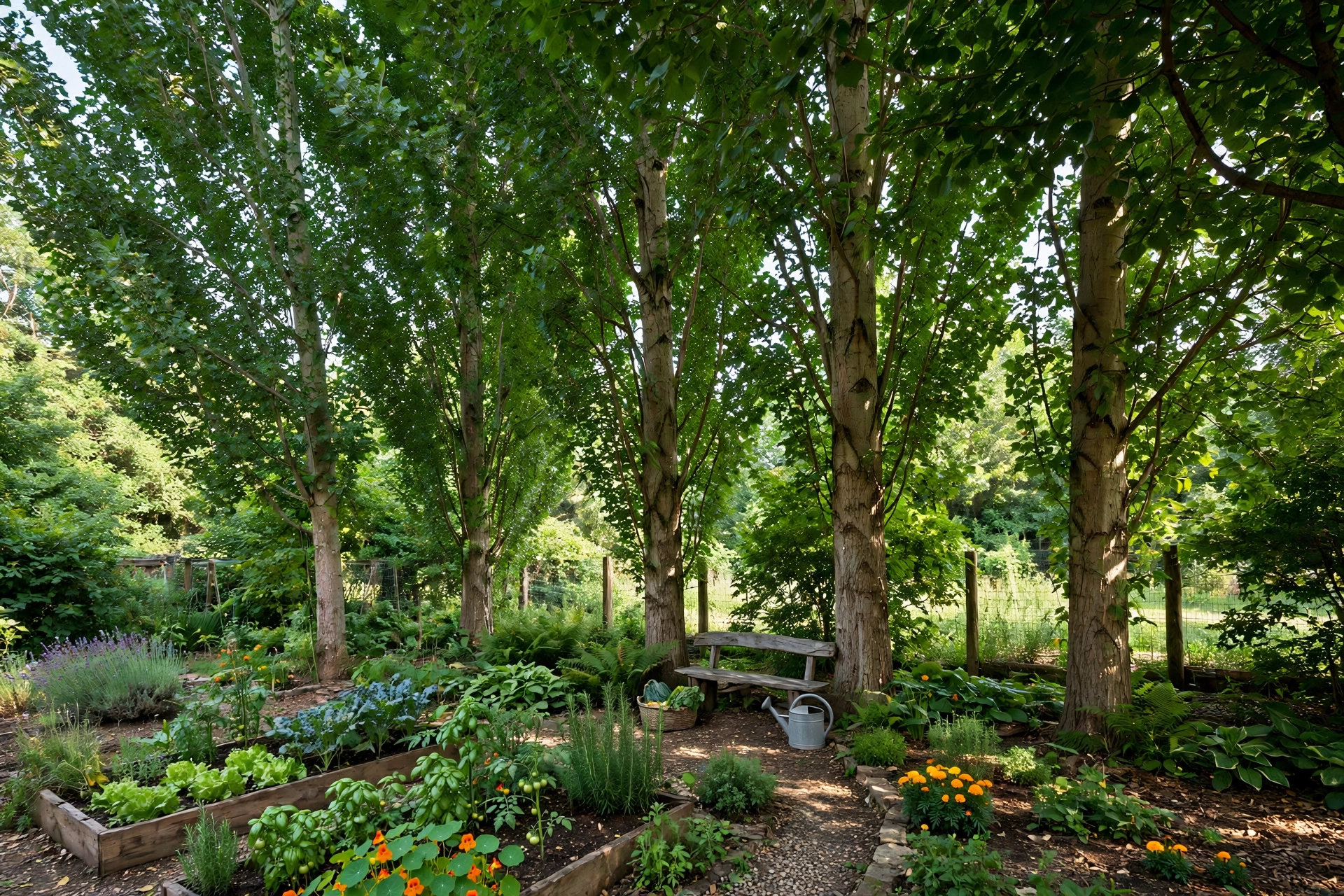
One of the smartest planting strategies is to plant fast and slow trees together. Use a fast grower, such as birch or alder, to give you shade and screening within three to five years, and plant a slower, longer-lived tree, such as oak, beech, or lime, a few metres behind it. The fast tree does the early work while the slow tree establishes quietly underneath. After fifteen or twenty years, when the slow tree is ready to take over, you can remove the fast grower — or keep it if there is room for both. This approach gives you an established-looking garden quickly without committing to a short-lived tree as your permanent centrepiece.
A mixed planting also protects you against pests and disease. A single-species hedge or screen can be wiped out by one outbreak, as many gardeners discovered when box blight or ash dieback arrived. A mix of three or four species, with different growth rates and habits, is far more resilient: if one species struggles, the others fill the gap. Try combining a fast evergreen such as western red cedar with a deciduous tree such as field maple, and add a flowering shrub layer underneath. The result looks more natural, supports more wildlife, and is much less likely to fail all at once.
How to Plant and Care for Fast-Growing Trees
Plant fast-growing trees with their mature size in mind, even more carefully than slow growers, because they will reach that size sooner. Allow at least the mature canopy radius from buildings, boundaries, and drains, and more for willow and poplar. Water well in the first two years, mulch to retain moisture, and stake only if needed. Prune annually to maintain shape and remove weak, crossing, or damaged branches.
Common Mistakes to Avoid
- Planting too close to the house or boundary: Fast growers reach mature size quickly, and problems arrive sooner.
- Choosing Leyland cypress without a maintenance plan: It will outgrow you if you stop trimming.
- Planting willow or poplar near drains: Their roots seek water and can block or damage pipes.
- Expecting a fast tree to live as long as a slow tree: Many fast growers are short-lived by nature.
- Planting a single species as a hedge: A mixed hedge is more resilient to pests and disease.
- Forgetting neighbours: A tree that blocks light or drops debris on a neighbour's garden can cause disputes.
FAQ
What is the fastest-growing tree for privacy? Leyland cypress is one of the fastest, growing up to a metre a year, but it needs regular maintenance and can become very large. Western red cedar is a more manageable fast alternative.
How fast do fast-growing trees actually grow? In good conditions, 60–90 cm per year is typical for birch, poplar, willow, and sycamore. Growth is slower in poor soil, shade, or drought, and faster in rich, moist soil with full sun.
Are fast-growing trees bad for foundations? They can be, if planted too close, especially on clay soil and especially willow and poplar, which have thirsty roots. Plant at a safe distance and check local guidance for your soil and species.
Should I plant a fast-growing tree or wait for a slow one? Consider planting both: a fast grower for short-term shade and privacy, and a slower, longer-lived tree behind it for the future. That gives you the best of both.
Do fast-growing trees need more water? Yes, usually. Rapid growth means high water demand, especially in the first few years and in dry summers. Deep weekly watering and a thick mulch ring will help a fast grower reach its potential without stress.
What is the best fast-growing tree for a small garden? For a small space, silver birch or a small ornamental cherry is often a better choice than poplar or willow. They grow quickly but stay a manageable size, and their light canopy does not darken the whole garden.
Conclusion
Fast-growing trees can transform a bare garden in a few years, giving shade, privacy, and a sense of establishment that would otherwise take a decade. The key is to choose with your eyes open: know the mature size, know the root behaviour, know the lifespan, and commit to the maintenance. Plant at a safe distance, water and prune in the early years, and have a long-term plan.
Safety note: Never eat or use any part of a tree based on an AI identification alone. If you are unsure about a species or its safety, consult a local expert before planting it.