
Try it: Try the free Tree Identifier on aitreeidentier.site — check which species you have before cutting, since only some trees regrow well after coppicing or pollarding.
Introduction
For centuries, people managed trees not by letting them grow tall and untouched, but by cutting them back regularly and harvesting the regrowth. Two of the oldest methods, coppicing and pollarding, are still used today in woodlands, gardens, parks, and along streets.
Understanding the difference matters, because cutting the wrong tree in the wrong way can kill it, while cutting the right tree at the right time can keep it healthy and productive for hundreds of years.
What Is Coppicing?
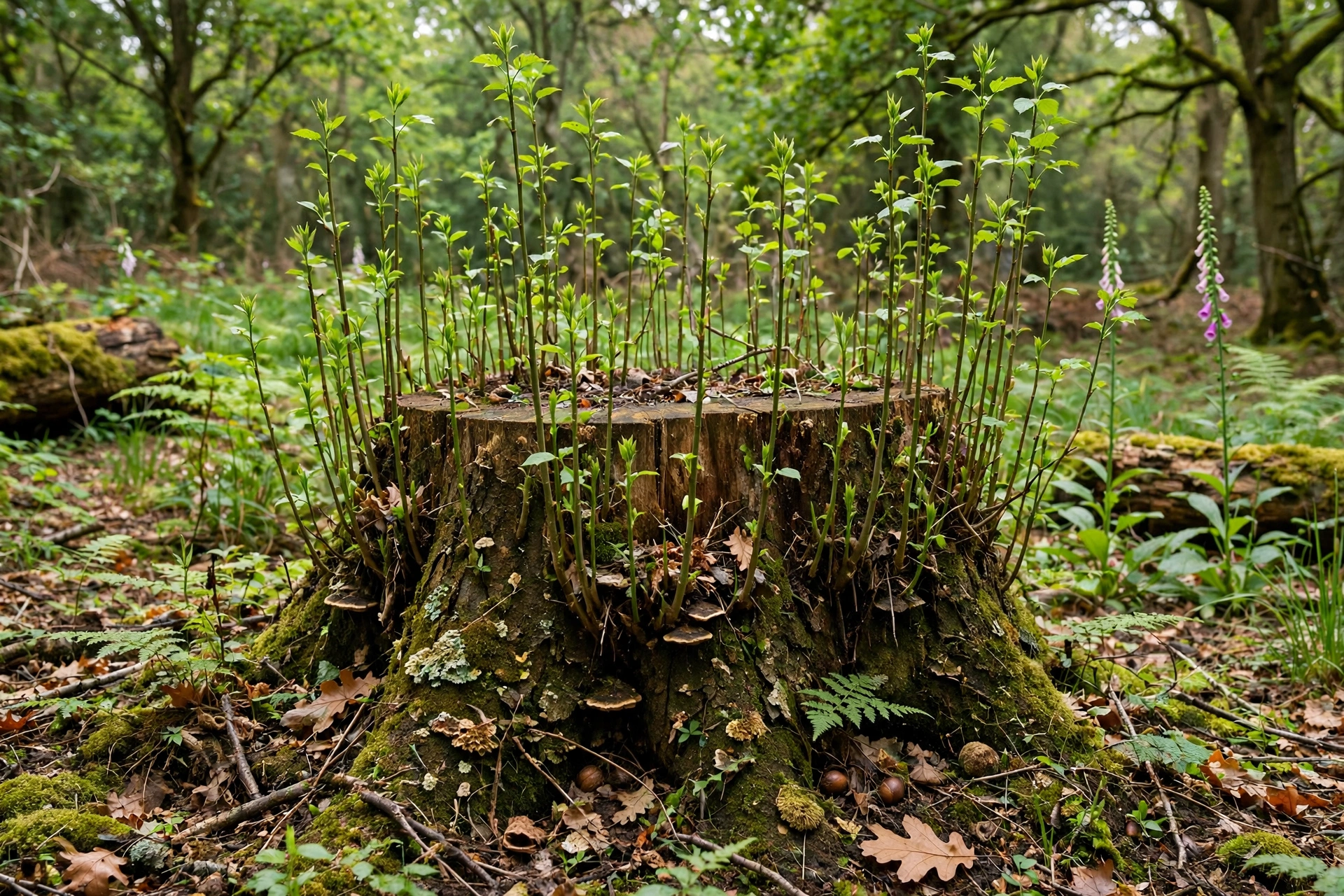
Coppicing means cutting a tree or shrub down to near ground level, usually in winter, and letting it regrow from the base. The cut stump, called a stool, sends up fast-growing new shoots, or poles, which can be harvested after a few years for firewood, fencing, or craft wood. The stool then regrows again, and the cycle repeats.
What Is Pollarding?
Pollarding is similar, but the cut is made higher up, usually 2 to 3 metres above the ground. The tree regrows from the cut points, called pollard heads or knuckles, producing a crown of new shoots above the reach of grazing animals. Pollarding is used for trees in streets, parks, and gardens, where low shoots would be eaten or in the way.
Coppicing vs Pollarding: Key Differences and Suitable Trees
The main difference is the height of the cut: coppicing cuts at the base, pollarding cuts above head height. Coppicing is mainly a woodland and harvesting method, while pollarding is mainly for controlling size where people, animals, and buildings are close by.
Both methods depend on the same ability: the tree must be a species that sprouts vigorously from dormant buds after cutting. Both are also long-term commitments. Once you start pollarding a tree, keep it up on a regular cycle, or heavy regrowth can snap off at the old cut points.
Not every tree regrows after hard cutting. Good coppice species include hazel, sweet chestnut, ash, oak, alder, willow, hornbeam, and lime, which sprout strongly from the base. Good pollard species include lime, plane, willow, poplar, ash, and oak. Many conifers, and trees such as beech and birch, respond poorly and should not be coppiced or pollarded. Always confirm the species before you begin.
The History and Wildlife Value of Coppicing
Coppicing is one of the oldest forms of woodland management in Europe, practised for thousands of years to produce a regular supply of wood without killing the tree. A coppiced woodland was a working landscape: hazel for hurdles and thatching spars, ash for tool handles, oak for bark used in tanning, and willow for baskets. The cycle of cutting created a patchwork of light and shade, because a freshly cut coppice lets sunlight reach the woodland floor, where wildflowers such as bluebells, primroses, and wood anemones flourish for a year or two before the canopy closes again. That changing light is why coppiced woods are so rich in wildlife: butterflies, bees, and birds all benefit from the sunny clearings, while the dense regrowth provides shelter and nesting sites.
Starting a Coppice Cycle in Your Garden
If you want to try coppicing, start small and start with the right species. Hazel is the classic beginner's coppice: it is easy to cut, regrows vigorously, and produces useful poles within five to seven years. Willow is even faster, regrowing within one to three years, and it is ideal for a damp corner of the garden. Plant your coppice stools about two metres apart, so they have room to grow, and let them establish for two or three years before the first cut. Make the first cut in winter, cutting cleanly close to the stool and sloping the cut slightly so rain runs off.
After cutting, the stool will produce a flush of new shoots in spring. In the first year, you can thin these to the strongest five or six per stool, or leave them all to grow and harvest them as a bundle later. Protect young shoots from rabbits and deer, which love the tender new growth, and keep the area around the stool free of grass and weeds. Mark the date of each cut on a simple plan of your garden, so you know when each stool is due to be cut again. A coppice is a long-term commitment, but it is a forgiving one: a stool that is cut a year late will still regrow, and a hazel stool can keep producing for a hundred years or more.
When and How to Cut, and Aftercare
Both methods are usually carried out in winter, while the tree is dormant and leafless. Winter cutting lets you see the structure clearly, avoids disturbing nesting birds, and gives the tree the whole spring to produce new shoots. Avoid cutting in late spring or summer, when the tree is in full leaf.
For coppicing, cut the stems cleanly close to the stool, sloping slightly so rain runs off. For pollarding, cut back to the same points each time, just above the previous cuts, so the knuckles build up gradually. Always use sharp, clean tools. If you are new to either method, start with a small hazel or willow in a garden, not a large street tree.
After cutting, the stool or pollard head will produce many new shoots in spring. For coppice, thin these shoots in the first year, keeping the strongest few, or leave them to grow and harvest them after several years. Pollarded trees need their cycle maintained: small, young growth is easy to cut, while growth left for ten years becomes heavy and risky to remove.
Common Mistakes Beginners Make
- Coppicing or pollarding the wrong species. Conifers and many other trees do not regrow after hard cutting, so confirm the species first.
- Starting pollarding on a mature, uncut tree. Cutting a large, mature tree back hard can shock or kill it.
- Cutting at the wrong time of year. Summer cutting stresses the tree; winter, during dormancy, is the usual season.
- Leaving a pollard uncut for too long. Heavy regrowth on old pollard heads can snap off in wind.
- Making ragged or torn cuts. Rough cuts heal slowly and invite rot, so use sharp tools.
- Attempting large trees without help. Pollarding a tall tree involves working at height, so leave large trees to qualified tree surgeons.
FAQ
What is the difference between coppicing and pollarding?
Coppicing cuts a tree down to near ground level so it regrows from the base, while pollarding cuts it at 2 to 3 metres up. Coppicing suits woodlands; pollarding suits streets, parks, and gardens.
How often should a coppice or pollard be cut?
Hazel coppice is often cut every 5 to 7 years, willow every 1 to 3 years, and pollarded street trees every 2 to 5 years.
Can I coppice a tree in my garden?
Yes, if it is a suitable species such as hazel, willow, or hornbeam, and you have space for the regrowth. Start small and cut in winter.
Does pollarding harm the tree?
When done correctly, on a suitable species and on a regular cycle, pollarding can extend a tree's life. Done badly, it can weaken or kill the tree.
Can I pollard a tree that has never been pollarded before? It depends on the species and the size. A young tree of a suitable species can be started as a pollard, but cutting a large, mature tree back hard can shock or kill it. If you are unsure, ask a qualified tree surgeon before you cut.
What can I use coppice wood for? Hazel poles are useful for bean poles, hurdles, and garden stakes, willow for weaving and firewood, and ash for tool handles. Even small-diameter poles are useful in the garden, and nothing need be wasted.
Conclusion
Coppicing and pollarding are two sides of the same old idea: cut a tree back in the right way, at the right time, and it will regrow stronger and more useful than before. Coppicing harvests wood from the base; pollarding controls size above head height. Both need the right species, sharp tools, winter timing, and a regular cycle.
Try it: Try the free Tree Identifier on aitreeidentier.site — check which species you have before cutting, since only some trees regrow well after coppicing or pollarding.
Safety disclaimer: Never work on large trees or use sharp tools unsafely based on AI guidance alone. Do not climb trees or cut large limbs yourself. Consult a local arborist or qualified tree surgeon for tall trees, pollarding at height, or any cutting work you are unsure about.